Category
page 1Cucujoidea families

Cucujidae
The Cucujidae, or flat bark beetles, are a family of distinctively flat beetles found worldwide (except Africa and Antarctica) under the bark of dead trees. The family has received considerable taxonomic attention in recent years and now consists of 70 species distributed in five genera. It was indicated Cucujus species are scavengers, only feeding on pupae and larvae of other insects and on other subcortical beetles such as their own. Since the Cucujidae prey on larvae of potentially tree damaging beetles that spread fungal diseases, they are considered to be beneficial to the health of livin

Erotylidae
thumb|A pleasing fungus beetle on bracket fungus in Singapore thumb|Toramus pulchellus
thumb|Ischyrus quadripunctatus
thumb|Acropteroxys gracilis (tribe Languriini)

Cryptophagidae
thumb|Silken fungus beetles, Cryptophagidae

Silvanidae
Silvanidae, "silvan flat bark beetles", is a family of beetles in the superfamily Cucujoidea, consisting of 68 described genera and about 500 described species. The family is represented on all continents except Antarctica, and is most diverse at both the generic and species levels in the Old World tropics.
Phalacridae
thumb|right|Olibrus liquidus
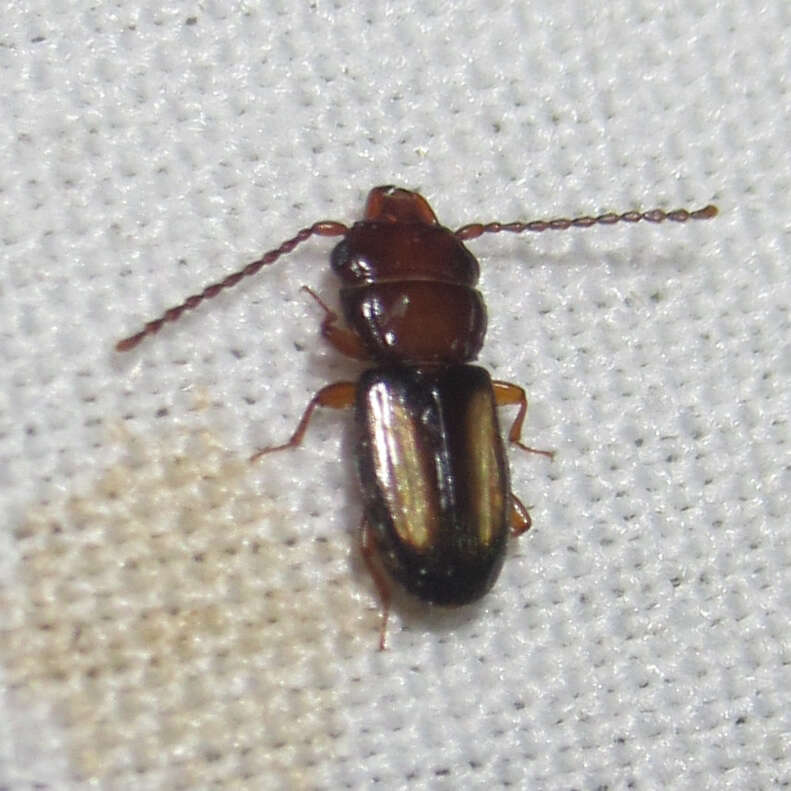
Laemophloeidae
Laemophloeidae, lined flat bark beetles, is a beetle family in the superfamily Cucujoidea characterized by predominantly dorso-ventrally compressed bodies, head and pronotal discs bordered by ridges or grooves, and inverted male genitalia. Size range of adults is in length. Currently, it contains 40 genera and about 450 species, and is represented on all continents except Antarctica; species richness is greatest in the tropics.
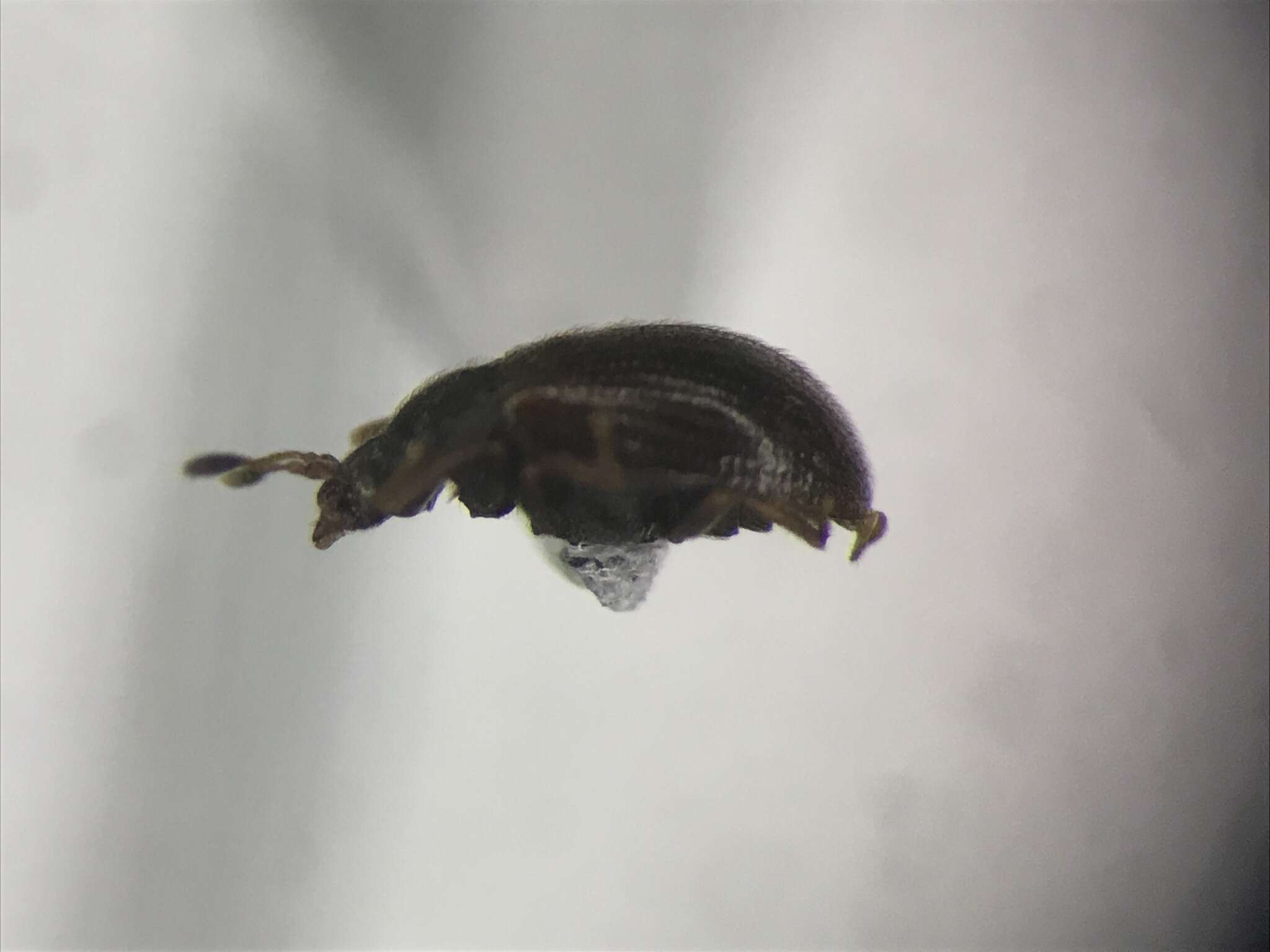
Sphindidae
Sphindidae is a family of beetles, in the suborder Polyphaga. They are called slime mold beetles due to their exclusive feeding on slime molds during adult and larval stages, other aspects of their life history are obscure. Palaeontological discoveries since 2015 have added to the geologic history of Sphindidae, including the discovery of Libanopsis, placed in the extinct subfamily Libanopsinae.
%20Syn.-%20Kateretes%20bipustulatus%20(Paykull%2C%201798)%20(37274650864).png)
Kateretidae
Kateretidae also known as short-winged flower beetles are a family of beetles in the superfamily Cucujoidea. There are 10 extant and 4 extinct genera, and at least 40 described species. They are found worldwide except in New Zealand. Adults are anthophagous, feeding on flowers, while the larvae are spermatophagous inside the flower corolla.
thumb|Kateretes pusillus
Boganiidae
Boganiidae is a family of beetles, in the superfamily Cucujoidea. Members of the family are found in southern Africa, Australia and New Caledonia. Adults and larvae are pollenivorous, feeding on the pollen of cycads and flowering plants of the families Myrtaceae, Meliaceae, Cunoniaceae and Elaeocarpaceae. Metacucujus and Paracucujus act as pollinators for cycads Encephalartos and Macrozamia respectively. This association with cycads goes back to at least the Mid-Cretaceous, with an extinct form being found with preserved cycad pollen in 99 million year old Burmese amber.
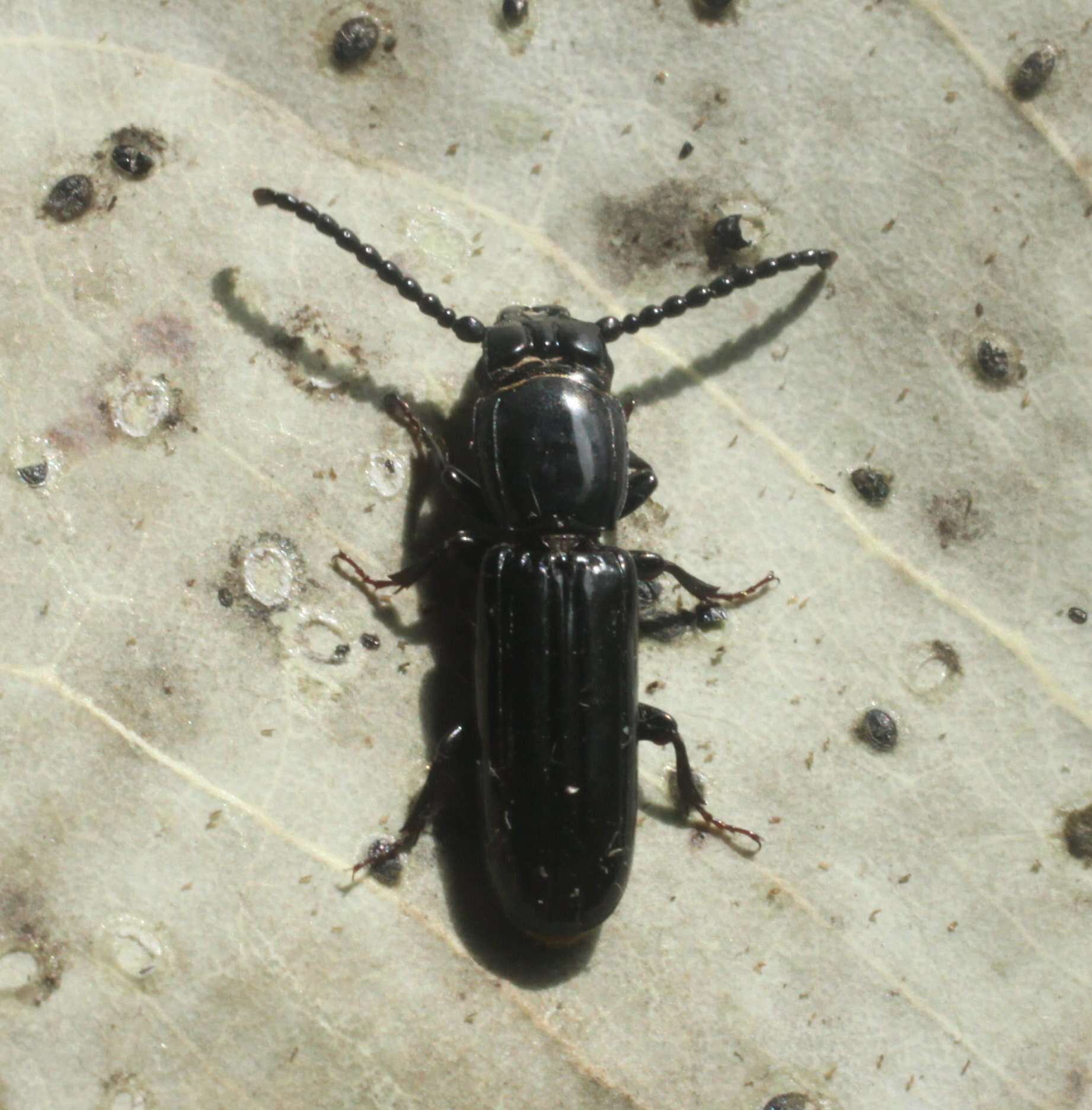
Passandridae
Passandridae, the "parasitic flat bark beetles," are a family of beetles notable for being one of the very few beetle families with larvae that are, as far as known, exclusively ectoparasitic on the immature stages of other beetles and Hymenoptera.
Monotomidae
Monotomidae is a family of beetles in the superfamily Cucujoidea. The family is found worldwide, with approximately 240 species in 33 genera. The ecological habits of the family are diverse, with different members of the group being found under tree bark, in decaying vegetation, on flowers and in ant nests. Their ecology is obscure, while at least some species are mycophagous, feeding on the fruiting bodies of ascomycete fungi, Rhyzophagus are predators on bark beetles (includings, eggs, larvae and young adults) and possibly Phoridae larvae, with the larvae of some species also being mycophago
Helotidae
Helotidae is a family of beetles, in the suborder Polyphaga. The family includes about five extant genera, Helota MacLeay, Neohelota Ohta, Afrohelotina Kirejtshuk, Metahelotella Kirejtshuk, and Strophohelota Kirejtshuk. Helotidae are found mainly in the Old World tropics and are absent from Australia and Madagascar. The antennae are clubbed on the final three segments and are retractable within grooves under the head. The wings have reduced venation with just 4 anal veins. Helotids are known to be associated with sap, fruit and flowers, and the larvae of some species are known to bore into woo

Phloeostichidae
Phloeostichidae is a family of beetles in the superfamily Cucujoidea. They are typically found under the bark of dead trees. Larvae have been found to consume plant tissue and some fungi, while the adults appear to be exclusively fungivores. The family contains four extant genera, Phloeostichus is native to the Palearctic, Rhopalobrachium is native to central-southern South America and eastern Australia, Hymaea is native to southeastern Australia, and Bunyastichus is found in Tasmania.

Smicripidae
Smicripidae is a family of beetles, in the superfamily Cucujoidea. The common name for this family is palmetto beetles. The family only has one extant genus, Smicrips, with six extant species native to tropical and subtropical regions of the Americas and extinct species from the Eocene of Europe and one extinct genus, Mesosmicrips, known from the mid Cretaceous (earliest Cenomanian) aged Burmese amber. Smicrips larvae are usually found amongst decaying vegetation, while adults are typically found on inflorescences (flower clusters), especially those of Arecaceae (palms), although associations

Hobartiidae
Hobartiidae is a family of beetles in the superfamily Cucujoidea. There are only two known genera, Hobartius (Sen Gupta & Crowson, 1966) and Hydnobioides (Sen Gupta & Crowson, 1966), with six species, five of which are native to Australia, and one species of Hobartius native to Chile and Argentina in South America. Members of the family are mycophagous, living in rotten, fungus infested logs of Araucaria, Nothofagus, and Eucalyptus, where they feed on the fruiting bodies of basidiomycetes.
Protocucujidae
Protocucujidae is a family of beetles, in the superfamily Cucujoidea. It has a single known genus, Ericmodes (Reitter, 1878) (syn Protocucujus Crowson, 1954). Species of Ericmodes are native to southern South America and Eastern Australia. Little is known of their biology, though adults and larvae probably live on vegetation, with adults having also been found in leaf litter and in flight.

Cavognathidae
Cavognathidae is a family of beetles, in the superfamily Cucujoidea. It contains a single genus, Taphropiestes (Reitter 1875) (Neocercus Broun, 1921, Cavognatha Crowson 1964 and Zeonidicola Crowson, 1973) with around a dozen species known from South America, Australia and New Zealand. In Australian and New Zealand species adults and larvae have been found living in bird nests, but their ecology is unclear. They are possibly scavengers.
Propalticidae
Propalticidae is a family of beetles, in the suborder Polyphaga. It contains two genera (Propalticus and Slipinskogenia) with the following species:
Cyclaxyridae
Cyclaxyridae are a family of beetles in the superfamily Cucujoidea. The only living genus is Cyclaxyra, with two species endemic to New Zealand. Other species have been named from fossils. They are also known as sooty mould beetles due to the association of Cyclaxyra with sooty mould. The extant species are mycophagous, feeding on spores, conidia, and hyphae.
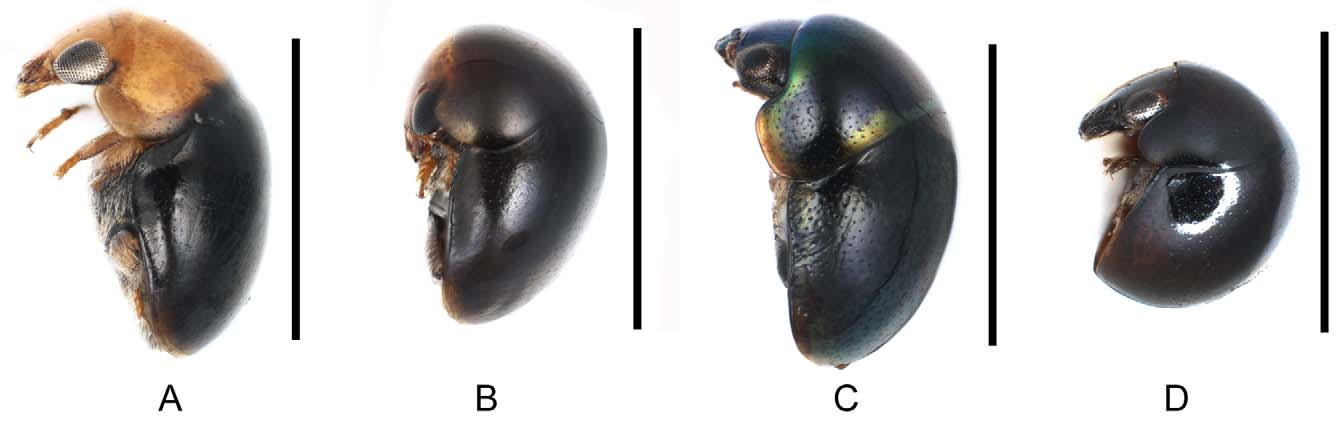
Cybocephalidae
Cybocephalidae is a family of sap, bark and fungus beetles in the order Coleoptera with a wide global distribution. The type genus Cybocephalus has more than 200 species in it and the entire family has about 220 species in all. Many species are predators of armoured scale insects (Diaspididae). There are four tarsal segments on all the legs. The body is only slightly longer than wide and very convex and shiny. They are small and about 1 to 3 mm long. The insect can roll into a ball like position with its downward facing head. The tarsomeres are lobed underneath. The family is sometimes tr
Agapythidae
REDIRECT Agapytho
Priasilphidae
Priasilphidae is a family of beetles in the superfamily Cucujoidea. They have a Gondwanan distribution, with the three known genera Chileosilpha, Priasilpha and Priastichus being native to Chile, New Zealand and Tasmania respectively. Most species are flightless, lacking wings. Priasilphids inhabit decaying wood and moss in forest habitats. They are likely mycophagous, feeding on fungi.
Myraboliidae
REDIRECT Myrabolia

Tasmosalpingidae
REDIRECT Tasmosalpingus