Category
page 1Cultural geography

civilization

globalization
Globalization (UK: globalisation) is the process of increasing interdependence and integration among the economies, markets, societies, and cultures of different countries worldwide. It can be attributed to a series of factors, including the reduction of barriers to international trade, the liberalization of capital movements, the development of transportation infrastructure, and the advancement of information and communication technologies. The term globalization first appeared in the early 20th century (replacing an earlier French term ). It developed its current meaning in the second half o

colonialism
thumb|A 1665 illustration of a Dutch East India Company factory in [[Hugli-Chuchura, depicting various elements of colonialism, including its hierarchies and impact on the colonized and their lands]]

fatherland
thumb|280px|Liberty Leading the People by [[Eugène Delacroix personifies the French motherland.]]
A homeland is a place where a national or ethnic identity has formed. The definition can also mean simply one's country of birth. When used as a proper noun, the Homeland, as well as its equivalents in other languages, often has ethnic nationalist connotations. A homeland may also be referred to as a fatherland, a motherland, or a mother country, depending on the culture and language of the nationality in question.

cosmopolitanism
Cosmopolitanism is the idea that all human beings are members of a single community. Its adherents are known as cosmopolitan or cosmopolite. Cosmopolitanism is both prescriptive and aspirational, believing humans can and should be "world citizens" in a "universal community". The idea encompasses different dimensions and avenues of community, such as promoting universal moral standards, establishing global political structures, or developing a platform for mutual cultural expression and tolerance.

global city
city which is an important node in the global economy

economic geography
study of the location, distribution and spatial organization of economic activities

Gaeltacht
250px|thumb|Official Gaeltacht regions in Ireland
A Gaeltacht ( , , ) is a district of Ireland, either individually or collectively, where the Irish government recognises that the Irish language is the predominant vernacular, or language of the home.
The Gaeltacht districts were first officially recognised during the 1920s in the early years of the Irish Free State, following the Gaelic revival, as part of a government policy aimed at restoring the Irish language.
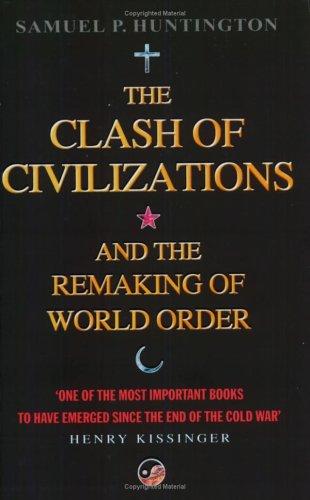
Clash of Civilizations
book
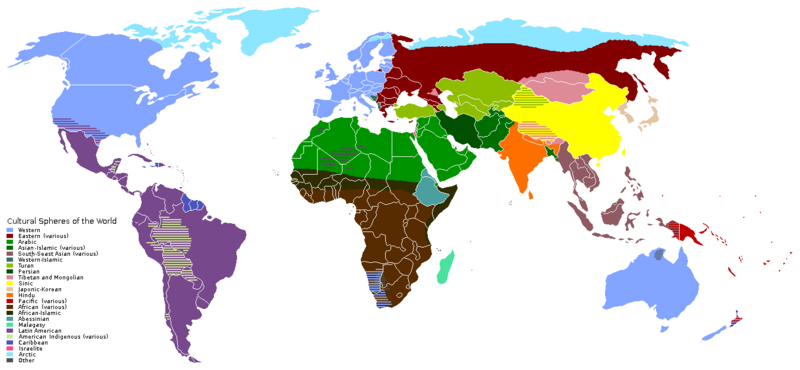
cultural geography
study of cultural products and norms and their variations across and relations to spaces and places

Westernization
Westernization (or Westernisation, see spelling differences), also Europeanisation or occidentalization (from the Occident), is a process whereby societies come under or adopt what is considered to be Western culture, in areas such as industry, technology, science, education, politics, economics, lifestyle, law, norms, mores, customs, traditions, values, mentality, perceptions, diet, clothing, language, writing system, religion, and philosophy. During colonialism it often involved the spread of Christianity. A related concept is Northernization, which is the consolidation or influence of the G
environmental determinism
study of how the physical environment predisposes societies and states towards particular development trajectories

cultural imperialism
cultural dominance in imperialism
cultural diversity
quality of diverse or different cultures
cultural identity
identity or feeling of belonging to a group
stateless nation
ethnic/national minority that does not possess its own state and is not the majority population in any nation state
cultural landscape
landscape, which is permanently embossed by humans
pan-nationalism
Pan-nationalism () in the social sciences includes forms of nationalism that aim to transcend (overcome, expand) traditional boundaries of basic or historical national identities in order to create a "higher" pan-national (all-inclusive) identity, based on various common denominators. In relation to classical state nationalism, pan-nationalism manifests itself through various political movements that advocate the formation of "higher" (pan-national) forms of political identity, based on a regional or continental grouping of national states, such as Pan-Africanism, Pan-Americanism, Pan-Arabism,
Heimat
Heimat () is a German word
translating to 'home' or 'homeland'.
The word has connotations specific to German culture, German society and specifically German Romanticism, German nationalism, German statehood and regionalism so that it has no exact English equivalent. The word describes a state of belonging "the opposite of feeling alien," and its definition is not limited to a geographical place.
cultural area
region with one relatively homogeneous human activity or complex of activities
settler colonialism
type of colonization

Gàidhealtachd
thumb|336px|right|Geographic distribution of Gaelic speakers in Scotland (2011)
The '''' (; English: Gaeldom'') usually refers to the Highlands and Islands of Scotland and especially the Scottish Gaelic-speaking culture of the area. The similar Irish language word refers, however, solely to Irish-speaking areas.
intercultural competence
set of behaviours or social skills
psychogeography
Psychogeography is the exploration of urban environments that emphasizes interpersonal connections to places and arbitrary routes. It was developed by members of the Letterist International and Situationist International, which were revolutionary groups influenced by Marxist and anarchist theory as well as the attitudes and methods of Dadaists and Surrealists.
third place
concept in sociology which identifies a place which is neither home nor a workplace
transculturation
Transculturation is a term coined by Cuban anthropologist Fernando Ortiz in 1940 to describe the phenomenon of merging and converging cultures. Transculturation encompasses more than transition from one culture to another; it does not consist merely of acquiring another culture (acculturation) or of losing or uprooting a previous culture (deculturation). Rather, it merges these concepts and instead carries the idea of the consequent creation of new cultural phenomena (neoculturation) in which the blending of cultures is understood as producing something entirely new.
cultural globalization
transmission of ideas, meanings and values around the world
culture change
in public policy, change in the beliefs or practices of a group of people
.jpg)
deglobalization
Deglobalization or deglobalisation is the process of diminishing interdependence and integration between certain units around the world, typically nation-states. It is widely used to describe the periods of history when economic trade and investment between countries decline. It stands in contrast to globalization, in which units become increasingly integrated over time, and generally spans the time between periods of globalization. While globalization and deglobalization are antitheses, they are not mirror images.
Greek East and Latin West
division of the Greco-Roman world into eastern Greek and western Latin parts

proto-globalization
Proto-globalization or early modern globalization is a period of the history of globalization roughly spanning the years between 1500 and 1800, following the period of archaic globalization. First introduced by historians A. G. Hopkins and Christopher Bayly, the term describes the phase of increasing trade links and cultural exchange that characterized the period immediately preceding the advent of so-called "modern globalization" in the 19th century.
Possibilism
theory of cultural geography
neogeography
Neogeography (literally "new geography") is the use of geographical techniques and tools for personal and community activities or by a non-expert group of users. Application domains of neogeography are typically not formal or analytical.
Persianate society
a culture massively influenced by Iranian culture
cultural travel
type of travel that emphasizes life of a foreign culture
time–space compression
term
cultural region
geographic region associated with a particular culture
auto-segregation
Self-segregation or auto-segregation is the separation of a religious, ethnic, or racial group from other groups in a country by the group itself naturally. This usually results in decreased social interactions between different ethnic, racial or religious groups and can be classed as a form of social exclusion.
monoculturalism
Monoculturalism is the policy or process of supporting, advocating, or allowing the expression of the culture of a single social or ethnic group. It generally stems from beliefs within the dominant group that their cultural practices are superior to those of minority groups and is often related to the concept of ethnocentrism, which involves judging another culture based on the values and standards of one's own culture, though this is usually untrue if cultural nationalism is dominant, as opposed to ethno-nationalism. It may also involve the process of assimilation whereby other ethnic groups
Rural crafts
cultural homogenization
aspect of cultural globalization
right to homeland
human right
sense of place
character and atmosphere of a place, the emotions evoked, special qualities, situation, and so on
Transculturalism
Transculturalism is defined as "seeing oneself in the other". Transcultural is in turn described as "extending through all human cultures" or "involving, encompassing, or combining elements of more than one culture".

emotional geography
subtopic within human cultural geography
topophilia
Topophilia (From Greek topos "place" and -philia, "love of") is a strong sense of place, which often becomes mixed with the sense of cultural identity among certain people and a love of certain aspects of such a place.
non-simultaneity
Non-simultaneity or nonsynchronism (German: Ungleichzeitigkeit, sometimes also translated as non-synchronicity) is a concept in the writings of Ernst Bloch which denotes the time lag, or uneven temporal development, produced in the social sphere by the processes of capitalist modernization and/or the incomplete nature of those processes. The term, especially in the phrase "the simultaneity of the non-simultaneous", has been used subsequently in predominantly Marxist theories of modernity, world-systems, postmodernity and globalization.
list of countries ranked by ethnic and cultural diversity level
Wikimedia list article
polyculturalism
Polyculturalism is an ideological approach to the consequences of intercultural engagements within a geographical area which emphasises similarities between, and the enduring interconnectedness of, groups which self-identify as distinct, thus blurring the boundaries which may be perceived by members of those groups.
music geography