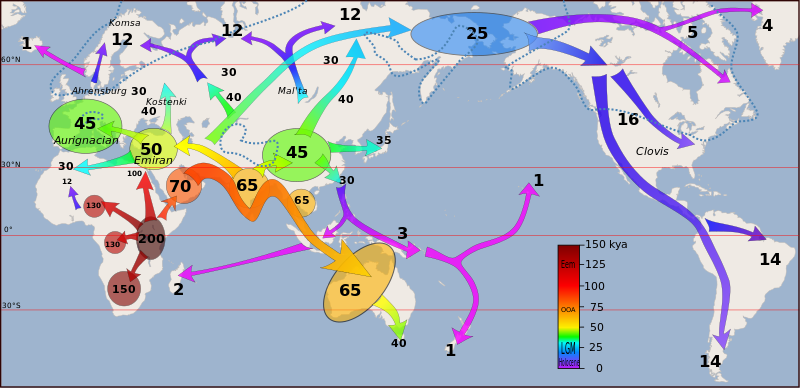
File:Early_migrations_mercator.svg · Wikimedia Commons · See Wikimedia Commons
globalization
Sign in to saveAlso known as globalisation
Globalization (UK: globalisation) is the process of increasing interdependence and integration among the economies, markets, societies, and cultures of different countries worldwide. It can be attributed to a series of factors, including the reduction of barriers to international trade, the liberalization of capital movements, the development of transportation infrastructure, and the advancement of information and communication technologies. The term globalization first appeared in the early 20th century (replacing an earlier French term ). It developed its current meaning in the second half o
Globalization is the increasing connection and integration of countries' economies, markets, societies, and cultures around the world, driven by factors like reduced trade barriers, easier movement of money, better transportation, and improved communication technology. It matters because these interconnections reshape how people work, trade, and interact across national boundaries.
AI-generated from the Wikipedia summary — may contain errors.
Wikidata facts
- Instance of
- social theory
- Subclass of
- interaction
- Named after
- globe
Show 8 more facts
- history of topic
- history of globalization
- Commons category
- Globalization
- topic's main category
- Category:Globalization
- topic has template
- Template:Globalization sidebar
- on focus list of Wikimedia project
- Wikipedia:Vital articles/Level/4
- studied by
- international studies
- has effect
- cultural conflict
- has cause
- mass media
via Wikidata · CC0
~90 min read
Encyclopedic overview
33 sectionsContents
- Etymology and usage
- History
- Archaic
- Early modern
- Modern
- Contemporary
- Economic globalization
- Cultural globalization
- Political globalization
- Globalization and gender
- Other dimensions
- Movement of people
- Movement of information
- Globalization and disease
- Measurement
- Support and criticism
- Public opinion
- Economics
- Global democracy
- Global civics
- International cooperation
- Anti-globalization movement
- Opposition to capital market integration
- Anti-corporatism and anti-consumerism
- Global justice and inequality
- Global justice
- Social inequality
- Anti-global governance
- Environmentalist opposition
- See also
- References
- Further reading
- External links
Globalization (UK: globalisation) is the process of increasing interdependence and integration among the economies, markets, societies, and cultures of different countries worldwide. It can be attributed to a series of factors, including the reduction of barriers to international trade, the liberalization of capital movements, the development of transportation infrastructure, and the advancement of information and communication technologies. The term globalization first appeared in the early 20th century (replacing an earlier French term ). It developed its current meaning in the second half of the 20th century, and came into popular use in the 1990s to describe the growing international connectivity of the post–Cold War world. The origins of globalization can be traced back to the 18th and 19th centuries, a period marked by significant advancements in transportation and communication technologies. These developments increased global interactions, supporting the growth of international trade and the exchange of ideas, beliefs, and cultures. While globalization is primarily an economic process of interaction and integration, it is also closely linked to social and cultural dynamics. Additionally, disputes and international diplomacy have played important roles in the history and evolution of globalization, continuing to shape its modern form. Though many scholars place the origins of globalization in modern times, others trace its history to long before the European Age of Discovery and voyages to the New World, and some even to the third millennium BCE. Large-scale globalization began in the 1820s, and in the late 19th century and early 20th century drove a rapid expansion in the connectivity of the world's economies and cultures. The term global city was subsequently popularized by sociologist Saskia Sassen in her work The Global City: New York, London, Tokyo (1991).
Globalization describes the growing interdependence of the world's economies, cultures, and populations, brought about by cross-border trade in goods and services, technology, and flows of investment, people, and information. Countries have built economic partnerships to facilitate these movements over many centuries.
Excerpted from Wikipedia’s “globalization” article, available under the CC BY-SA 4.0 licence.
Gallery (52)
Available in 140 languages
- Español
- Français
- Deutsch
- 中文
- 日本語
- Русский
- Português
- Italiano
- العربية
- हिन्दी
- Afrikaans
- Albanian
- Albanian
- Aragonese
- Armenian
- Assamese
- Asturian
- azb
Show 121 more
- Azerbaijani
- Bahasa Indonesia
- Bangla
- Bashkir
- Basque
- bat_smg
- be_x_old
- Belarusian
- Bishnupriya
- Bosnian
- Breton
- btm
- Bulgarian
- Buriat
- Burmese
- Catalan
- Central Kurdish
- Chechen
- Cornish
- Croatian
- Czech
- Danish
- Egyptian Arabic
- eml
- Esperanto
- Estonian
- Faroese
- Fiji Hindi
- Filipino
- Finnish
- fiu_vro
- Galician
- gcr
- Georgian
- Gilaki
- Greek
- Guarani
- Gujarati
- Hebrew
- Hungarian
- Icelandic
- Ido
- Iloko
- Irish
- Jamaican Creole English
- Javanese
- Kannada
- Kanuri
- Kara-Kalpak
- Karachay-Balkar
- Kazakh
- kbp
- Kyrgyz
- Lao
- Latin
- Latvian
- Limburgish
- Lingua Franca Nova
- Lithuanian
- Lombard
- Low German
- Luxembourgish
- Macedonian
- Malagasy
- Malay
- Malayalam
- Marathi
- Mingrelian
- Mirandese
- Moksha
- Mongolian
- Nederlands
- Nepali
- Newari
- Norwegian
- Norwegian Nynorsk
- Occitan
- Pashto
- Piedmontese
- Polski
- Punjabi
- Romanian
- Romansh
- Rusyn
- Sanskrit
- Scots
- Scottish Gaelic
- Serbian
- Serbian (Latin)
- Sicilian
- simple
- Sindhi
- Sinhala
- Slovak
- Slovenian
- Sundanese
- Svenska
- Swahili
- Tajik
- Tamil
- Tatar
- Telugu
- Tiếng Việt
- Türkçe
- Ukrainian
- Urdu
- Uzbek
- Veps
- Waray
- Welsh
- Western Frisian
- Western Panjabi
- Wu Chinese
- Yakut
- Yiddish
- Zaza
- zh_min_nan
- zh_yue
- فارسی
- ไทย
- 한국어
via Wikidata sitelinks · CC0