Category
page 1Cultural studies

Frankfurt School
school of neo-Marxist interdisciplinary social theory
cultural assimilation
process in which a group or culture comes to resemble another group

acculturation
Acculturation refers to the psychological, social, and cultural transformation that takes place through direct contact between two cultures, wherein one or both engage in adapting to dominant cultural influences without compromising their essential distinctiveness. It occurs when an individual acquires, adopts, or adjusts to a new cultural environment as a result of being placed into another culture or when another culture is brought into contact. This balancing process can result in a mixed society with prevailing and blended features or with splintered cultural changes, depending on the soci
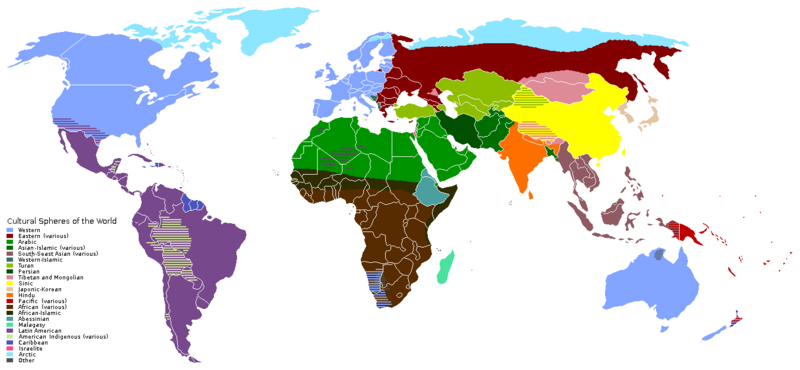
cultural geography
study of cultural products and norms and their variations across and relations to spaces and places

Turkology
thumb|300px|Turkic language map-present range
cultural studies
academic field of critical theory and literary criticism
cultural history
study of cultural activity and evolution of traditions over time

cultural imperialism
cultural dominance in imperialism
rape culture
sociological concept used to describe a setting in which rape is pervasive and normalized due to societal attitudes about gender and sexuality
organizational culture
values and behaviours that contribute to the unique social and psychological environment of an organization

shield-maiden
thumb|350px|right|Hervor dying after the Hlǫðskviða by [[Peter Nicolai Arbo]]
culturology
Culturology or the science of culture is a branch of the social sciences concerned with the scientific understanding, description, analysis, and prediction of cultures as a whole. While ethnology and anthropology studied different cultural practices, such studies included diverse aspects: sociological, psychological, etc., and the need was recognized for a discipline focused exclusively on cultural aspects.
material culture
physical aspect of culture in the objects and architecture that surround people
enculturation
Enculturation is the process by which people learn the dynamics of their surrounding culture and acquire values and norms appropriate or necessary to that culture and its worldviews.
social criticism
form of interpreting and sorting issues in contemporary society
Jewish studies
academic discipline centered on the study of Jews and Judaism
cultural capital
sociological concept
girl power
slogan encouraging women's empowerment
cultural psychology
study of how psychological and behavioral tendencies are rooted in and embodied in culture

albanology
thumb|Albanian folk dance from Civita, Calabria|Civita, [[Calabria, Italy]]
Albanology, also known as Albanian studies, is an interdisciplinary branch of the humanities that addresses the language, costume, literature, art, culture and history of Albanians. Within the studies the scientific methods of literature, linguistics, archeology, history and culture are used. However the Albanian language is the main point of research of the studies.
culture industry
expression suggesting that popular culture is used to manipulate mass society into passivity
intercultural competence
set of behaviours or social skills
animal captivity
condition of an animal being held by humans
Tartu–Moscow Semiotic School
semiotic organization leaded by Juri Lotman
Subaltern
colonial populations who are socially, politically, and geographically excluded from the hierarchy of power of an imperial colony and from the metropolitan homeland of an empire
Sorbian studies
academic discipline
warrior woman
archetypal figure
colonial mentality
internalized attitude of ethnic, national or cultural inferiority
post-materialism
In sociology, postmaterialism is the transformation of individual values from materalist, physical, and economic to new individual values of autonomy and self-expression. The term was popularized by the political scientist Ronald Inglehart in his 1977 book The Silent Revolution, in which he discovered that the formative affluence experienced by the post-war generations was leading some of them to take their material security for granted and instead place greater importance on non-material goals such as self-expression, autonomy, freedom of speech, gender equality, and environmentalism. Ingleha
visual culture
aspect of culture expressed in visual images
conceptual history
study of the history of concepts
caucasology
Caucasology, or Caucasiology is the historical and geopolitical studies of the Caucasus region. The branch has more than 150 years history. In 1972, the Caucasiological Center (renamed to International Caucasiological Center in 2000) was founded under the auspices of the Israel President Zalman Shazar.
transculturation
Transculturation is a term coined by Cuban anthropologist Fernando Ortiz in 1940 to describe the phenomenon of merging and converging cultures. Transculturation encompasses more than transition from one culture to another; it does not consist merely of acquiring another culture (acculturation) or of losing or uprooting a previous culture (deculturation). Rather, it merges these concepts and instead carries the idea of the consequent creation of new cultural phenomena (neoculturation) in which the blending of cultures is understood as producing something entirely new.

Coptology
thumb|upright|A painting of a cross from Kellia, late 6th century.
thumb|‘Coptic Baptismal Procession’ by English Pre-Raphaelite painter [[Simeon Solomon, 1865.]]
Coptology is the scientific study of the Coptic people.
pizza effect
phenomenon whereby an element of a nation's culture is transformed elsewhere, then re-imported back to its culture
cultural memory
topic in cultural studies and historiography
lipstick feminism
niche variety of third-wave feminism that embraces the coexistence of stereotypical concepts of femininity and female sexual empowerment; response to previous feminist waves which separated feminism and hyperfeminity
persecution of people with albinism
Tanzanian et al Albianism
culture of fear
arrangement in which fear of retribution is pervasive
Budapest School
school of Marxist humanism
Kartvelian studies
science of the Kartvelian languages (Georgia, Caucasus)
Cultural cringe
an internalized inferiority complex that causes people in a country to dismiss their own culture as inferior to the cultures of other countries
cultural rights
human rights related to culture and art
culture theory
comparative anthropology and semiotics that seeks to define the heuristic concept of culture in operational and/or scientific terms

cultural turn
1970s movement in the humanities and social sciences

Cultural entomology
media archaeology
sub-discipline of archaeology
malinchism
thumb|upright=1.5|350px|right|Codex Azcatitlan, [[Hernán Cortés and Malinche (far right), early 16th-century indigenous pictorial manuscript of the conquest of Mexico]]
Gandhigiri
Gandhigiri is a neologism in India which is used to express the tenets of Gandhism (the ideas of Mahatma Gandhi, which include Satyagraha and Ahimsa) in contemporary terms. The term became popular due to its usage in the 2006 Hindi film, Lage Raho Munna Bhai.
Marxist cultural analysis
anti-capitalist cultural critique
Besharmi Morcha
Indian transnational movement
performance studies
interdisciplinary academic field
Cybernetic Culture Research Unit
experimental cultural theorist collective
list of female action heroes and villains
Wikimedia list article
consumer capitalism
condition in which consumer demand is manipulated through mass-marketing
dominant culture
sociological term for a cultural phenomena
Domestication theory
Approach in science and technology studies
Syriac studies
the study of the Syriac language and Syriac Christianity
desecularization
thumb|270x270px|Importance of religion by country in a 2008-2009 poll by Gallup.In sociology, desecularization (also spelled desecularisation) is a resurgence or growth of religion after a period of secularization. The theory of desecularization is a reaction to the theory known as the secularization thesis, which posits a gradual decline in the importance of religion and in religious belief itself, as a universal feature of modern society. The term desecularization was coined by Peter L. Berger, a former proponent of the secularization thesis, in his 1999 book The Desecularization of the Worl
cultural materialism
school of critical theory founded by Raymond Williams in the 1980s