Category
page 1Cyanobacteria genera
%20Figure%202.jpg)
Nostoc
Nostoc, also known as star jelly, '''troll's butter, spit of moon, fallen star, witch's butter''' (not to be confused with the fungi commonly known as witches' butter), and '''witch's jelly,' is the most common genus of cyanobacteria found in a variety of both aquatic and terrestrial environments that may form colonies composed of filaments of moniliform cells in a gelatinous sheath of polysaccharides. It may also grow symbiotically within the tissues of plants, providing nitrogen to its host through the action of terminally differentiated cells known as heterocysts. Nostoc is a genus that inc
Anabaena
Anabaena is a genus of filamentous cyanobacteria that exist as plankton. They are known for nitrogen-fixing abilities, and they form symbiotic relationships with certain plants, such as the mosquito fern. They are one of four genera of cyanobacteria that produce neurotoxins, which are harmful to local wildlife, as well as farm animals and pets. Production of these neurotoxins is assumed to be an input into its symbiotic relationships, protecting the plant from grazing pressure.

Spirulina
genus of Cyanobacteria

Oscillatoria
thumb|225px|
Arthrospira
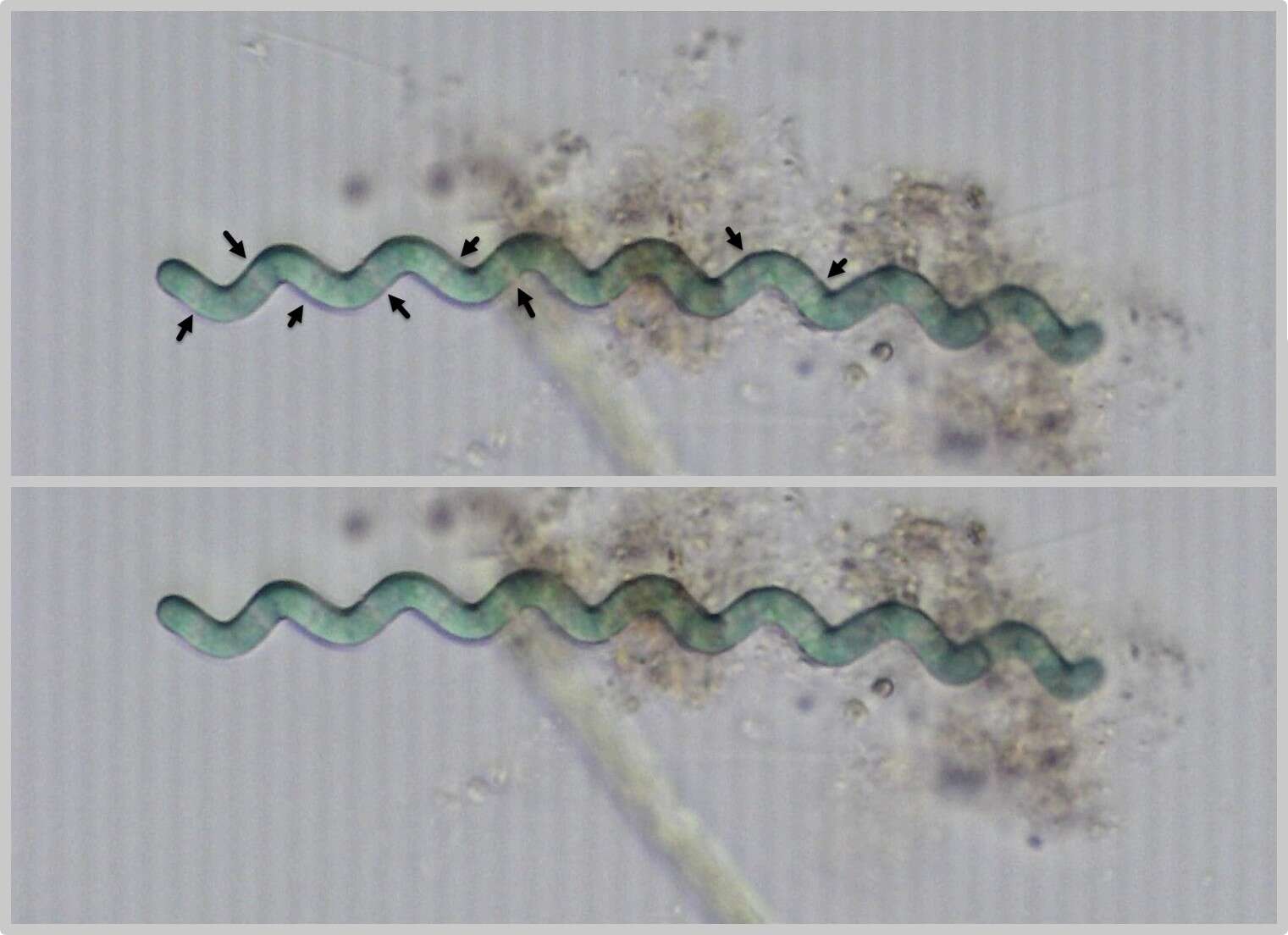
Arthrospira is a genus of free-floating filamentous cyanobacteria characterized by cylindrical, multicellular trichomes in an open left-hand helix. It was originally proposed in 1892 and went through a period of disuse between 1932 and 1974 due to an error perpetuated by Geitler. It contained the cultivated species used for producing spirulina until 2019, when it was found that the sequence of the type species A. jenneri was only distantly related to the cultivated species with several established genera in between, causing a new genus Limnospira to be created for them.
Prochlorococcus
Prochlorococcus is a genus of very small (0.6 μm) marine cyanobacteria with an unusual pigmentation (chlorophyll a2 and b2). These bacteria belong to the photosynthetic picoplankton and are probably the most abundant photosynthetic organism on Earth. Prochlorococcus microbes are among the major primary producers in the ocean, responsible for a large percentage of the photosynthetic production of oxygen. Prochlorococcus strains, called ecotypes, have physiological differences enabling them to exploit different ecological niches. Analysis of the genome sequences of Prochlorococcus strains s

Microcystis
Microcystis is a genus of freshwater cyanobacteria that includes the harmful algal bloom-forming Microcystis aeruginosa.

Synechococcus
thumb|224px| Transmission electron micrograph showing a species of the cyanobacteria Synechococcus. The carboxysomes appear as polyhedral dark structures.

Trichodesmium
Trichodesmium, also called sea sawdust, is a genus of filamentous cyanobacteria. They are found in nutrient poor tropical and subtropical ocean waters (particularly around Australia and in the Red Sea, where they were first described by Captain Cook). Trichodesmium is a diazotroph; that is, it fixes atmospheric nitrogen into ammonium, a nutrient used by other organisms. Trichodesmium is thought to fix nitrogen on such a scale that it accounts for almost half of the nitrogen fixation in marine systems globally. Trichodesmium is the only known diazotroph able to fix nitrogen in daylight under ae

Aphanizomenon
Aphanizomenon is a genus of cyanobacteria that inhabits freshwater lakes and can cause dense blooms. These cyanobacteria are unicellular organisms that form linear (non-branching) chains known as trichomes. Parallel trichomes can further unite into aggregates called rafts. Cyanobacteria such as Aphanizomenon are known for using photosynthesis to create energy and thus rely on sunlight as their energy source. Aphanizomenon bacteria also play a significant role in the Nitrogen cycle due to their ability to perform nitrogen fixation. Studies on the species Aphanizomenon flos-aquae have shown that
Gloeocapsa
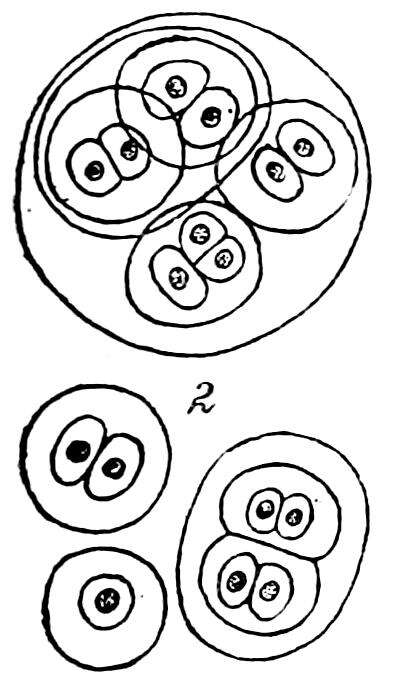
Gloeocapsa (from the Greek gloia (gelatinous) and the Latin capsa (case)) is a genus of cyanobacteria. The cells secrete individual gelatinous sheaths which can often be seen as sheaths around recently divided cells within outer sheaths. Recently divided cell pairs often appear to be only one cell since the new cells cohere temporarily. They are also known as glow caps, a term derived from the yellowish hue given off by the cap.

Nodularia
Nodularia is a genus of filamentous nitrogen-fixing cyanobacteria, or blue-green algae. They occur mainly in brackish or salinic waters, such as the hypersaline Makgadikgadi Pans, the Peel-Harvey Estuary in Western Australia or the Baltic Sea. Nodularia cells occasionally form heavy algal blooms. Some strains produce a cyanotoxin called nodularin R, which is harmful to humans.

Chroococcus
Chroococcus is a genus of cyanobacteria belonging to the family Chroococcaceae.

Scytonema
thumb|Heterocyst of [[Scytonema crispum]]
Scytonema is a genus of photosynthetic cyanobacteria that contains over 100 species. It grows in filaments that form dark mats. Many species are aquatic and are either free-floating or grow attached to a submerged substrate, while others species grow on terrestrial rocks, wood, soil, or plants. Scytonema is a nitrogen fixer, and can provide fixed nitrogen to the leaves of plants on which it is growing. Some species of Scytonema form a symbiotic relationship with fungi to produce a lichen.
thumb|Scyptolin A
Scyptolins are a type of elastase inhibitors i

Rivularia
genus of Cyanobacteria

Merismopedia
Merismopedia (from the Greek merismos [division] and the Greek pedion [plain]) is a genus of cyanobacteria found in fresh and salt water. It is ovoid or spherical in shape and arranged in rows and flats, forming rectangular colonies held together by a mucilaginous matrix. Species in this genus divide in only two directions, creating a characteristic grid-like pattern.

Lyngbya
Lyngbya is a genus of cyanobacteria, unicellular autotrophs that form the basis of the oceanic food chain.

Gloeobacter
Gloeobacter is a genus of cyanobacteria. It is the sister group to all other photosynthetic cyanobacteria. Gloeobacter's order, Gloeobacterales, is unique among cyanobacteria in not having thylakoids, which are characteristic for all other cyanobacteria and chloroplasts. Instead, the light-harvesting complexes (also called phycobilisomes), that consist of different proteins, sit on the inside of the plasma membrane (among the cytoplasm). Subsequently, the proton gradient in Gloeobacter is created across the plasma membrane, whereas it forms across the thylakoid membrane in cyanobacteria and ch

Synechocystis
Synechocystis is a genus of unicellular, freshwater cyanobacteria in the family Merismopediaceae. It includes a strain, Synechocystis sp. PCC 6803, which is a well studied model organism.
Prochloron
Prochloron (from the Greek pro (before) and the Greek chloros (green) ) is a genus of unicellular oxygenic photosynthetic prokaryotes commonly found as an extracellular symbiont on coral reefs, particularly in didemnid ascidians (sea squirts). Part of the phylum cyanobacteria, it was theorized (endosymbiotic theory) that Prochloron is a predecessor of chloroplasts, components found in photosynthetic eukaryotic cells. However, this theory is largely refuted by phylogenetic studies which indicate Prochloron is not on the same line of descent that lead to the chloroplasts of algae and land plants

Cylindrospermum
thumb|upright=0.5|Illustration of "Cylindrospermum stagnale". h, heterocyst; sp, resting spore

Chroococcidiopsis
thumb|Chroococcidiopsis thermalis can photosynthesize in far-red light, and might be suitable for future Mars colonists.

Calothrix
Calothrix is a genus of cyanobacteria. They are generally found in freshwater.

Stigonema
Stigonema is a genus of cyanobacteria in the family Stigonemataceae. Established in 1824 and formally defined in 1886, this genus contains 68 species of filament-forming cyanobacteria that create visible mats or crusts. The organisms are distinguished by their true branching pattern, where side-branches arise from cells along the main filament, and by filaments that are typically several cells thick. Some species also serve as the photosynthetic partner () in certain lichens, embedded within fungal tissue.

Phormidium
Phormidium is a common genus of cyanobacteria with a cosmopolitan distribution. This genus is in the family Oscillatoriaceae. Species in this genus will produce a range of cyanotoxins. Under favorable conditions, Phormidium forms continuous and large mats, which are documented to harbor various species of bacteria or algae.
Planktothrix
Planktothrix is a diverse genus of filamentous cyanobacteria observed to amass in algal blooms in water ecosystems across the globe. Like all Oscillatoriales, Planktothrix species have no heterocysts and no akinetes. Planktothrix are unique because they have trichomes and contain gas vacuoles unlike typical planktonic organisms. Previously, some species of the taxon were grouped within the genus Oscillatoria, but recent work has defined Planktothrix as its own genus. A tremendous body of work on Planktothrix ecology and physiology has been done by Anthony E. Walsby, and the 55.6 kb microcystin

Gloeotrichia
Gloeotrichia is a large (~2 mm) colonial genus of Cyanobacteria, belonging to the order Nostocales. The name Gloeotrichia is derived from the appearance of the filamentous body with prominent mucilage matrix. Found in lakes across the globe, gloeotrichia are notable for the important roles that they play in the nitrogen and phosphorus cycles. Gloeotrichia are also a genus of concern for lake managers, as they have been shown to push lakes towards eutrophication and to produce potentially deadly Microcystin-LR.

Aulosira
Aulosira is a genus of cyanobacteria found in a variety of environmental niches that forms colonies composed of filaments of moniliform cells.
Johannesbaptistia
Johannesbaptistia is a genus of brackish–freshwater cyanobacteria which has a very characteristic morphology. It is the only member of the family Cyanothrichaceae. When the name was changed from Cyanothrix to Johannesbaptistia (due to the rules of priority in the International Code of Nomenclature for algae, fungi, and plants), the family name was not changed.
Woronichinia
Woronichinia is a genus of cyanobacteria, belonging to the family Coelosphaeriaceae.
Borzia
genus of Cyanobacteria

Leptolyngbya
Leptolyngbya is a genus of cyanobacteria in the family Leptolyngbyaceae. The genus has a cosmopolitan distribution.
Cyanothece
Cyanothece is a genus of unicellular, diazotrophic, oxygenic photosynthesizing cyanobacteria.

Gomphosphaeria
thumb|Gomphosphaeria aponina Kütz., illustration of a colony pressed apart

Geitlerinema
Geitlerinema is a genus of cyanobacteria belonging to the family Coleofasciculaceae.
Collenia
Collenia is genus of fossil cyanobacteria that form a particular type of stromatolites.

Dolichospermum
Dolichospermum is a genus of cyanobacteria belonging to the family Nostocaceae. It was created by splitting from Anabaena using molecular evidence. It is paraphyletic as the author intends: the genera Aphanizomenon and Cuspidothrix, though cladistically included, have "distinct and unique" morphological features that set them apart.