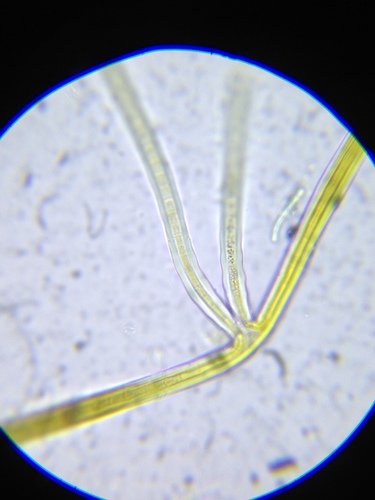
(c) trientalid, some rights reserved (CC BY-NC), uploaded by trientalid · cc-by-nc
Scytonema
Sign in to savethumb|Heterocyst of [[Scytonema crispum]] Scytonema is a genus of photosynthetic cyanobacteria that contains over 100 species. It grows in filaments that form dark mats. Many species are aquatic and are either free-floating or grow attached to a submerged substrate, while others species grow on terrestrial rocks, wood, soil, or plants. Scytonema is a nitrogen fixer, and can provide fixed nitrogen to the leaves of plants on which it is growing. Some species of Scytonema form a symbiotic relationship with fungi to produce a lichen. thumb|Scyptolin A Scyptolins are a type of elastase inhibitors i
Species
GENUS
- KingdomBacteria
- PhylumCyanobacteria
- ClassCyanobacteriia
- OrderCyanobacteriales
- FamilyScytonemataceae
Scytonema ist eine Gattung aus dem Stamm der Cyanobakterien (Blaualgen).
via GBIF
Museum specimens
- Specimen records
- 6,571
- With media
- 4,919
- Family
- Scytonemataceae
- Collections
- FC-UNAM, UHM, US
- Recorded in
- Mexico, United States
Wikidata facts
- Instance of
- taxon
- Image
- Scytonema crispum heterocyste.jpeg
Show 7 more facts
- taxon rank
- genus
- taxon name
- Scytonema
- Commons category
- Scytonema
- Gram staining
- gram-negative bacteria
- taxon common name
- スキトネマ属
- LPSN URL
- lpsn.dsmz.de/genus/scytonema
Sources (1)
via Wikidata · CC0
~1 min read
Encyclopedic overview
3 sectionsContents
- Species
- References
- External links
thumb|Heterocyst of [[Scytonema crispum]] Scytonema is a genus of photosynthetic cyanobacteria that contains over 100 species. It grows in filaments that form dark mats. Many species are aquatic and are either free-floating or grow attached to a submerged substrate, while others species grow on terrestrial rocks, wood, soil, or plants. Scytonema is a nitrogen fixer, and can provide fixed nitrogen to the leaves of plants on which it is growing. Some species of Scytonema form a symbiotic relationship with fungi to produce a lichen. thumb|Scyptolin A Scyptolins are a type of elastase inhibitors isolated from some species of Scytonema.
A study comparing red macroalgae to Scytonema species showed their potential for cosmetical use, both for their antioxidants properties and photoprotection capacities due to their compounds MAAs, and scytonemin (unique to Scytonema). This study indicated that they could be used as photoprotectors absorbing both in the UV-B and UV-A.
Excerpted from Wikipedia’s “Scytonema” article, available under the CC BY-SA 4.0 licence.
Gallery (5)
Available in 8 languages
via Wikidata sitelinks · CC0