Category
page 1Death gods
.jpg)
Odin
thumb|Odin, in his guise as a wanderer, as imagined by Georg von Rosen (1886)

Yama
Yama (), also known as Kāla and Dharmarāja, is the Hindu god of death and justice, responsible for the dispensation of law and punishment of sinners in his abode, Naraka. He is often identified with Dharmadeva, the personification of Dharma, though the two deities have different origins and myths.

Nergal
Nergal (Sumerian: dKIŠ.UNU or ; ; Aramaic: ܢܸܪܓܲܠ; ) was a Mesopotamian god worshiped through all periods of Mesopotamian history, from Early Dynastic to Neo-Babylonian times, with a few attestations indicating that his cult survived into the period of Achaemenid domination. He was primarily associated with war, death, and disease, and has been described as the "god of inflicted death". He reigned over Kur, the Mesopotamian underworld, depending on the myth either on behalf of his parents Enlil and Ninlil, or in later periods as a result of his marriage with the goddess Ereshkigal. Originally
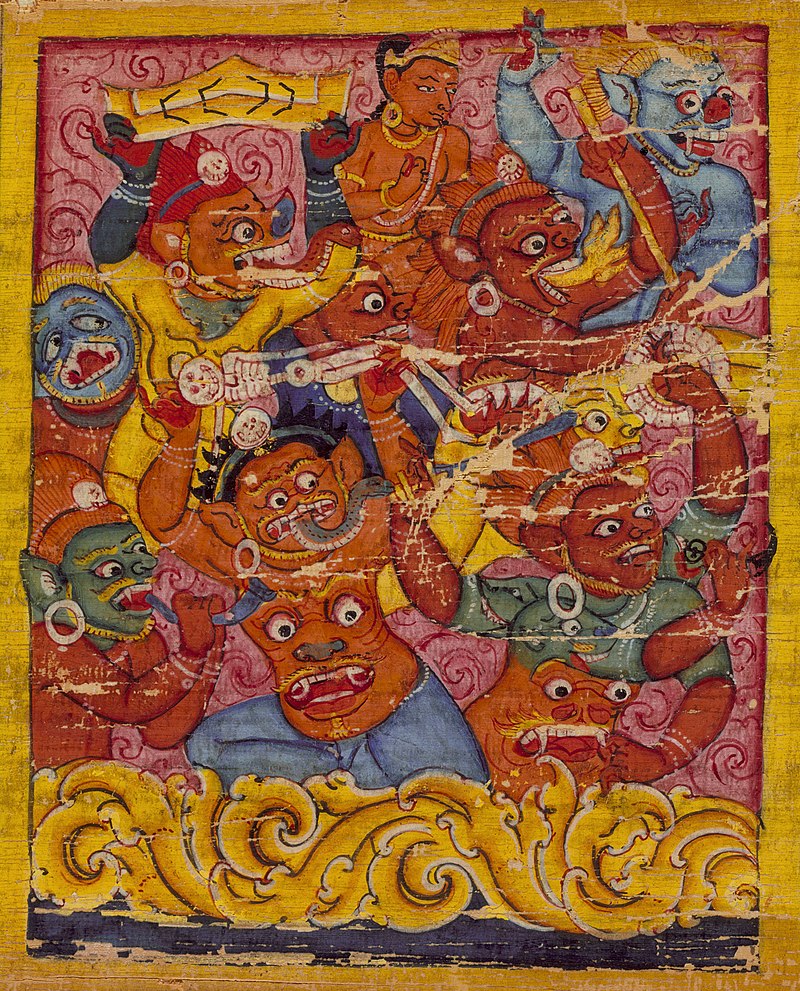
Māra Pāpīyān
God of death and sin. Ruler of the 6th heaven in the Kāmadhātu

Rudra
Rudra (, ) is a Rigvedic deity associated with Shiva, the wind or storms, Vayu, medicine, and the hunt. One translation of the name is 'the roarer'. In the Rigveda, Rudra is praised as the "mightiest of the mighty". Rudra means "who eradicates problems from their roots". Depending upon the period, the name Rudra can be interpreted as 'the most severe roarer/howler' or 'the most frightening one'. This name appears in the Shiva Sahasranama, and R. K. Sharma notes that it is often used as a name of Shiva in later languages. The "Shri Rudram" hymn from the Yajurveda is dedicated to Rudra and is im

shinigami
thumb|Statue of Yama (Buddhism)|Yama
Chernobog
Slavic deity of darkness

Xolotl
In Aztec mythology, Xolotl () was a god of fire and lightning. He was commonly depicted as a dog-headed man and was a psychopomp. He was also god of twins, monsters, death, misfortune, sickness, and deformities. Xolotl is the canine brother and twin of Quetzalcōātl, the pair being sons of the virgin Chīmalmā. He is the dark personification of Venus as the Evening Star, and was associated with heavenly fire. The axolotl is named after him.
The Dagda
deity
.jpg)
Acala
' or Achala (, "The Immovable", ), also known as (, "Immovable Lord") or ' (, "Noble Immovable Lord"), is a wrathful deity and dharmapala (protector of the Dharma) prominent in Vajrayana Buddhism and East Asian Buddhism.
Dis Pater
Roman god of the underworld
Manannán mac Lir
sea god in Irish mythology
Mictlantecuhtli
Mictlāntēcutli or Mictlantecuhtli (, meaning "Lord of Mictlan"), in Aztec mythology, is a god of the dead and the king of Mictlan (Chicunauhmictlan), the lowest and northernmost section of the underworld. He is one of the principal gods of the Aztecs and is the most prominent of several gods and goddesses of death and the underworld. The worship of Mictlantecuhtli sometimes involved ritual cannibalism, with human flesh being consumed in and around the temple. Other names given to Mictlantecuhtli include Ixpuztec (“Broken Face”), Nextepehua (“Scatterer of Ashes”), and Tzontemoc (“He Who Lowers
Mot
ancient Canaanite god of death and the Underworld
Namtar
Namtar () was a figure in ancient Mesopotamian religion who, depending on the context, could be regarded both as a minor god and as a demon of disease. He is best attested as the sukkal (attendant deity) of Ereshkigal, the goddess of the underworld. Like her, he was not the object of active worship, though references to it are made in literary texts, and additionally some incantations entrust him with keeping various other malevolent forces in the underworld.
Maya death gods
god of Death (Maya cult)

Yamantaka
thumb|Yamantaka is the "destroyer of death" deity in Vajrayana Buddhism, above riding a water buffalo.|320x320pxYamāntaka or Vajrabhairava is the "destroyer of death" deity of Vajrayana Buddhism. Sometimes he is conceptualized as "conqueror of the lord of death". Of the several deities in the Buddhist pantheon named Yamāntaka, the most well known belongs to the Anuttarayoga class of tantra of deities popular within the Gelug school of Tibetan Buddhism.
_(14594639700).jpg)
Camazotz
In the Late Post-Classic Maya mythology of the Popol Vuh, Camazotz ( from Mayan ) (alternate spellings Cama-Zotz, Sotz, Zotz) is a bat spirit at the service of the lords of the underworld. Camazotz means "death bat" in the Kʼicheʼ language. In Mesoamerica generally, the bat is often associated with night, death, and sacrifice.

Kāla
Kala (, ) is a Sanskrit term that means 'time' or 'death'. As time personified, destroying all things, Kala is a god of death, and often used as one of the epithets of Yama. In Shaivism, Kala is known as the fiery avatar of Shiva, Kala Bhairava or Kalagni Rudra; and in Vaishnavism Kala is also associated with Narasimha and Pralaya. As applied to gods and goddesses, ' is not always distinguishable from ', meaning 'black'.
Yama (Buddhism)
a Buddhist dharmapala (wrathful god) said to judge the dead, preside over the Narakas (Hells) and the cycle of afterlife saṃsāra
Februus
Februus is an ancient Italic god of purifications, who was worshipped by both the Romans and Etruscans. He was also worshipped as the god of the underworld by the Etruscans. For them, Februus was also the god of riches (money and gold) and death, both connected loosely to the underworld in the same natural manner as with the better-known Roman god Pluto. Februus' name could mean "the underground [one]" in the Etruscan language.

Ankou
thumb|Ankou in La Roche-Maurice, Finistère
Sia
deification of perception in the Heliopolitan Ennead cosmogony
Mors
personification of death in Roman mythology

Erlik
thumb|The city of the infernal king Erlik-Khan, surrounded by iron walls, precedes court over the souls of the dead. In front of him, a hell-being is reading the scrolls of sins and virtues.
Baron Samedi
Loa of Haitian Vodou
Horned God
Wiccan and Neopagan deity

Supay
thumb|200px|Supay, as interpreted in a Peruvian festival
In the Quechua, Aymara, and Inca mythologies, '''''' (from "shadow"; ) was originally an ambivalent spirit, both benevolent and harmful, a denizen of the Incan netherworld (Hurin Pacha) who might enter the world of the living as "shadow", perhaps attempting to bring someone as companion into the world of the dead.
Dark Lord
stock character; an evil, very powerful, often godlike or near-immortal sorcerer
%2C%20The%20Bull%20-%20geograph.org.uk%20-%20284005.jpg)
Donn
thumb|250px|Bull Rock, off the southwest coast of Ireland, is often identified with Teach Duinn (the House of Donn)
Bata
deity

Śuri
Śuri (), Latinized as '''''', was an ancient Etruscan infernal, volcanic and solar fire god, also venerated by other Italic peoples – among them Capenates, Faliscans, Latins and Sabines – and later adopted into ancient Roman religion.

Peckols
Peckols and Patollo, (in Lithuanian, Pikulas arba Pikuolis (Pocols, Pecols, Picullus, Pykullas) usually identified with Patulu (Patollo, Patollum, Patolli, Patolen)) were gods in the pagan Prussian mythology who were worshiped by the Old Prussians. Most researchers believe that, despite varying names, Peckols and Patollo were probably the same god in charge of the underworld and the dead. It is usually described as an angry, evil spirit similar to the Lithuanian Velnias.

Itztlacoliuhqui
In Aztec mythology, Itztlacoliuhqui is the god of frost. He also represents matter in its lifeless state.

Maximón
Maximón () is a Maya deity and folk saint, represented in various forms by the Maya peoples of several towns in the Guatemalan Highlands. Oral tradition of his creation and purpose in these communities is complex, diverse, and born of the ancient Maya traditions centuries ago.
Weneg
deity
Torngarsuk
thumb|Torngarsuk as depicted in the Dictionnaire Infernal, 1863 edition.
Adroa
Adroa is the supreme god or spirit of the Lugbara people of central Africa.
Batara Kala
javanese and Balinese god of the underworld
Aipaloovik
In Inuit mythology, Aipaloovik is an evil sea god associated with death and destruction. He is considered the opposite of Anguta. He is a danger to all fishermen.
Degei
In Fijian mythology, Degei (pronounced Ndengei), enshrined as a serpent, is the supreme god of Fiji. He is the creator of the (Fijian) world, fruits, and of men and is specially connected to Rakiraki District, Fiji. He judges newly dead souls after they pass through one of two caves: Cibaciba or Drakulu. A few he sends to paradise Burotu. Most others are thrown into a lake, where they will eventually sink to the bottom (Murimuria) to be appropriately rewarded or punished.
Nya (God)
Slavic god or death god
Whiro
Whiro-te-tipua (aka Whiro) is the lord of darkness and embodiment of all evil in Māori mythology. Usually depicted as a lizard-like creature, he inhabits the underworld and is responsible for the ills of all people, a contrast to his brother and enemy Tāne.
Thongalen
Thongalen (also, Thongalel, Thongaren or Thongarel) is the god of the dead and the king of the underworld in Meitei mythology and Sanamahism, the indigenous religion of Manipur.
He is the Guardian God of the nadir..
Muut
Muut was the personification and messenger of death in the culture of the Native American Cahuilla people of southern California and northern Mexico, and was usually depicted as an owl or as the unseen hooting of owls. He was one of the most active and vividly remembered of the nukatem, a special classification of beings who were created by Mukat, the Creator figure, in the 'beginning.' Death was considered a necessary part of life by the Cahuilla, and thus Muut was seen as more of a psychopomp than a frightening grim reaper character. This role was assigned by Mukat, who argued that overpopul