Category
page 1Debt

debt
thumb|right|Payday loan businesses lend money to customers, who then owe a debt to the payday loan company.

interest
thumb|right|upright=1.3|A bank sign in Malawi listing the interest rates for deposit accounts at the institution and the base rate for lending money to its customers
In finance and economics, interest is payment from a debtor or deposit-taking financial institution to a lender or depositor of an amount above repayment of the principal sum (that is, the amount borrowed), at a particular rate. It is distinct from a fee which the borrower may pay to the lender or some third party. It is also distinct from dividend which is paid by a company to its shareholders (owners) from its profit or reserve,

credit
thumb|right|200px|A credit card is a common form of credit. With a credit card, the credit card company, often a [[bank, grants a line of credit to the card holder. The card holder can make purchases from merchants, and borrow the money for these purchases from the credit card company.]]
thumb|right|px|Domestic credit to private sector in 2005
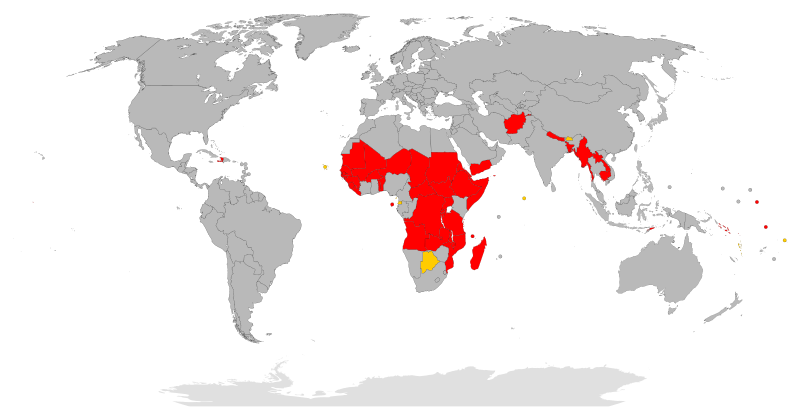
least developed countries
list of countries that exhibits the lowest indicators of socioeconomic development

creditor
A creditor or lender is a party (e.g., person, organization, company, or government) that has a claim on the services of a second party. It is a person or institution to whom money is owed. The first party, in general, has provided some property or service to the second party under the assumption (usually enforced by contract) that the second party will return an equivalent property and service. The second party is frequently called a debtor or borrower. The first party is called the creditor, which is the lender of property, service, or money.
debtor
A debtor or debitor is a legal entity (legal person) that owes a debt to another entity. The entity may be an individual, a firm, a government, a company or other legal person. The counterparty is called a creditor. When the counterpart of this debt arrangement is a bank, the debtor is more often referred to as a borrower.
external debt
total debt a country owes to foreign creditors

Sharia-compliant banking
banking and finance activity compliant with Islamic law
leverage
the use of borrowed funds rather than fresh equity in the purchase of an asset
list of countries by external debt
Wikimedia list article
default
failure to meet the legal obligations of a loan or other financial contract
1998 Russian financial crisis
ekonomická krize v Rusku v polovině roku 1998
securitization
Securitization is the financial practice of pooling various types of contractual debt such as residential mortgages, commercial mortgages, auto loans, or credit card debt obligations (or other non-debt assets which generate receivables) and selling their related cash flows to third party investors as securities, which may be described as bonds, pass-through securities, or collateralized debt obligations (CDOs).
Investors are repaid from the principal and interest cash flows collected from the underlying debt and redistributed through the capital structure of the new financing.
Securities bac

overdraft
thumb|"I warn you, Sir! The discourtesy of this bank is beyond all limits. One word more and I – I withdraw my overdraft!"
----
Cartoon from Punch (magazine)|Punch Magazine Vol. 152, June 27, 1917
insolvency
In accounting, insolvency is the state of being unable to pay the debts, by a person or company (debtor), at maturity; those in a state of insolvency are said to be insolvent. There are two forms: cash-flow insolvency and balance-sheet insolvency.
oniomania
obsession with shopping and buying behavior that causes adverse consequences
legal liability
legal obligation for any damage, enforceable by either civil law or criminal law
economic impact of the Russian invasion of Ukraine
financial crisis resulting from Russia's 2022 invasion of Ukraine
odious debt
legal theory that says that the national debt incurred by a despotic regime should not be enforceable
.png)
bailout
A bailout is the provision of financial help to a corporation or country which otherwise would be on the brink of bankruptcy. A bailout differs from the term bail-in (coined in 2010) under which the bondholders or depositors of global systemically important financial institutions (G-SIFIs) are forced to participate in the recapitalization process but taxpayers are not. Some governments also have the power to participate in the insolvency process; for instance, the U.S. government intervened in the General Motors bailout of 2009–2013. A bailout can, but does not necessarily, avoid an insolvency
bad debt
monetary amount owed to a creditor that is unlikely to be paid
payday loan
small, short-term unsecured loan
debt restructuring
process of renegotiation regarding an organization's, or sovereign entity's delinquent debts
subordinated debt
financial product
debenture
In corporate finance, a debenture is a medium- to long-term debt instrument used by large companies to borrow money at a fixed rate of interest. The legal term "debenture" originally referred to a document that either creates a debt or acknowledges it, but in some countries the term is now used interchangeably with bond, loan stock or note. A debenture is thus like a certificate of loan or a loan bond evidencing the company's liability to pay a specified amount with interest. Although the money raised by the debentures becomes a part of the company's capital structure, it does not become share
debt moratorium
delay in the payment of debts, usually by government
vulture fund
fund that invests in distressed assets
debt-trap diplomacy
China's diplomatic practice coercing alignment or access of an indebted country to its creditor
zombie company
company that has difficulties meeting its interest payments
Consolidation
form of debt refinancing that entails taking out one loan to pay off many others
credit crunch
sudden reduction in the general availability of loans or credit or a sudden tightening of the conditions required to obtain a loan from banks
mezzanine capital
any subordinated debt or preferred equity instrument that represents a claim on a company's assets which is senior only to that of the common shares
Agreement on German External Debts
treaty
rule of 72
methods of estimating the doubling time of an investment
IOU
An IOU (abbreviated from the phrase "I owe you") is usually an informal document acknowledging debt. An IOU differs from a promissory note in that an IOU is not a negotiable instrument and does not specify repayment terms such as the time of repayment. IOUs usually specify the debtor, the amount owed, and sometimes the creditor. IOUs may be signed or carry distinguishing marks or designs to ensure authenticity. In some cases, IOUs may be redeemable for a specific product or service rather than a quantity of currency, constituting a form of scrip.
consumer debt
amount owed by individual consumers (as opposed to amounts owed by businesses or governments)
Buy now, pay later
consumer lending approach
secured loan
type of loan with collateral pledged
arrears
In finance, arrears (or arrearage) is a legal term for the part of a debt that is overdue after missing one or more required payments. The amount of the arrears is the amount accrued from the date on which the first missed payment was due. The term is usually used in relation with periodically-recurring payments such as rent, bills, royalties (or other contractual payments), and child support.
debt clock
public counter of government debt
floating charge
security interest over the assets of a company
internal debt
part of the total government debt in a country that is owed to lenders within the country
distressed securities
tradable financial asset from legal status
debit note
commercial document issued by a buyer to a seller as a means of formally requesting a credit note
credit cycle
the expansion and contraction of access to credit over time period, regarded by some as the fundamental process driving the business cycle
Museum of Foreign Debt
museum in Buenos Aires, Argentina
Tax shield
tax deduction
Deleveraging
At the micro-economic level, deleveraging refers to the reduction of the leverage ratio, or the percentage of debt in the balance sheet of a single economic entity, such as a household or a firm. It is the opposite of leveraging, which is the practice of borrowing money to acquire assets and multiply gains and losses.
exchangeable bond
type of hybrid security
Debt-for-nature swap
The exchange of foreign debt for investments
Household debt
combined debt of all people in a household
External financing
Pecking order theory
financial model
To rob Peter to pay Paul
Saying
German economic crisis
downturn of Germany's economy since 2022
Accord and satisfaction
concept in contract law
credit card debt
form of consumer debt accumulated through the use of credit cards