Category
page 1Deception

corruption
Corruption is a form of dishonesty or a criminal offense that is undertaken by a person or an organization that is entrusted in a position of authority to acquire illicit benefits or abuse power for one's gain. Corruption may involve activities like bribery, influence peddling, embezzlement, and fraud as well as practices that are legal in many countries, such as lobbying. Political corruption occurs when an office-holder or other governmental employee acts in an official capacity for personal gain.

propaganda
thumb|James Montgomery Flagg's famous "[[Uncle Sam" propaganda poster, made during World War I]]
Propaganda is communication that is primarily used to influence or persuade an audience to further an agenda, which may not be objective and may be selectively presenting facts to encourage a particular synthesis or perception, or using loaded language to produce an emotional rather than a rational response to the information that is being presented. Propaganda can be found in a wide variety of different contexts.

lie
thumb|The fictional character Pinocchio is a common depiction of a liar.
A lie is an assertion that is believed to be false, typically used with the intention of deceiving or misleading someone. The practice of communicating lies is called lying. A person who communicates a lie may be termed a liar. Lies can be interpreted as deliberately false statements or misleading statements, though not all statements that are literally false are considered lies – metaphors, hyperboles, and other figurative rhetoric are not intended to mislead, while lies are explicitly meant for literal interpretation by
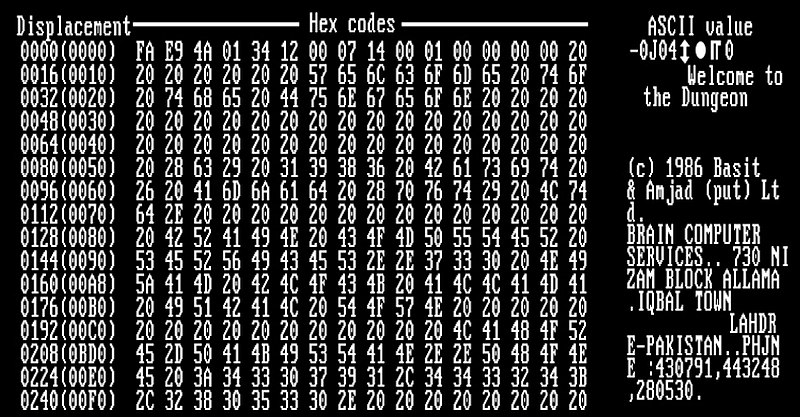
computer virus
type of computer program that, when executed, replicates itself by modifying other computer programs and inserting its own code

pseudoscience
thumb|upright=1.35|A typical 19th-century phrenology chart: during the 1820s, phrenologists claimed the mind was located in areas of the brain, and were attacked for doubting that mind came from the nonmaterial soul. Their idea of reading "bumps" in the skull to predict personality traits was later discredited. Phrenology was first termed a pseudoscience in 1843 and continues to be considered so.

fraud
thumb|right|200px|A fake automated teller slot used to commit bank fraud upon bank patrons
In law, fraud is intentional deception to deprive a victim of a legal right or to gain from a victim unlawfully or unfairly. Fraud can violate civil law (e.g., a fraud victim may sue the fraud perpetrator to thwart the fraud or recover monetary compensation) or criminal law (e.g., a fraud perpetrator may be prosecuted and imprisoned by governmental authorities), or it may be an element of another civil or criminal wrong despite itself causing no loss of money, property, or legal right. The purpose of fra

phishing
Phishing is a form of social engineering and a scam where attackers deceive people into revealing sensitive information or installing malware such as viruses, worms, adware, or ransomware. Phishing attacks have become increasingly sophisticated and often transparently mirror the site being targeted, allowing the attacker to observe everything while the victim navigates the site, and traverses any additional security boundaries with the victim. As of 2020, it is the most common type of cybercrime, with the Federal Bureau of Investigation's Internet Crime Complaint Center reporting more incident
illusion
An illusion is a distortion of the senses, which can reveal how the mind normally organizes and interprets sensory stimulation. Although illusions distort the human perception of reality, they are generally shared by most people.

honesty
thumb|Diogenes Searching for an Honest Man, attributed to J. H. W. Tischbein ()
Honesty or truthfulness is a facet of moral character that connotes positive and virtuous attributes such as integrity, truthfulness, straightforwardness (including straightforwardness of conduct: earnestness), along with the absence of lying, cheating, theft, etc. Honesty also involves being trustworthy, loyal, fair, and sincere.

fake news
false or misleading information presented as news

stage magic
performing art involving the use of illusion

placebo
thumb|Placebos are typically inert tablets, such as sugar pills.
A placebo ( ) is a medicine or treatment intended to appear genuine to its recipient, but which has no pharmaceutical effect. Common placebos include inert tablets (like sugar pills), inert injections (like saline), sham surgery, and other procedures.

delusion
A delusion is a fixed belief that is not amenable to change in light of conflicting evidence. As a pathology (delusional disorder), it is distinct from a belief based on false or incomplete information, confabulation, dogma, illusion, hallucination, or some other misleading effects of perception, as individuals with those beliefs are able to change or readjust their beliefs upon reviewing the evidence. However:

disinformation
Disinformation is false or misleading information deliberately spread to deceive people, or to secure economic or political gain and which may cause public harm. Disinformation is an orchestrated adversarial activity in which actors employ strategic deceptions and media manipulation tactics to advance political, military, or commercial goals. Disinformation is implemented through coordinated campaigns that "weaponize multiple rhetorical strategies and forms of knowing—including not only falsehoods but also truths, half-truths, and value judgements—to exploit and amplify culture wars and other

camouflage
thumb|upright=1.35|The peacock flounder can change its pattern and colours to match its environment.
thumb|upright=1.35|A soldier applying camouflage face paint; both helmet and jacket are disruptive coloration|disruptively patterned.|alt=photo of a soldier putting on camouflage face paint

spyware
Spyware (a portmanteau for spying software) is any malware that aims to gather information about a person or organization and send it to another entity in a way that harms the user by violating their privacy, endangering their device's security, or other means. This behavior may be present in other malware and in legitimate software. Websites may engage in spyware behaviors like web tracking. Hardware devices may also be affected.
.jpg)
betrayal
thumb|The Taking of Christ by Caravaggio (c.1602) shows Judas betraying Jesus.
Betrayal is the breaking or violation of a presumptive contract, trust, or confidence that produces moral and psychological conflict within a relationship amongst individuals, between organizations or between individuals and organizations. Often betrayal is the act of supporting a rival group, or it is a complete break from previously decided upon or presumed norms by one party from the others. Someone who betrays others is commonly known as a traitor or betrayer.
%20on%20Google%20Trends.svg)
gaslighting
thumb|Google Trends topic searches for "Gaslighting" began a substantial increase in 2016.

clickbait
thumb|right|upright=1.35|Fictional examples of "chumbox" style adverts, employing common clickbait tactics of using an information gap to encourage reader curiosity, and promising easy-to-read numbered lists

deception
Deception is the act of convincing of one or many recipients of untrue information. The person creating the deception knows it to be false while the receiver of the information does not. It is often done for personal gain or advantage.

cognitive dissonance
mental stress or discomfort experienced by an individual who holds two or more contradictory beliefs, ideas, or values at the same time

social engineering
information security concept: psychological manipulation of people into performing actions or divulging confidential information
.png)
hoax
upright=1.3|thumb|The Dreadnought hoax|Dreadnought hoaxers in Abyssinian [[regalia; the bearded figure on the far left is the writer Virginia Woolf.]]
A hoax (: hoaxes) is a widely publicised falsehood created to deceive its audience with false and often astonishing information, with the either malicious or humorous intent of causing shock and interest in as many people as possible.
%20petrol%20station.%20-%20Budapest%2C%20XII.%20distr.%20Istenhegyi%20St.%2C%2055.JPG)
greenwashing
thumb|right|250px|Solar power|Solar-powered petrol station in [[Budapest, Hungary]]
thumb|right|250px|A Volkswagen [[Golf TDI in 2010, featuring the phrase "clean diesel" (a type of fuel, also known as ultra-low-sulfur diesel). The company later faced scrutiny and conviction due to an emissions scandal.]]

false flag
act with the intent of disguising the actual source of responsibility and pinning blame on a second party

false dilemma
informal fallacy involving falsely limited alternatives, when in fact there is at least one additional option

Potemkin village
structure built solely to deceive others into thinking that a situation is better than it really is

sockpuppet
online identity used for purposes of deception
red herring
false clue that misleads or distracts attention away from a relevant or important question

misinformation
thumb|A sign for the successful Vote Leave|campaign to leave in the [[2016 United Kingdom European Union membership referendum. The claim made by the sign was widely considered to have been an example of misinformation.|alt=Sign reading: We send the EU £50 MILLION EVERY DAY / Let's spend it on our NHS instead / [heartbeat graphic] / Vote Leave on 23 June]]

quackery
thumb|250px|Works Progress Administration|WPA poster, 1936–38

forgery
thumb|right|330px|On the right, real sheet of a theatre surimono by Kunisada; on the left, a faked signature of Hokkei, .
advance-fee scam
type of fraud where the victim unknowingly engages in one way trade with the perpetrator
counterfeit money
money that was created illegally

shrinkflation
alt=Photo showing size difference of 165g and 134g Pringles cans.|thumb|Kellogg's shortened and shrank the diameter of the standard tube of [[Pringles in Australia through the 2010s and 2020s, as they shifted production from the United States to Malaysia. The net weight of each tube was reduced from 165g to 134g, the size of each Pringle was also reduced, and consumers also noticed a blander taste. These changes also coincided with price increases.]]
Apate
In Greek mythology, Apate (; Ancient Greek: Ἀπάτη Apátē) is the goddess and personification of deceit. Her mother is Nyx, the personification of the night. In Roman mythology her equivalent is Fraus (Fraud), while her male counterpart is Dolus (Deception), both considered children of Nyx and Erebus according to Cicero. Her opposite number Aletheia, the goddess of truth.
playback singer
singer whose singing is pre-recorded for use in film
tonic immobility
behavior in which animals take on the appearance of being dead
big lie
gross distortion or misrepresentation of the truth
truth drug
class of psychoactive drug

charlatan
thumb|Pietro Longhi: The Charlatan, 1757

disguise
thumb|Buster Keaton using his tie as a quick disguise
thumb|A gun disguised as a maglite
thumb|Adolf Hitler depicted in possible disguises by the [[United States Secret Service in 1944]]
Hippias Minor
book
self-deception
Self-deception or self-delusion is a process of denying or rationalizing away the relevance, significance, or importance of opposing evidence and logical argument. Self-deception involves convincing oneself of a truth (or lack of truth) so that one does not reveal any self-knowledge of the deception.
spin
form of propaganda in public relations
IP address spoofing
creating IP packets using forged IP addresses in headers
alternative facts
expression associated with political misinformation established in 2017
good cop/bad cop
Interrogation and negotiation tactic

sportswashing
thumb|President Vladimir Putin holding the [[FIFA World Cup Trophy at a pre-tournament ceremony for the 2018 FIFA World Cup hosted in Russia]]
Sportswashing is a term used to describe the practice of governments, individuals, corporations, or other groups using sports to improve reputations tarnished by wrongdoing. A form of propaganda, sportswashing can be accomplished through hosting sporting events, purchasing or sponsoring sporting teams, or participating in a sport.
victim playing
Fabrication or exaggeration of victimhood
cognitive distortion
exaggerated or irrational thought pattern involved in the onset and perpetuation of psychopathological states
academic dishonesty
any type of cheating that occurs in relation to a formal academic exercise
front organization
surrogate organization answering to someone else
rage-baiting
In internet slang, rage-baiting (also ragebaiting, rage-farming, or rage-seeding) is the manipulative tactic of eliciting outrage with the goal of increasing internet traffic, online engagement, and revenue, as well as attracting new subscribers, followers, or supporters. This manipulation occurs through offensive or inflammatory headlines, memes, tropes, or comments that provoke users to respond in kind.
bluff
tactic in poker and other card games
half-truth
A half-truth is a deceptive statement that includes some element of truth. The statement might be partly true, the statement may be totally true, but only part of the whole truth, or it may use some deceptive element, such as improper punctuation, or double meaning, especially if the intent is to deceive, evade, blame or misrepresent the truth.

countershading
thumb|upright=1.35|Many animals, such as this grey reef shark, are countershaded.
thumb|Illustration from the artist Abbot Thayer's 1909 book on camouflage of a Luna [[caterpillar Actias lunaa) in position b) inverted.]]
poisoning the well
type of logical fallacy
bad faith
Duplicity, fraud, or deception
noble lie
untruth propagated to strengthen social harmony