Category
page 1Deified Chinese men

Confucius
Confucius (), born Kong Qiu, was a Chinese philosopher of the Spring and Autumn period who is traditionally considered the paragon of Chinese sages. Much of the shared cultural heritage of the Sinosphere originates in the philosophy and teachings of Confucius. His philosophical teachings, called Confucianism, emphasized personal and governmental morality, harmonious social relationships, righteousness, kindness, sincerity, and a ruler's responsibilities to lead by virtue.

Mao Zedong
1st chairman of the Chinese Communist Party and founder of the People's Republic of China (1893–1976)

Laozi
Laozi (, ; ), formerly Latinized as Laocius, was a legendary Chinese philosopher considered to be the author of the Tao Te Ching (Pinyin: Dào Dé Jīng), one of the foundational texts of Taoism. Modern scholarship generally regards his biographical details as later inventions and his opus a collaboration of various writers, with the name Laozi, literally meaning 'Old Master', likely intended to portray an archaic anonymity that could converse with Confucianism. Traditional accounts addend him as , born in the 6th-centuryBC state of Chu during China's Spring and Autumn period (). Serving as the r

Li Bai
Classical Chinese poet of the Tang dynasty (701–762)
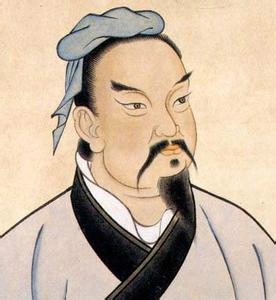
Sun Tzu
6th century BCE Chinese general and military strategist

Chiang Kai-shek
Chinese politician, military leader, and President of the ROC (1887–1975)

Cai Lun
Chinese official credited with inventing paper (died 121)

Qu Yuan
Chinese poet and politician (c.340–278 BC)

Zhuge Liang
Chinese statesman and military strategist (181–234)

Guan Yu
Chinese general serving warlord Liu Bei (160-220)

Koxinga
Zheng Chenggong (; 27 August 1624 – 23 June 1662), born Zheng Sen () and better known internationally by his honorific title Koxinga (), was a Southern Ming general who resisted the Qing conquest of China in the 17th century and expelled the Dutch from Taiwan, founding the Kingdom of Tungning.

Yao
legendary Chinese ruler, one of the Five Emperors

Emperor Taizu of Song
founding emperor of the Song Dynasty (reigned 960-976)

Shennong
thumb|upright|Shennong Yan Emperor () is well known as the first Emperor of Ancient China, who not only invented the farming tools for his people, but also herbs for treating his people's illnesses. Depicted in a mural painting from the Han dynasty.

Hong Xiuquan
Chinese revolutionary and leader of Taiping Rebellion (1814–1864)

Budai
Budai is a nickname given to the historical Chinese monk Qieci () in the Later Liang Dynasty, who is often identified with and venerated as the future Buddha Maitreya in Chan Buddhism and Buddhist scripture. With the spread of Chan Buddhism, he also came to be venerated in Vietnam, Korea, and Japan.
King Zhou of Shang
last king of Chinese Shang dynasty (r. 1075 BBCE-1046 BCE)
Zhang Fei
Chinese military general (died 221)

Bao Zheng
magistrate, judge, politician, mayor of Kaifeng, Northern Song dynasty (999-1062)
King Wen of Zhou
King of Zhou

Sima Yi
Chinese general, politician and regent (179-251)
Yue Fei
Song dynasty general, killed by royal decree from the Emperor Gaozong of Song (1103–1142)
Dan of Zhou
Legendary regional lord, regent, and culture hero of the early Zhou dynasty
Ziying
third and last ruler of the Qin dynasty during 207 BC
Han Xin
Chinese military general and politician (231-196 BC)
Meng Tian
Chinese inventor and military general from the state of Qin during the Warring States period

Zhao Yun
Chinese military general (died 229)
Wei Zheng
Tang Dynasty chancellor (580-643)
Li Zhi
Chinese philosopher (1527–1602)
Sun Bin
Chinese general, military strategist and writer (died 316 BC)

Zhang Zhongjing
a physician and pharmacologist (150–219), hailed as medical sage, from Eastern Han Dynasty, China
.png)
Cangjie
Cangjie is a legendary figure in Chinese mythology, said to have been an official historian of the Yellow Emperor and the inventor of Chinese characters. Legend has it that he had four eyes, and that when he invented the characters, the deities and ghosts cried and the sky rained millet. He is considered a legendary rather than historical figure, or at least not considered to be the sole inventor of Chinese characters. Cangjie was the eponym for the Cangjiepian proto-dictionary, the Cangjie method of inputting characters into a computer, and a Martian rock visited by the Mars rover Spirit, and

Cai Shen
alt=Caishen Statue at Gardens by the Bay|thumb|Caishen statue at Singapore's Gardens by the Bay to welcome [[Lunar New Year 2024.]]
Wu
Founding Liang emperor from 502 to 549
Jiang Ziya
military strategist of King Wen of Zhou and King Wu of Zhou
Wu Zixu
Chinese Wu kingdom general and politician (died 484 BC)
Fusu
Fusu (died August or September 210BC) was the eldest son and heir apparent of Qin Shi Huang, the First Emperor of the Qin dynasty.
Bai Qi
Chinese Qin state military general ( c. 332 BC – 257 BC)

Jizi
Jizi, Qizi, or Kizi (), called in Korean Kija (), was a semi-legendary Chinese sage who is said to have ruled Kija Chosŏn in the 11th century BCE. Early Chinese documents like the Book of Documents and the Bamboo Annals described him as a virtuous relative of the last king of the Shang dynasty who was punished for remonstrating with the king. After Shang was overthrown by Zhou in the 1040s BCE, he allegedly gave political advice to King Wu, the first Zhou king. Chinese texts from the Han dynasty (206 BCE – 220 CE) onwards claimed that King Wu enfeoffed Jizi as ruler of Chaoxian (, pronounced "
Luo Binwang
Chinese writer
Lu Ban
5th-century BC Chinese engineer and inventor
Ma Chao
Chinese military general and warlord (176–222)
Chen Sheng
Qin Dynasty rebel
Gan Ning
General serving warlord Sun Quan (died c. 220)
Fú Jiān
third emperor of Former Qin during the he Sixteen Kingdoms period
Cai Xiang
Chinese calligrapher-architect (1012–1067)
Yi Yin
Chinese chancellor
Li Mu
Chinese general for the State of Zhao
Ma Yuan
Chinese general who served during the Eastern Han dynasty.
Ma Dai
3rd century State of Shu Han general
Old Man of the South Pole
Taoist deification of Canopus, the brightest star of the constellation Carina; symbolizes happiness and longevity
Dongfang Shuo
Han dynasty scholar-official
Chen Youliang
Chinese rebel
Yu Qian
Chinese general, imperial scholar and poet (1398-1457)
Bian Que
ancient Chinese physician
Wang Shenzhi
Chinese prince (862-925)
Yang Shen
Ming Dynasty poet (1488-1559)
Guan Ping
Chinese general serving warlord Liu Bei (died 220)
Emperor Yi of Chu
king of Chinese state of Chu from 208 to 206 BC
Daode Tianzun
deification of Laozi in the Taoist pantheon