File:Budai,_British_Museum.jpg · Wikimedia Commons · See Wikimedia Commons
Budai
Sign in to saveAlso known as Hotei, Laughing Buddha, Shi Qici, Budai heshang, Changtingzi, Qici
Budai is a nickname given to the historical Chinese monk Qieci () in the Later Liang Dynasty, who is often identified with and venerated as the future Buddha Maitreya in Chan Buddhism and Buddhist scripture. With the spread of Chan Buddhism, he also came to be venerated in Vietnam, Korea, and Japan.
Person · Open Library
- Works
- 10
Top works
- Zhongguo zhi men
- Huang tu hun
- Yuan ju de ge yao
- Ren yuan sen lin
- Dao huo zhe
via Open Library + Wikidata
Key facts
- Person.image
- Budai, British Museum.jpg
- Person.caption
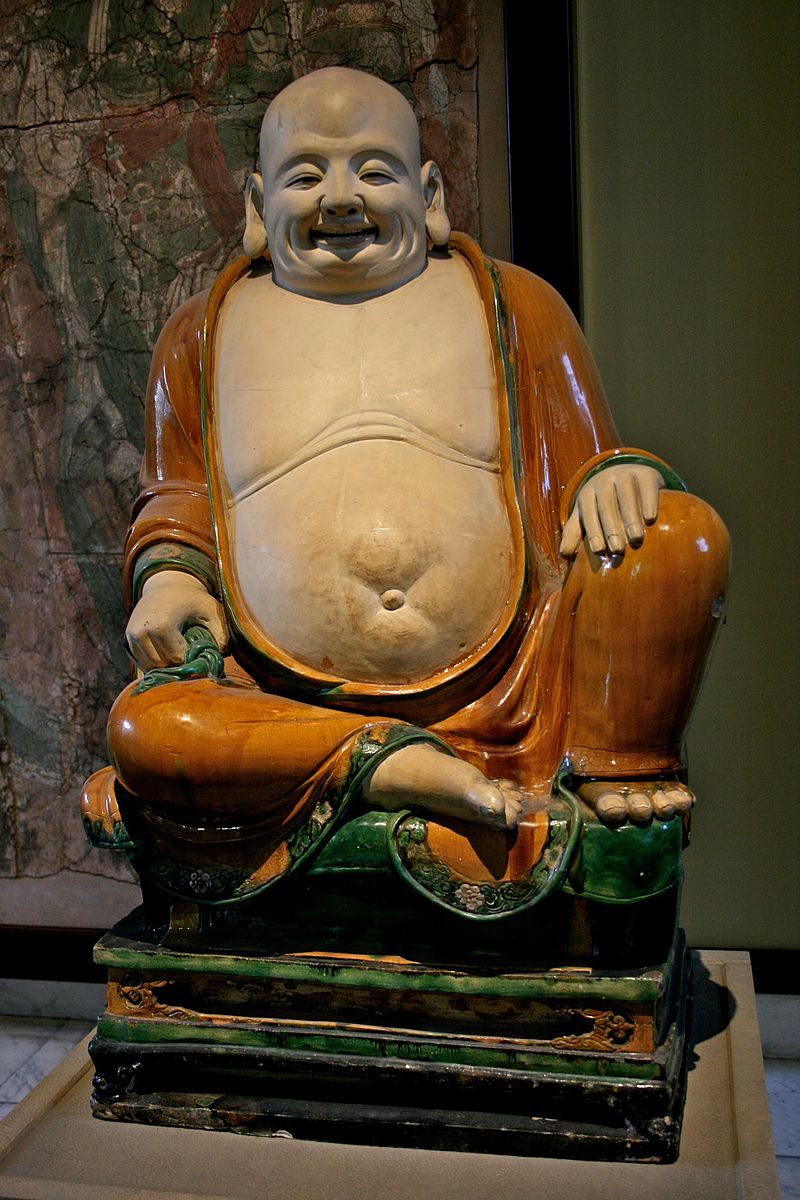
- Glazed ceramic sculpture of Budai.China, Ming dynasty, 1486.
- Person.death_date
- 28 March 917
via Wikipedia infobox
Wikidata facts
- Instance of
- human
- Part of
- Seven Lucky Gods
- Gender
- male
- Citizenship
- Tang dynasty
- Occupation
- Buddhist monk
- Religion
- Buddhism
- Image
- Budai, British Museum.jpg
Show 5 more facts
- Commons category
- Budai
- date of birth
- 0850-00-00
- date of death
- 0916-00-00
- last words
- 彌勒真彌勒,化身千百億,時時示時人,時人自不識
- incarnation of
- Maitreya
Sources (2)
via Wikidata · CC0
~12 min read
Encyclopedic overview
15 sectionsContents
- Hagiography
- In Chan Buddhism
- In art
- Sculpture
- Paintings
- Crafts
- Confusion with other religious figures
- Angida
- Gautama Buddha
- Kangxi Emperor
- Phra Sangkajai
- See also
- Notes
- References
- External links
Budai is a nickname given to the historical Chinese monk Qieci () in the Later Liang Dynasty, who is often identified with and venerated as the future Buddha Maitreya in Chan Buddhism and Buddhist scripture. With the spread of Chan Buddhism, he also came to be venerated in Vietnam, Korea, and Japan.
The name "Budai" literally means "cloth sack", and refers to the bag he is often depicted carrying as he wanders. His jolly nature and eccentric lifestyle distinguish him from most Buddhist masters or figures. He is almost always shown smiling or laughing, hence his nickname in Chinese, the "Laughing Buddha". Budai is traditionally depicted as having a huge stomach (possibly a symbol of abundance or forgiveness) and many stories surrounding Budai involve his love of food and drink. Because of this, he is also referred to as the "Fat Buddha", especially in the Western world, where he is often mistaken for The Buddha.
Excerpted from Wikipedia’s “Budai” article, available under the CC BY-SA 4.0 licence.