Category
page 1Deified Roman emperors

Augustus
Augustus (born Gaius Octavius; 23 September 63 BC – 19 August AD 14), also known as Octavian (), was the founder of the Roman Empire and the first Roman emperor from 27 BC until his death in AD 14. The reign of Augustus initiated an imperial cult and an era of imperial peace (the or ) in which the Roman world was largely free of armed conflict. The principate, a style of government where the emperor showed nominal deference to the Senate, was established during his reign and lasted until the Crisis of the Third Century.

Marcus Aurelius
16th Roman Emperor from 161 to 180 and Stoic philosopher

Constantine the Great
Roman emperor from 306 to 337 and first to convert to Christianity (272–337)

Trajan
Trajan ( ; born Marcus Ulpius Traianus, 18 September 53) was a Roman emperor from AD 98 to 117, remembered as the second of the Five Good Emperors of the Nerva–Antonine dynasty. He was a philanthropic ruler and a successful soldier-emperor who presided over one of the greatest military expansions in Roman history, during which, by the time of his death, the Roman Empire reached its maximum territorial extent. He was given the title of optimus princeps ('the best ruler') by the Roman Senate.
.png)
Hadrian
Hadrian ( ; born Publius Aelius Hadrianus, 24 January 76 – 10 July 138) was Roman emperor from 117 to 138. Hadrian was born in Italica, in the present-day Andalusian province of Seville in southern Spain, an Italic settlement in Hispania Baetica; his gens Aelia came from the town of Hadria in eastern Italy. He was a member of the Nerva–Antonine dynasty.

Vespasian
Vespasian (; ; 17 November 9 AD – 23 June 79) was Roman emperor from 69 to 79. The last emperor to reign in the Year of the Four Emperors, he founded the Flavian dynasty, which ruled the empire for 27 years. His fiscal reforms and consolidation of the empire brought political stability and an extensive building program.

Claudius
Tiberius Claudius Caesar Augustus Germanicus ( ; ; 1 August 10 BC – 13 October AD 54), or Claudius, was a Roman emperor, ruling from AD 41 to 54. A member of the Julio-Claudian dynasty, Claudius was born to Drusus and Antonia Minor at Lugdunum in Roman Gaul, where his father was stationed as a military legate. He was the first Roman emperor to be born outside Italy.
.png)
Titus
Titus Flavius Vespasianus (; 30 December 39 – 13 September 81 AD) was Roman emperor from 79 to 81 AD. A member of the Flavian dynasty, Titus succeeded his father Vespasian upon his death, becoming the first Roman emperor ever to succeed his biological father.

Diocletian
Diocletian ( ; ; ; 242/245 – 311/312), nicknamed Jovius, was Roman emperor from 284 until his abdication in 305. He was born Diocles to a family of low status in the Roman province of Dalmatia. As with other Illyrian soldiers of the period, Diocles rose through the ranks of the military early in his career, serving under Aurelian and Probus, and eventually becoming a cavalry commander for the army of Emperor Carus. After the deaths of Carus and his son Numerian on a campaign in Persia, Diocles was proclaimed emperor by the troops, taking the name "Diocletianus". The title was also claimed by C

Theodosius I
Roman emperor from 379 to 395

Antoninus Pius
15th Roman Emperor (138–161)

Septimius Severus
Roman emperor from 193 to 211

Caracalla
Marcus Aurelius Antoninus (born Lucius Septimius Bassianus, 4 April 188 – 8 April 217), better known by his nickname Caracalla (; ), was Roman emperor from 198 to 217 AD, first serving as nominal co-emperor under his father and then ruling alone after 211 AD. He was a member of the Severan dynasty, the elder son of Emperor Septimius Severus and Empress Julia Domna. Severus proclaimed Caracalla co-ruler in 198, doing the same with his other son Geta in 209. The two brothers briefly shared power after their father's death in 211, but Caracalla soon had Geta murdered by the Praetorian Guard

Aurelian
Aurelian (; ; 9 September ) was a Roman emperor from 270 to 275 during the Crisis of the Third Century. During his reign, he won an unprecedented series of military victories which reunited the Roman Empire after it had nearly disintegrated under the pressure of barbarian invasions and internal revolts. For his success in restoring the Empire's territorial integrity, Aurelian was honored with the title ("Restorer of the World").
.png)
Commodus
Commodus (; ; 31 August 161 – 31 December 192) was Roman emperor from 177 to 192, first serving as nominal co-emperor under his father Marcus Aurelius and then ruling alone from 180. Commodus's sole reign is commonly thought to mark the end of the Pax Romana, a golden age of peace and prosperity in the history of the Roman Empire.

Nerva
Nerva (; born Marcus Cocceius Nerva; 8 November 30 – 27 January 98) was a Roman emperor from AD 96 to 98. Nerva became emperor when aged almost 66, after a lifetime of imperial service under Nero and the succeeding rulers of the Flavian dynasty.

Severus Alexander
Roman Emperor (208-235)

Decius
Gaius Messius Quintus Trajanus Decius ( 201June 251), known as Trajan Decius or simply Decius (), was Roman emperor from 249 to 251.

Pertinax
Publius Helvius Pertinax ( ; 1 August 126 – 28 March 193) was Roman emperor for the first three months of 193, succeeding Commodus and becoming the first ruler of the turbulent Year of the Five Emperors.

Constantius Chlorus
Roman emperor (250-306)

Philip the Arab
Roman Emperor (204-249)

Valerian
Roman emperor
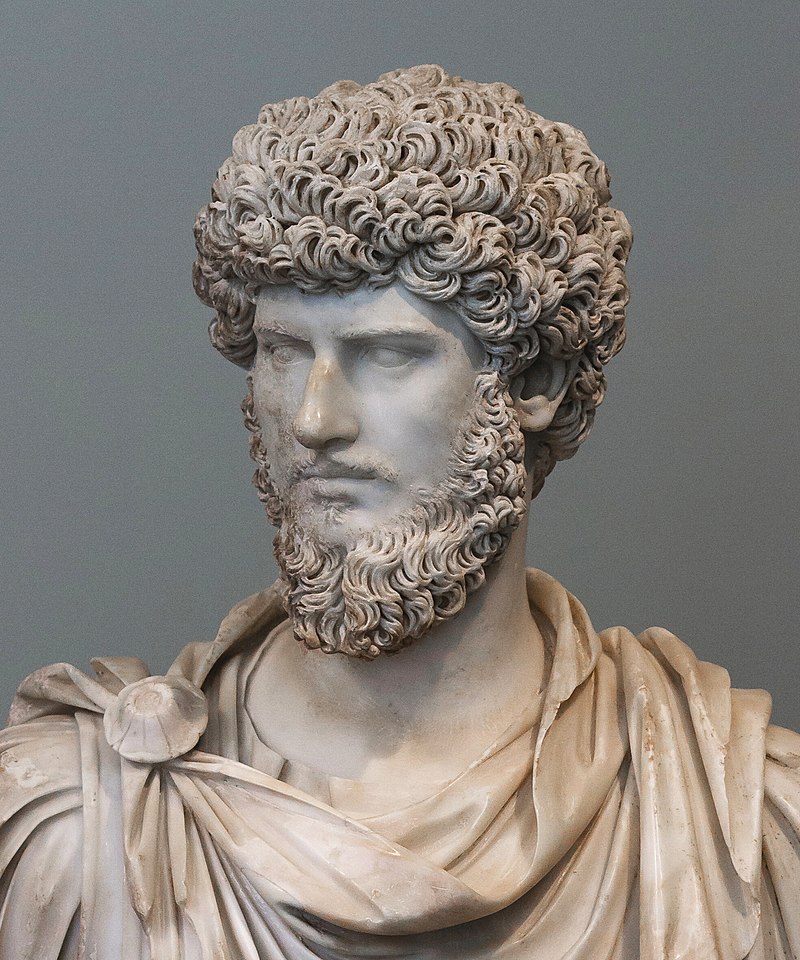
Lucius Verus
joint Roman Emperor with Marcus Aurelius (161–169)

Valentinian I
Roman emperor from 364 to 375

Valens
Valens (; ; 328 – 9 August 378) was Roman emperor from 364 to 378. Following a largely unremarkable military career, he was named co-emperor by his elder brother Valentinian I, who gave him the eastern half of the Roman Empire to rule. In 378, Valens was defeated and killed at the Battle of Adrianople against the invading Goths, which astonished contemporaries and marked the beginning of barbarian encroachment into Roman territory.

Claudius Gothicus
Roman Emperor from 268 to 270 (213–270)

Gordian III
Roman emperor (225-244)

Gordian I
Roman Emperor
.jpg)
Gallienus
Publius Licinius Egnatius Gallienus (, ; – September 268) was Roman emperor with his father Valerian from 253 to 260 and alone from 260 to 268. He ruled during the Crisis of the Third Century that nearly caused the collapse of the empire. He won numerous military victories against usurpers and Germanic tribes, but was unable to prevent the secession of important provinces. His 15-year reign was the longest in half a century.

Geta
Roman emperor from 209 to 211

Maximian
Maximian (; ), nicknamed Herculius, was Roman emperor from 286 to 305. He was Caesar from 285 to 286, then Augustus from 286 to 305. He shared the latter title with his co-emperor and superior, Diocletian, whose political brain complemented Maximian's military brawn. Maximian established his residence at Trier but spent most of his time on campaign. In late 285, he suppressed rebels in Gaul known as the Bagaudae. From 285 to 288, he fought against Germanic tribes along the Rhine frontier. Together with Diocletian, he launched a scorched earth campaign deep into Alamannic territory in 288, refo

Probus
3rd-century Roman Emperor (232-282)
%20-%20Foto%20G.%20Dall'Orto%2028-5-2006.jpg)
Galerius
Galerius Valerius Maximianus (; Greek: Γαλέριος; 258 – May 311) was Roman emperor from 305 to 311. He participated in the system of government later known as the Tetrarchy, first acting as caesar under Emperor Diocletian. In this period Galerius obtained victory warring against the Persian Sasanian Empire, defeating Narseh at the battle of Satala in 298 and possibly sacking the Sasanian capital of Ctesiphon in 299. He also campaigned across the Danube against the Carpi, defeating them in 297 and 300. Galerius was promoted to augustus upon the abdication of Diocletian in 305, but had to contend

Gordian II
Roman Emperor in 238 AD

Gratian
Gratian (; ; 18 April 359 – 25 August 383) was emperor of the Western Roman Empire from 367 to 383. The eldest son of Valentinian I, Gratian was raised to the rank of Augustus as a child and inherited the West after his father's death in 375. He nominally shared the government with his infant half-brother Valentinian II, who was also acclaimed emperor in Pannonia on Valentinian's death. The East was ruled by his uncle Valens, who was later succeeded by Theodosius I.

Valentinian II
Roman emperor from 375 to 392
%2002.jpg)
Numerian
Numerian (; died November 284) was Roman emperor from 283 to 284 with his older brother Carinus. They were sons of Carus, a general raised to the office of praetorian prefect under Emperor Probus in 282.

Herennius Etruscus
Roman emperor (220-251)

Saloninus
Publius Licinius Cornelius Saloninus Valerianus (died 260), typically just called Saloninus, was a young Roman nobleman who briefly became emperor in 260. The grandson of Valerian I, Saloninus was appointed caesar (heir) in 258 in an attempt to shore up the Licinian line of succession during the Crisis of the Third Century. During his time in power, Saloninus administered the German marches out of Cologne. Nevertheless, Saloninus soon became embroiled in a dispute with future Gallic emperor Postumus over war spoils. In 260, Saloninus' troops acclaimed him augustus (emperor) in an unsuccessful
imperial cult of ancient Rome
worship of deceased and deified emperors in ancient Roman religion
Temple of the Emperors (Ephesus)
temple constructed on two-storied substructions to the west of the State Agora in Ephesus