Category
page 1Doric Greek poets

Pindar
Pindar (; ; ; ) was an Ancient Greek lyric poet from Thebes. Of the canonical nine lyric poets of ancient Greece, his work is the best preserved. Quintilian wrote, "Of the nine lyric poets, Pindar is by far the greatest, in virtue of his inspired magnificence, the beauty of his thoughts and figures, the rich exuberance of his language and matter, and his rolling flood of eloquence, characteristics which, as Horace rightly held, make him inimitable." His poems can also, however, seem difficult and even peculiar. The Athenian comic playwright Eupolis once remarked that they "are already reduced
Theocritus
Theocritus (; , Theokritos; ; born 300 BC, died after 260 BC) was a Greek poet from Sicily, Magna Graecia, and the creator of Ancient Greek pastoral poetry.
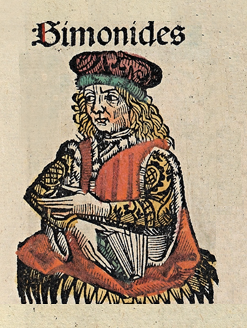
Simonides of Ceos
Greek lyric poet (c. 556–468 BC)
.jpg)
Alcman
thumb|Roman-period mosaic portrait of Alcman from Gerasa, 3rd century AD
Alcman (; Alkmán; fl. 7th century BC) was an Ancient Greek choral lyric poet from Sparta. He is the earliest representative of the Alexandrian canon of the Nine Lyric Poets. He wrote six books of choral poetry, most of which is now lost; his poetry survives in quotation from other ancient authors and on fragmentary papyri discovered in Egypt. His poetry was composed in the local Doric dialect with Homeric influences. Based on his surviving fragments, his poetry was mostly hymns, and seems to have been composed in long sta

Bacchylides
right|thumb|A Musician by Albert Joseph Moore
Bacchylides (; Bakkhulides; – ) was a Greek lyric poet. Later Greeks included him in the canonical list of Nine Lyric Poets, which included his uncle Simonides. The elegance and polished style of his lyrics have been noted in Bacchylidean scholarship since at least Longinus. Some scholars have characterized these qualities as superficial charm. He has often been compared unfavourably with his contemporary, Pindar, as "a kind of Boccherini to Pindar's Haydn". However, the differences in their styles do not allow for easy comparison, and translator R

Stesichorus
upright=1.25|thumb|A scene from the Tabula Iliaca, bearing the inscription "Sack of Troy according to Stesichorus"
Stesichorus (; , Stēsichoros; c. 630 – 555 BC) was a Greek lyric poet native of Metauros (Gioia Tauro today). He is best known for telling epic stories in lyric metres, and for some ancient traditions about his life, such as his opposition to the tyrant Phalaris, and the blindness he is said to have incurred and cured by composing verses first insulting and then flattering to Helen of Troy.
Epicharmus of Kos
late 6th/early 5th century BC Greek dramatist and philosopher

Ibycus
Ibycus (; ; ) was an Ancient Greek lyric poet, a citizen of Rhegium in Magna Graecia, probably active at Samos during the reign of the tyrant Polycrates and numbered by the scholars of Hellenistic Alexandria in the canonical list of nine lyric poets. He was mainly remembered in antiquity for pederastic verses, but he also composed lyrical narratives on mythological themes in the manner of Stesichorus. His work survives today only as quotations by ancient scholars or recorded on fragments of papyrus recovered from archaeological sites in Egypt, yet his extant verses include what are considered

Erinna
thumb|Fanciful portrait of Erinna from Finden's Gallery of Graces (1834)
Erinna (; ) was an ancient Greek poet. She is best known for her long poem The Distaff, a 300-line hexameter lament for her childhood friend Baucis, who had died shortly after her marriage. A large fragment of this poem was discovered in 1928 at Oxyrhynchus in Egypt. Along with The Distaff, three epigrams ascribed to Erinna are known, preserved in the Greek Anthology. Biographical details about Erinna's life are uncertain. She is generally thought to have lived in the first half of the fourth century BC, though some ancie

Anyte of Tegea
thumb|right|Illustration of Anyte by Lucien Lévy-Dhurmer, for [[Renée Vivien's Les Kitharèdes]]
Anyte of Tegea (; ) was a Hellenistic poet from Tegea in Arcadia. Little is known of her life, but twenty-four epigrams attributed to her are preserved in the Greek Anthology, and one is quoted by Julius Pollux; nineteen of these are generally accepted as authentic. She introduced rural themes to the genre, which became a standard theme in Hellenistic epigrams. She is one of the nine outstanding ancient women poets listed by Antipater of Thessalonica in the Palatine Anthology. Her pastoral poetry ma

Nossis
thumb|right|Marble bust of Nossis by Francesco Jerace
Sophron
Sophron of Syracuse (, fl. 430 BC), Magna Graecia, was a writer of mimes (μῖμος, a kind of prose drama).
Leonidas of Tarentum
ancient Greek poet

Mesomedes
Mesomedes of Crete () was a Greek citharode and lyric poet and composer of the early 2nd century AD in Roman Greece. Prior to the discovery of the Seikilos epitaph in the late 19th century, the hymns of Mesomedes were the only surviving written music from the ancient world. Three were published by Vincenzo Galilei in his Dialogo della musica antica e della moderna (Florence, 1581), during a period of intense investigation into music of the ancient Greeks. These hymns had been preserved through the Byzantine tradition (Anthol. pal. xiv. 63, xvi. 323), and were presented to Vincenzo by Girolamo
Isyllus
Isyllus () was an ancient Greek poet from Epidaurus, of the 4th or 3rd century BC.
Gnesippus
Gnesippus (), son of Cleomachus, a Doric lyric poet, according to Meineke, whose light and licentious love verses were attacked by the Athenian comic poets Chionides, Cratinus, and Eupolis. The passages quoted by Athenaeus (παιγνιαγράφου τῆς ἱλαρᾶς μούσης, playful composer) seem to support, however, the opinion of Welcker, that Gnesippus was also a tragic poet, and that the description of his poetry given by Athenaeus refers to his choral odes, which traditionally were written in a standardized Doric form.