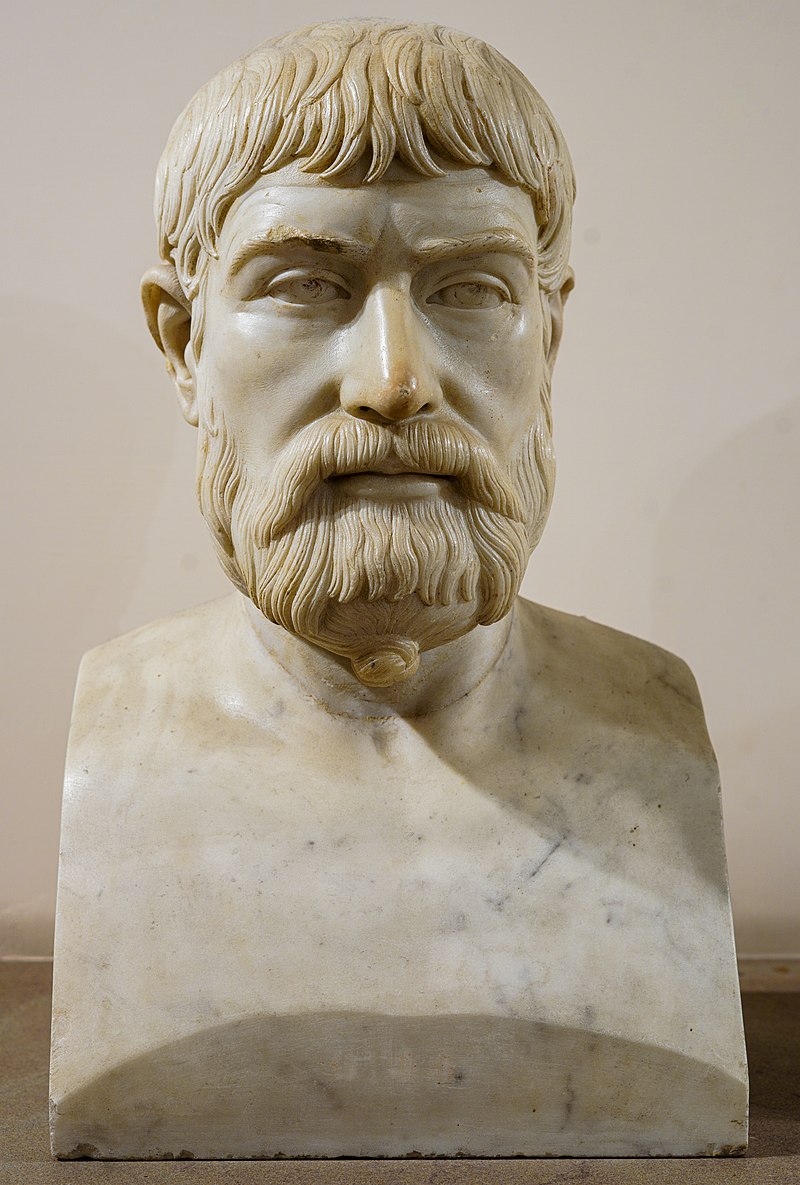
File:Bust_of_Pindar.jpg · Wikimedia Commons · See Wikimedia Commons
Pindar
Sign in to saveAlso known as Pindarus, Pindaros, Dircæan Swan
Pindar (; ; ; ) was an Ancient Greek lyric poet from Thebes. Of the canonical nine lyric poets of ancient Greece, his work is the best preserved. Quintilian wrote, "Of the nine lyric poets, Pindar is by far the greatest, in virtue of his inspired magnificence, the beauty of his thoughts and figures, the rich exuberance of his language and matter, and his rolling flood of eloquence, characteristics which, as Horace rightly held, make him inimitable." His poems can also, however, seem difficult and even peculiar. The Athenian comic playwright Eupolis once remarked that they "are already reduced
OverviewAI-generated
Pindar was a male poet, mythographer, and writer who wrote in Ancient Greek and Aeolic Greek. He was a citizen of the Boeotian confederation and belonged to the Greek ethnic group. His native language was Aeolic Greek, and he is described by sources including the Encyclopædia Britannica 11th edition, the Brockhaus and Efron Encyclopedic Dictionary, and The Nuttall Encyclopædia. His name in his native language is Πίνδαρος.
He was born around 522 BC and died around 443 BC. Pindar’s notable work is the Victory Odes. Other works attributed to him include Sentenzen, The odes of Pindar tr. into English metre, Les Olympiques de Pindare, Odas, and Pindari Olympia, Pythia, Nemea, Isthmia. He is associated with the significant place of Thebes.
Synthesized by Vinony from 19 facts across 3 sources: Wikidata, Open Library, Europeana Sparql. Generated from structured data (not the Wikipedia text) and checked against those facts — may still contain errors.
Person · Open Library
- Born
- ca. 522 BC
- Died
- ca. 443 BC
- Works
- 373
Top works
- Sentenzen
- The odes of Pindar tr. into English metre
- Les Olympiques de Pindare
- Odas
- Pindari Olympia, Pythia, Nemea, Isthmia
via Open Library + Wikidata
Key facts
- Writer.image
- Bust of Pindar.jpg
- Writer.image_upright
- 0.9
- Writer.caption
- Pindar, Roman copy of Greek 5th century BC bust (Museo Archeologico Nazionale, Naples)
- Writer.native_name
- Πίνδαρος
- Writer.native_name_lang
- grc
- Writer.birth_place
- Cynoscephalae, Boiotia
- Writer.death_date
- (aged approximately 80)
- Writer.death_place
- Argos
- Writer.occupation
- Lyric poet
- Writer.genre
- Poetry
via Wikipedia infobox
Wikidata facts
- Instance of
- human
- Gender
- male
- Citizenship
- Boeotian confederation
- Occupation
- writer
- Languages spoken
- Aeolic Greek
- Native language
- Aeolic Greek
- Notable work
- Victory Odes
- Field of work
- poetry
- Image
- Pindar statue.jpg
Show 10 more facts
- Commons category
- Pindar
- Commons Creator page
- Pindar
- topic's main category
- Category:Pindar
- ethnic group
- Greeks
- writing language
- Ancient Greek
- name in native language
- Πίνδαρος
- date of birth
- 0517-00-00
- date of death
- 0450-00-00
- P12749
- Josef Stübben
- significant place
- Thebes
Sources (3)
via Wikidata · CC0
Works in European collections
34 objects attributed to Pindar, held across European museums, libraries & archives · via Europeana

Pindari Carmen Primum In Psaumidem Sive Olympicorum Quartum Cum Commentarii Specimine

Pindari Olympia, Pythia, Nemea, Isthmia :Graece & Latine
![Aristologia Pindarica Graecolatina: Hoc est, quicquid est in Pindaro, uate ut uetustißimo, ita quoq [ue] castißimo & sapientißimo, memorabile... obuium... = Aristologia Pindarikē Hellenikolatinē](https://api.europeana.eu/thumbnail/v2/url.json?uri=http%3A%2F%2Fwww.bsb-muenchen-digital.de%2Fweb1126%2Fbsb11264163%2Fimages%2Fbsb11264163_00009.jpg&type=IMAGE)
Aristologia Pindarica Graecolatina: Hoc est, quicquid est in Pindaro, uate ut uetustißimo, ita quoq [ue] castißimo & sapientißimo, memorabile... obuium... = Aristologia Pindarikē Hellenikolatinē

Panta ta Pindaru .... 1

Pindari Carmina quae supersunt :cum deperditorum fragmentis selectis. 2, Commentarius
Pindarou. Olympia. Pythia. Nemea. Isthmia. Kallimachou hymnoi, hoi heuriskomenoi. Dionysiou periēgēsis Lykophronos alexandra, to skoteinon poiēma. Pindari. Olympia. Pythia. Nemea. Isthmia. Callimachi hymni qui inueniuntur. Dionysius de situ orbis, Licophronis Alexandra, obscurum poema

Pindarus

Pindarus

Pindarus

Pindarus

Pindarus
Pindari Carmina [Printed Text]:] cum lectionis varietate et adnotationibus
Pindari poetae vetustissimi, lyricorum facile principis, Olympia, Pythia, Nemea, Isthmia [Texto impreso]
Pindari Olympia, Pythia, Nemea, Isthmia [Texto Pin]:] caeterorum octo lyricorum carmina, Alcaei, Sapphus, Stesiehori, Ibici, Anacreontis, Bacchilidis, Simonidis, Alemanis, nonnulla etiam aliorum, omnia graece & latine, Pindari interpretatio noua est, eaque ad verbum, caeteri partim ad verbum, partim carmine sunt redditi

Carmina Quae Supersunt Cum Deperditorum Fragmentis Selectis Ex Recensione Boeckhii Commentario Perpetuo Illustravit Ludolphus Dissenius, Professor Gottingensis

Le Odi. Traduzione Di Giuseppe Borghi Riveduta E Corretta Dal Traduttore

Pindari Carmina Ex Interpretatione Latina Emendatiore. Cvravit Christian. Gottlob Heyne

Odi
Tutte le opere

Werke, Urschrift, Übersetzung in den Pindarischen Versmaaßen und Erläuterungen. Th. 1

Carmina :cum lectionis varietate et adnotationibus. 1

Pindari Carmina

Pindar's Siegesgesaenge :mit Prolegomenis ueber Pindarische Kolometrie und Textkritik. 1, Olympische Siegesgesänge : griechisch und deutsch

Pindari Carmina :cum lectionis varietate et adnotationibus. 2,2, Scholia In Pythia Nemea Et Isthmia

An attempt at a prosaic translation of the Greek songs of Pindar. 1, 1 The Olympic victory songs in themselves

Pindari Carmina :cum lectionis varietate et adnotationibus. 2,1, Interpretatio Latina Et Scholia In Olympia : Vetera Et Recentia

Pindari Carmina :cum lectionis varietate et adnotationibus. 1

Pindari Opera quae supersunt. 2,2

Pindari Carmina

Pindaru Periodos hoc est Pindari Lyricorum Principis, Plus Quam Sexcentis In Locis emaculati ... Olympionikai. Pythionikai. Nemeonikai. Isthmionikai Illustrati :Versione nova fideli. Rationis metricae indicatione certa.Ddispositione textus genuina. Commentatio sufficiente ...
![Olympionikai, Pythionikai, Nemeonikai, Isthmionikai. [2], Pythionikai](https://api.europeana.eu/thumbnail/v2/url.json?uri=http%3A%2F%2Fwww.bsb-muenchen-digital.de%2Fweb1047%2Fbsb10476272%2Fimages%2Fbsb10476272_00005.jpg&type=IMAGE)
Olympionikai, Pythionikai, Nemeonikai, Isthmionikai. [2], Pythionikai

Pindari Opera quae supersunt. 2,1

Pindari Carmina quae supersunt :cum deperditorum fragmentis selectis. 1, Carmina : cum annnatatione critica

Carmina :cum lectionis varietate et adnotationibus. 3,1, Carminum Pindaricorum fragmenta et Godofredi Hermanni Dissertationes Pindaricae
~50 min read
Encyclopedic overview
23 sectionsContents
- Biography
- Sources
- Life
- Infancy to adulthood
- Middle age
- Old age and death
- Post mortem
- Values and beliefs
- Works
- Victory odes<!--linked from 'Loeb Classical Library'-->
- Style
- Structure
- Chronological order
- Manuscripts, shreds and quotes
- Influence and legacy
- Horace's tribute
- Bowra's tribute
- See also
- Notes
- References
- Sources
- Further reading
- External links
Pindar (; ; ; ) was an Ancient Greek lyric poet from Thebes. Of the canonical nine lyric poets of ancient Greece, his work is the best preserved. Quintilian wrote, "Of the nine lyric poets, Pindar is by far the greatest, in virtue of his inspired magnificence, the beauty of his thoughts and figures, the rich exuberance of his language and matter, and his rolling flood of eloquence, characteristics which, as Horace rightly held, make him inimitable." His poems can also, however, seem difficult and even peculiar. The Athenian comic playwright Eupolis once remarked that they "are already reduced to silence by the disinclination of the multitude for elegant learning". Some scholars in the modern age also found his poetry perplexing, at least until the 1896 discovery of some poems by his rival Bacchylides; comparisons of their work showed that many of Pindar's idiosyncrasies are typical of archaic genres rather than of only the poet himself. His poetry, while admired by critics, still challenges the casual reader and his work is largely unread among the general public.
Pindar was the first Greek poet to reflect on the nature of poetry and on the poet's role. His poetry illustrates the beliefs and values of Archaic Greece at the dawn of the Classical period. Like other poets of the Archaic Age, he has a profound sense of the vicissitudes of life, but he also articulates a passionate faith in what men can achieve by the grace of the gods, most famously expressed in the conclusion to one of his Victory Odes:
Excerpted from Wikipedia’s “Pindar” article, available under the CC BY-SA 4.0 licence.
Gallery (10)
Available in 68 languages
- Español
- Français
- Deutsch
- 中文
- 日本語
- Русский
- Português
- Italiano
- العربية
- Albanian
- Albanian
- Aragonese
- Armenian
- Azerbaijani
- Bahasa Indonesia
- Basque
- be_x_old
- Belarusian
Show 49 more
- Breton
- Bulgarian
- Catalan
- Central Kurdish
- Croatian
- Czech
- Danish
- Egyptian Arabic
- Esperanto
- Estonian
- Extremaduran
- Filipino
- Finnish
- Galician
- Georgian
- Greek
- Hebrew
- Hungarian
- Icelandic
- Ido
- Interlingua
- Kazakh
- Latin
- Latvian
- Lithuanian
- Macedonian
- Malayalam
- Nederlands
- Norwegian
- Occitan
- Piedmontese
- Polski
- Pontic
- Romanian
- Serbian
- Serbian (Latin)
- Sicilian
- simple
- Slovak
- Svenska
- Tiếng Việt
- Türkçe
- Ukrainian
- Waray
- Welsh
- Wu Chinese
- zh_yue
- فارسی
- 한국어
via Wikidata sitelinks · CC0