Category
page 1Earth goddesses

Demeter
In ancient Greek religion and mythology, Demeter (; Attic: Dēmḗtēr ; Doric: Dāmā́tēr) is the Olympian goddess of the harvest and agriculture, presiding over crops, grains, food, and the fertility of the earth. Although Demeter is mostly known as a grain goddess, she also appeared as a goddess of health, birth, and marriage, and had connections to the Underworld. She is also called Deo ( Dēṓ).
.JPG)
Persephone
In ancient Greek mythology and religion, Persephone ( ; , classical pronunciation: ), also called Kore () or Cora, is the daughter of Zeus and Demeter. She became the queen of the underworld after her abduction by her uncle Hades, the king of the underworld, who later took her into marriage. The myth of her abduction, her sojourn in the underworld, and her cyclical return to the surface represents her functions as the embodiment of spring and the personification of vegetation, especially grain crops, which disappear into the earth when sown, remain hidden for a period, sprout from the earth, a

Gaia
In Greek mythology, Gaia (; , a poetic form of (''''), meaning 'land' or 'earth'), also spelled Gaea (), is the personification of Earth. She is the mother of Uranus (Sky), with whom she conceived the Titans (themselves parents of many of the Olympian gods), the Cyclopes, and the Giants, as well as of Pontus (Sea), from whose union she bore the primordial sea gods. Her equivalent in the Roman pantheon was Terra.

Rhea
female Titan in Greek mythology, mother of Zeus and mother of Hera
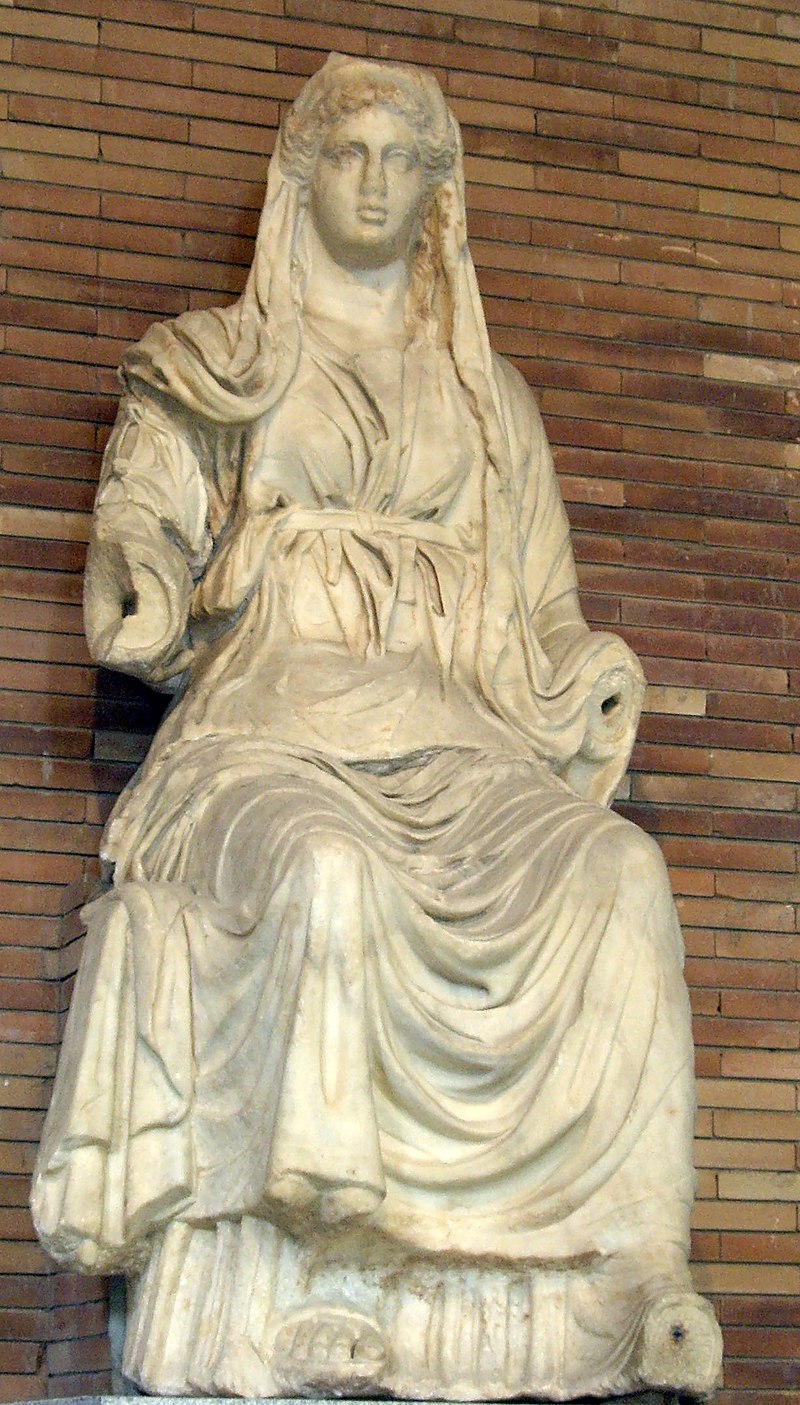
Ceres
Roman goddess of agriculture

mother goddess
goddess who represents or is a personification of nature, motherhood, fertility, creation
Terra
personification of the Earth in ancient Roman religion and mythology

Pachamama
Pachamama () or Mama Pacha () is the Andean deity representing space-time, revered by the peoples of the Andes. In Inca mythology and religion, she is a "mother goddess" type deity, representing the universal energy that connects everything. She is considered an omnipresent deity with creative power, capable of sustaining life in the cosmos. Her shrines are hallowed rocks, or the boles of legendary trees, and her artists envision her as a woman bearing harvests of potatoes or coca leaves. The four cosmological Quechua principlesWater, Earth, Sun, and Moonclaim Pachamama as their prime origin.

Prithvi
Prithvi (Sanskrit: पृथ्वी, ', also पृथिवी, ', "the Vast One", also rendered Pṛthvī Mātā), is the Sanskrit name for the Earth, as well as the name of the goddess-personification of it in Hinduism. The goddess Prithvi is an archetypal Mother Goddess, and one of the most important goddesses in the historical Vedic religion.

Sif
thumb|The goddess Sif holds her long, golden hair while grain grows behind her in an illustration from 1897
In Norse mythology, Sif is a golden-haired goddess associated with earth. Sif is attested in the Poetic Edda, compiled in the 13th century from earlier traditional sources, and the Prose Edda, written in the 13th century by Snorri Sturluson, and in the poetry of skalds. In both the Poetic Edda and the Prose Edda, she is known for her golden hair and is married to the thunder god Thor.

Jörð
thumb|alt=Stone statue of a seated female figure with two children on her lap|Moder Jord (Mother Earth) by Stephan Sinding
Jörð (), also named Fjorgyn or Hlodyn, is the personification of Earth and a goddess in Norse mythology. She is the mother of the thunder god Thor and a sexual partner of Odin. Jörð is attested in Danish history , composed in the 12th century by Danish historian Saxo Grammaticus; the Poetic Edda, compiled in the 13th century by an unknown individual or individuals; and the Prose Edda, also composed in the 13th century. Her name is often employed in skaldic poetry and kenni

Mokosh
Mokosh ( ) is a Slavic goddess. No narratives about this deity have survived: Mokosh was mentioned in various sermons (called Words and Teachings) against Paganism along with the vilas, but is not described by them, and all modern desriptions are reconstructions.

Gerðr
thumb|''Skirnir's Message to Gerd'' (1908) by W. G. Collingwood.
Mother Nature
personification of Earth's environment

Ops
In ancient Roman religion, Ops, (Latin: "Plenty") also spelled Opes or Opis, was a fertility and earth goddess of abundance, prosperity, and agriculture, and the consort of Saturn. As Ops Consiva, she presided over the reserved portion of the harvest alongside Consus, the god of stored grain. She was celebrated during two yearly festivals: Opiconsivia in August and Opalia in December.
Bhūmi
Hindu goddess representing Mother Earth
Ki
babylonian goddess
Danu
deity in Celtic mythology
.jpg)
Tlazolteotl
thumb|From the Codex Borbonicus, this shows the 13th [[trecena of the Aztec sacred calendar (tonalpohualli). The deity Tlazolteotl is wearing a flayed human skin and giving birth to Cinteotl. The 13 day-signs of this trecena, starting with 1 Earthquake, begin at the bottom left and wrap around.]]
In Aztec mythology, Tlahzolteōtl (or , ) is a deity of sex, sexuality, lust, carnality, sin, vice, impurity, temptation, fertility, purification, absolution, steam baths, and a patroness of adulterers. She is known by three names, ("she who eats or filthy excrescence [sin]") and ("the death caused by
Diti
Diti () is a daughter of the Prajapati Daksha in Hinduism. She is a wife of the sage Kashyapa and the mother of the demonic race Daityas and the divine group of Marutas.
Ila
androgyne in Hindu mythology
Rangi and Papa
primordial parents in Māori mythology
Kishar
In the Babylonian epic Enuma Elish, Kishar () is the daughter of Lahamu and Lahmu, the first children of Tiamat and Abzu. She is the female principle, sister and wife of Anshar, the male principle, and the mother of Anu. Kishar may represent the earth as a counterpart to Anshar, the sky, and can be seen as an earth mother goddess. Her name also means "Whole Earth".
Triple Goddess
concept in Neopaganism
Antu
Mesopotamian goddess

Toci
thumb|Statue of Toci (Tlazolteotl) from Mexico, 900–1521 CE (British Museum, id:)
Toci is a prominent deity in the religion and mythology of the pre-Columbian Aztec civilization of Mesoamerica.

Erecura
right|thumb|220px|Map showing the location of inscriptions to this goddess, under various spellings.
thumb|Figurine dating from the 2nd or 3rd century A. D. found in Stuttgart, Germany
Erecura or Aerecura (also found as Herecura or Eracura) was a goddess worshipped in ancient times, often thought to be Celtic in origin, mostly represented with the attributes of Proserpina and associated with the Roman underworld god Dis Pater, as on an altar from Sulzbach. She appears with Dis Pater in a statue found at Oberseebach, Switzerland, and in several magical texts from Austria, once in the company of
Iusaaset
Iusaaset, Iusaas, or, in Greek, Saosis, is a primordial goddess in Ancient Egyptian religion, a feminine counterpart to the male creator deity Atum. Iusaaset was depicted as a woman with a scarab beetle on her head. She was worshipped in the city of I͗wnw or Iunu, Greek Heliopolis, as was Atum. Iusaaset was associated with the acacia tree and acacias stood at the sanctuary dedicated to Iusaaset at Heliopolis.

Arinna
thumb|Relief of the Sun-Goddess of Arinna in Alaca Höyük
Phra Mae Thorani
Earth goddess of Buddhist mythology
Žemyna
Žemyna (also Žemynėlė or Žemelė) (from – earth) is the goddess of the earth in Lithuanian religion. She is usually regarded as mother goddess and one of the chief Lithuanian gods similar to Latvian Zemes māte. Žemyna personifies the fertile earth and nourishes all life on earth, human, plant, and animal. All that is born of earth will return to earth, thus her cult is also related to death. As the cult diminished after baptism of Lithuania, Žemyna's image and functions became influenced by the cult of Virgin Mary.
Urash
Uraš (), or Urash, was a Mesopotamian goddess regarded as the personification of the earth. She should not be confused with a male deity sharing the same name, who had agricultural character and was worshiped in Dilbat. She is well attested in association with Anu, most commonly as his spouse, though traditions according to which she was one of his ancestors or even his alternate name are also known. She could be equated with other goddesses who could be considered his wives, namely Ki and Antu, though they were not always regarded as identical. Numerous deities were regarded as children of Ur
Mefitis
In Roman mythology, Mefitis (or Mephitis; Mefite in Italian) was a goddess of Italic origins primarily worshipped by the Samnites and Osci in southern Italy. Mefitis was associated with water— particularly foul-smelling or sulfurous water— and noxious fumes. Her main temple was situated near Lake Ampsanctus, which was described as deadly by Cicero and Pliny. The temple itself was reported to contain poisonous gas that killed anyone who entered, and Virgil described it as an entrance to the underworld.
Houtu
Hòutǔ () or Hòutǔshén (), also known as Hòutǔ Niángniáng (in Chinese either , Aoshen or ), otherwise called Dimǔ () or Dimǔ Niángniáng (), is the deity of all land and earth in Chinese religion and mythology. Houtu is the overlord of all the Tudigongs ("Lord of Local Land"), Sheji ("the State"), Shan Shen ("God of Mountains"), City Gods ("God of Local City"), and landlord gods worldwide.
Mat Zemlya
Slavic mother goddess
Atira
Mother goddess of the Native American Pawnee
Spenta Armaiti
female divine entity in Zoroastrianism

Nantosuelta
thumb|A depiction of Nantosuelta from Speyer, showing her distinctive sceptre and birds. The head of Sol can be seen in the tympanum.
In Celtic mythology, Nantosuelta is the goddess of nature, the earth, fire, and fertility.
Ala
Ordinani deity
Spandaramet
Spandaramet () or Sandaramet (Սանդարամետ) was the Armenian name of the Zoroastrian yazata (angelic divinity) Spenta Armaiti, one of the six Amesha Spentas, and the guardian of the earth.

Amalur
thumb|Amalur
Amalur or Ama Lurra (Basque for "Mother Earth"), is the mother of Ekhi, the sun, and Ilazki, the moon, in Basque mythology. She is the home not only of living beings, but also of mythological creatures, divinities and souls. Amalur (Mother Earth) sustains the life of plants and animals. She holds amazing treasures in her bosom.
Njörun
In Norse mythology, Njörun (Old Norse: Njǫrun , sometimes modernly anglicized as Niorun) is a goddess attested in the Prose Edda, written in the 13th century by Snorri Sturluson, and various kennings (including once in the Poetic Edda). Scholarly theories concerning her name and function in the pantheon include etymological connections to the Norse god Njörðr and the Roman goddess Nerio, and suggestions that she may represent the earth or be the unnamed sister-wife of Njörðr.

Māra
Māra is the highest-ranking goddess in Latvian mythology, the ancient Dawn-goddess, previously called Austra, and, not at all, although often stated, the same as Zemes māte (Mother Earth, pace).

Etügen Eke
Mongolian Earth goddess

Vasudhārā
Vasudhārā whose name means "stream of gems" in Sanskrit, also known as "Gold Tara", is the Buddhist goddess of wealth, prosperity, and abundance. Her popularity peaks in Nepal where she has a strong following among the Buddhist Newars of the Kathmandu Valley and is thus a central figure in Newar Buddhism. She is one of the most popular goddesses worshipped in many Buddhist countries and is a subject of Buddhist legends and art.
Asase Ya
Goddess of fertility
Leimalel Sitapi
meitei earth Goddess
Spider Grandmother
figure in native American mythology
Papahanaumoku
In the religion and mythology of the ancient Hawaiians, Papahānaumoku () — often simply called Papa — is a goddess and the Earth Mother. She is mentioned in the chants as the consort of the sky god Wākea. Their daughter is beautiful goddess Hoʻohōkūkalani, the main character of one myth. Papa is still worshipped by some Hawaiians, especially by women, as a primordial force of creation who has the power to give life and to heal. The Northwestern Hawaiian Islands Marine National Monument was renamed in 2007 to the Papahānaumokuākea Marine National Monument, in honour of Papa.
earth goddess
deification of the Earth
Tonantzin
thumb|Stone figure of Tonatzin found at the Museo Nacional de las Intervenciones, [[Mexico City]]
Tonantzin ( ) is a Nahuatl title composed of to- "our" + nān "mother" + -tzin "(honorific suffix)". When addressing Tonantzin directly, men use the suffixed vocative form Tonāntziné [], and women use the unsuffixed vocative form Tonāntzín [].
Litavis
frame|right|Latin inscription reading DEO MARTI CICOLLUI ET LITAVI ('To Mars Cicolluos and Litavis').Litavis (Gaulish: Litauī 'Earth', lit. 'the Broad One') is a Gallic deity whose cult is primarily attested in east-central Gaul during the Roman period, where she mainly appears as the consort of Mars Cicolluis. She was probably originally an earth-goddess.'' The divine pair Mars Cicolluis–Litavis was likely associated with fertile and nourishing land, an interpretation supported by the meanings of both divine names. In medieval Celtic languages, various terms derived from the name *Litauia'' (
Papa
earth mother in Māori mythology
Dhéǵhōm
Dheghom ( or ; lit. 'earth'), or '''''' (PIE: , lit. the 'Broad One'), is the reconstructed name of the Earth-goddess in the Proto-Indo-European mythology.
Cel
Etruscan goddess of the Earth
Babalon
Babalon (also known as the Scarlet Woman, Great Mother or Mother of Abominations) is a goddess found in the occult system of Thelema, which was established in 1904 with the writing of The Book of the Law by English author and occultist Aleister Crowley. The spelling of the name as "Babalon" was revealed to Crowley in The Vision and the Voice. Her name and imagery feature prominently in Crowley's "Liber Cheth vel Vallum Abiegni".
E Bukura e Dheut
character in Albanian folklore, a crafty fairy.
Ma
Sumerian goddess
Amy Carlson
American cult leader
Artimpasa
Artimpasa (; ) was a complex androgynous Scythian goddess of fertility who possessed power over sovereignty and the priestly force. Artimpasa was the Scythian variant of the Iranian goddess Arti/Aṣ̌i.