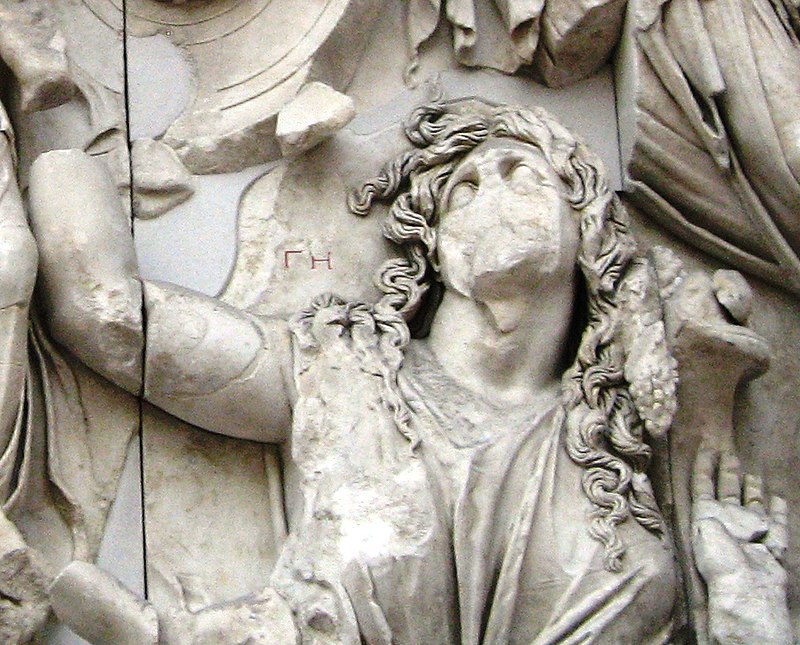
File:Pergamonmuseum_-_Antikensammlung_-_Pergamonaltar_13_detail.jpg · Wikimedia Commons · See Wikimedia Commons
Gaia
Sign in to saveAlso known as Gaea, Ge
In Greek mythology, Gaia (; , a poetic form of (''''), meaning 'land' or 'earth'), also spelled Gaea (), is the personification of Earth. She is the mother of Uranus (Sky), with whom she conceived the Titans (themselves parents of many of the Olympian gods), the Cyclopes, and the Giants, as well as of Pontus (Sea), from whose union she bore the primordial sea gods. Her equivalent in the Roman pantheon was Terra.
In Greek mythology, Gaia is the personification of Earth and the mother of many important divine beings, including Uranus (Sky), the Titans, the Cyclopes, and the Giants. She matters because she represents the foundational creative force in Greek mythology, giving birth to the major gods and cosmic powers that populate their religious stories.
AI-generated from the Wikipedia summary — may contain errors.
Key facts
- Deity.type
- Greek
- Deity.name
- Gaia
- Deity.deity_of
- Personification of the Earth
- Deity.image
- Pergamonmuseum - Antikensammlung - Pergamonaltar 13 detail.jpg
- Deity.caption
- Gaia pleading for her sons the Gigantes (Giants), detail of the Gigantomachy frieze, Pergamon Altar, Pergamon museum, Berlin
- Deity.other_names
- GeGaeaChthon
- Deity.script_name
- Greek
- Deity.script
- ,
- Deity.consort
- Uranus
- Deity.parents
- None (Hesiod)
- Deity.offspring
- Uranus, Pontus, the Ourea, the Hecatonchires, the Cyclopes, the Titans, the Gigantes, Nereus, Thaumus, Phorcys, Ceto, Eurybia, Tritopatores, Typhon
- Deity.Roman_equivalent
- Terra
- Deity.symbol
- Fruit
via Wikipedia infobox
Wikidata facts
Show 8 more facts
- Commons category
- Gaia
- worshipped by
- Greek mythology
- domain of saint or deity
- fertility
- topic's main category
- Category:Gaia
- described by source
- Pauly–Wissowa
- unmarried partner
- Helios
- name in native language
- Γαία
- on focus list of Wikimedia project
- Wikipedia:Vital articles/Level/4
via Wikidata · CC0
~27 min read
Encyclopedic overview
20 sectionsContents
- Etymology
- Description
- Mythology
- Hesiod
- Birth of Gaia, Uranus, and the Titans
- Other offspring and the castration of Uranus
- Titanomachy
- Other sources
- Cult
- Epithets
- Temples
- Interpretations
- Modern paganism
- Family
- Olympian descendants
- Offspring
- See also
- Notes
- References
- External links
In Greek mythology, Gaia (; , a poetic form of (''''), meaning 'land' or 'earth'), also spelled Gaea (), is the personification of Earth. She is the mother of Uranus (Sky), with whom she conceived the Titans (themselves parents of many of the Olympian gods), the Cyclopes, and the Giants, as well as of Pontus (Sea), from whose union she bore the primordial sea gods. Her equivalent in the Roman pantheon was Terra.
==Etymology== The Greek name (Gaia or ) is a mostly epic, collateral form of Attic (Gē ), and Doric (Ga ), perhaps identical to (Da ), both meaning "Earth". Some scholars believe that the word is of uncertain origin. Beekes suggested a probable Pre-Greek origin. M.L. West derives the name from the Indo-European form *dʰéǵʰōm (earth). Greek: gaia (She lay with Heaven and bore deep-swirling Oceanus, Coeus and Crius and Hyperion and Iapetus, Theia and Rhea, Themis, and Mnemosyne and gold-crowned Phoebe and lovely Tethys. After them was born Cronos (Cronus) the wily, youngest, and most terrible of her children, and he hated his lusty sire.
Excerpted from Wikipedia’s “Gaia” article, available under the CC BY-SA 4.0 licence.
Gallery (10)
Available in 81 languages
- Español
- Français
- Deutsch
- 中文
- 日本語
- Русский
- Português
- Italiano
- العربية
- Afrikaans
- Armenian
- Assamese
- Asturian
- Azerbaijani
- Bahasa Indonesia
- Bangla
- Bashkir
- Basque
Show 62 more
- Bavarian
- Belarusian
- Bosnian
- Breton
- Bulgarian
- Catalan
- Central Kurdish
- Cherokee
- Chuvash
- Croatian
- Czech
- Danish
- Egyptian Arabic
- Esperanto
- Estonian
- Filipino
- Finnish
- Galician
- Georgian
- Greek
- Hebrew
- Hungarian
- Icelandic
- Ido
- Irish
- Kazakh
- Kurdish
- Latin
- Latvian
- Lithuanian
- Luxembourgish
- Macedonian
- Malay
- Manipuri
- Nederlands
- Norwegian
- Norwegian Nynorsk
- Occitan
- Polski
- Punjabi
- Romanian
- Scots
- Serbian
- Serbian (Latin)
- simple
- Slovak
- Slovenian
- Svenska
- Tajik
- Tamil
- Tatar
- Tiếng Việt
- Türkçe
- Ukrainian
- Uzbek
- Veps
- Waray
- Wu Chinese
- zh_yue
- فارسی
- ไทย
- 한국어
via Wikidata sitelinks · CC0