Category
page 1Eclipses
solar eclipse
natural phenomenon wherein the Sun is obscured by the Moon

Lunar eclipse
A lunar eclipse, also called a blood moon, is an astronomical event that occurs when the Moon orbits through Earth's shadow. Lunar eclipses occur during eclipse season, when the Moon's orbital plane is approximately in line with Earth and the Sun. The type and length of a lunar eclipse depend on the Moon's proximity to the lunar node.

eclipse
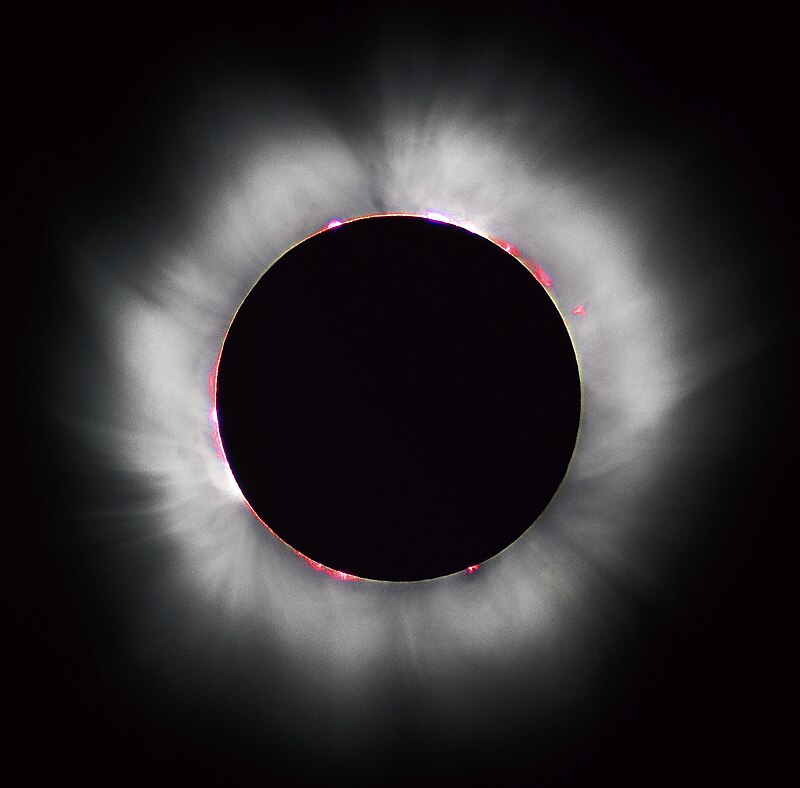
thumb|Totality during the solar eclipse of August 11, 1999, showing the [[solar corona and prominences]]
thumb|The lunar umbra on Earth during the solar eclipse of August 21, 2017, as seen from space

saros series
series of eclipses separated by a saros period

syzygy
straight-line configuration of three celestial bodies in astronomy

Rahu
thumb|The Planet Rahu and other Astral Figures, painting by the Mahesh of Chamba (fl. c. 1730 - 1770). [[Rietberg Museum]]
Rāhu (Sanskrit: राहु, 16px|☊) is one of the nine major celestial bodies (navagraha) in Hindu texts and the king of meteors. It represents the ascension of the Moon in its precessional orbit around the Earth, also referred to as the north lunar node, and along with Ketu, is a "shadow planet" that causes eclipses. Despite having no physical existence, Rahu has been allocated the status of the planet by ancient seers owing to its strong influence in astrology.
Baily's beads
feature of total and annular solar eclipses
Ketu
Hindu deity representing descending lunar node
magnitude of eclipse
fraction of the diameter of the eclipsed body which is in eclipse
eclipse cycle
intervals of eclipses
Svarbhānu
Svarbhānu () is an asura traditionally held responsible for solar eclipses and lunar eclipses in Vedic mythology. The name is also used as an attribute of the asuras Rahu and Ketu in Puranic mythology, who are also connected to the solar eclipse and the lunar eclipse.
exeligmos
An exeligmos () is a period of 54 years, 33 days that can be used to predict successive eclipses with similar properties and location. For a solar eclipse, after every exeligmos a solar eclipse of similar characteristics will occur in a location close to the eclipse before it. For a lunar eclipse the same part of the earth will view an eclipse that is very similar to the one that occurred one exeligmos before it (see main text for visual examples). The exeligmos is an eclipse cycle that is a triple saros, three saroses (or saroi) long, with the advantage that it has nearly an integer number of
Tiangou
thumb|Tiangou from the Shan Hai Jing
The tiangou () is a legendary creature from China. The tiangou resembles a black dog or meteor, and is thought to eat the Sun or Moon during an eclipse.

Eclipse season
Period when eclipses can occur
inex
The inex (plural inexes) is an eclipse cycle of 10,571.95 days (about 29 years minus 20 days). The cycle was first described in modern times by Crommelin in 1901, but was named by George van den Bergh who studied it in detail half a century later. One inex after an eclipse of a particular saros series there will be an eclipse in the next saros series, unless the latter saros series has come to an end.