File:Solar_eclipse_1999_4.jpg · Wikimedia Commons · See Wikimedia Commons
eclipse
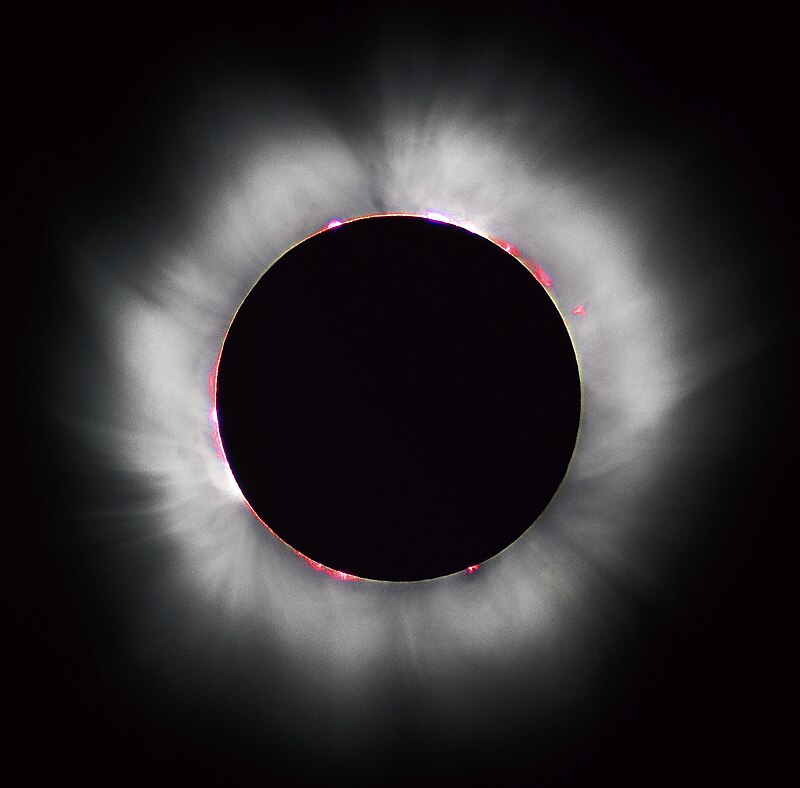
Sign in to savethumb|Totality during the solar eclipse of August 11, 1999, showing the [[solar corona and prominences]] thumb|The lunar umbra on Earth during the solar eclipse of August 21, 2017, as seen from space
An eclipse occurs when one celestial body blocks the light from another, such as when the Moon passes in front of the Sun or Earth's shadow falls on the Moon. Eclipses have fascinated people throughout history and provide scientists with valuable opportunities to study celestial phenomena like the Sun's corona and the interactions between Earth, Moon, and Sun.
AI-generated from the Wikipedia summary — may contain errors.
Wikidata facts
- Subclass of
- occurrence
- Image
- The 1919 solar eclipse.jpg
Show 5 more facts
- has effect
- shadow
- topic's main category
- Category:Eclipses
- Commons category
- Eclipses
- Commons gallery
- Eclipse
- on focus list of Wikimedia project
- Wikipedia:Vital articles/Level/4
via Wikidata · CC0
~23 min read
Encyclopedic overview
18 sectionsContents
- Etymology
- Umbra, penumbra and antumbra
- Eclipse cycles
- Earth–Moon system
- Solar eclipse
- Lunar eclipse
- Historical record
- Eclipses in mythology and religion
- Other planets and dwarf planets
- Gas giants
- Mars
- Pluto
- Mercury and Venus
- Eclipsing binaries
- Types
- See also
- References
- External links
thumb|Totality during the solar eclipse of August 11, 1999, showing the [[solar corona and prominences]] thumb|The lunar umbra on Earth during the solar eclipse of August 21, 2017, as seen from space
An eclipse is an astronomical event which occurs when an astronomical object or spacecraft is temporarily obscured, by passing into the shadow of another body or by having another body pass between it and the viewer. This alignment of three celestial objects is known as a . An eclipse is the result of either an (completely hidden) or a (partially hidden). A "deep eclipse" (or "deep occultation") is when a small astronomical object is behind a bigger one.
Excerpted from Wikipedia’s “eclipse” article, available under the CC BY-SA 4.0 licence.
Gallery (42)
Available in 98 languages
- Español
- Français
- Deutsch
- 中文
- 日本語
- Русский
- Português
- Italiano
- العربية
- हिन्दी
- Afrikaans
- Albanian
- Aragonese
- Aramaic
- Armenian
- Asturian
- Azerbaijani
- Bahasa Indonesia
Show 79 more
- Bangla
- Banjar
- Basque
- be_x_old
- Belarusian
- Betawi
- Bhojpuri
- Bikol
- blk
- Breton
- Bulgarian
- Burmese
- Catalan
- cbk_zam
- Central Kurdish
- Croatian
- Esperanto
- Estonian
- Filipino
- Finnish
- Galician
- Greek
- Hebrew
- Ido
- Igbo
- Irish
- Jamaican Creole English
- Javanese
- Kannada
- Kazakh
- Kyrgyz
- Lao
- Latin
- Latvian
- Lithuanian
- Lombard
- Macedonian
- Malagasy
- Malay
- Malayalam
- Maltese
- Marathi
- mnw
- Neapolitan
- Nederlands
- Nepali
- Newari
- Norwegian
- Norwegian Nynorsk
- Polski
- Punjabi
- Romanian
- Sanskrit
- Scots
- Serbian
- Serbian (Latin)
- Sicilian
- simple
- Slovak
- Slovenian
- Sundanese
- Svenska
- Tajik
- Tamil
- Telugu
- Tiếng Việt
- Türkçe
- Ukrainian
- Urdu
- Uzbek
- Venetian
- Walloon
- Waray
- Western Frisian
- Wu Chinese
- zh_yue
- فارسی
- ไทย
- 한국어
via Wikidata sitelinks · CC0