Category
page 1Electrophysiology

action potential
process by which neurons communicate with each other by changes in their membrane potentials.

electroencephalography
Electroencephalography (EEG)
is a method to record an electrogram of the spontaneous electrical activity of the brain. The bio signals detected by EEG have been shown to represent the postsynaptic potentials of pyramidal neurons in the neocortex and allocortex. It is typically non-invasive, with the EEG electrodes placed along the scalp (commonly called "scalp EEG") using the International 10–20 system, or variations of it. Electrocorticography, involving surgical placement of electrodes, is sometimes called "intracranial EEG". EEG is widely used both as a clinical diagnostic tool, particularl

electrocardiography
thumb|Use of monitoring (medicine)|real time monitoring of the heart in an [[intensive care unit in a German hospital (2015), the monitoring screen above the patient displaying an electrocardiogram and various values of parameters of the heart like heart rate and blood pressure]]
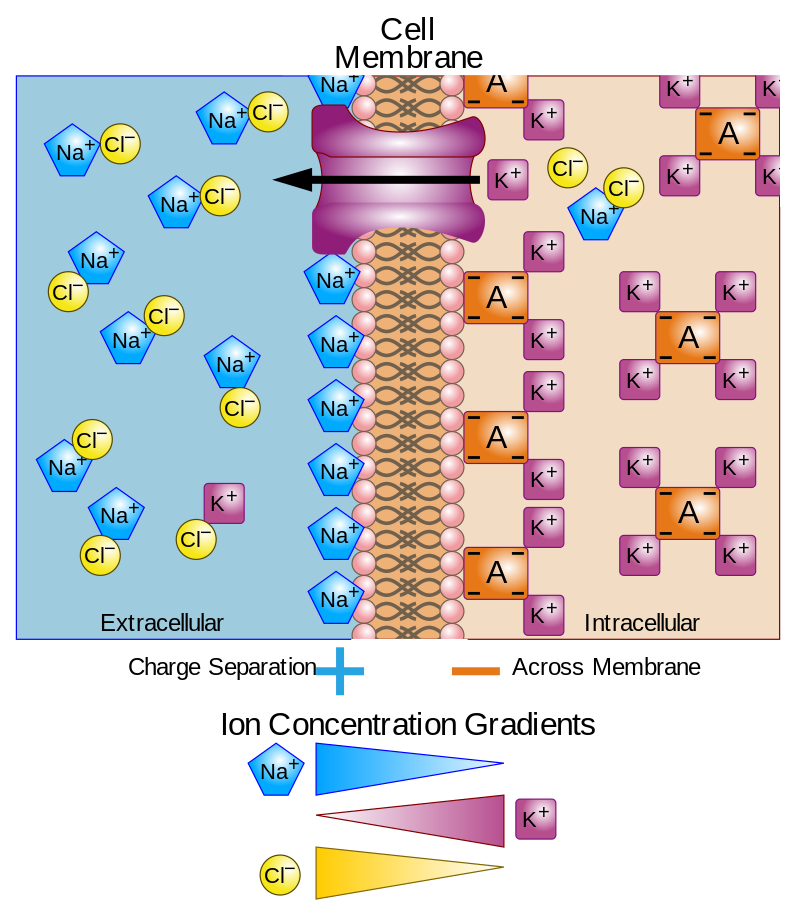
membrane potential
type of physical quantity
ion channel complex
pore-forming membrane protein that allows the passage of ions through a membrane

electromyography
Electromyography (EMG) is a technique for evaluating and recording the electrical activity produced by skeletal muscles. EMG is performed using an instrument called an electromyograph to produce a record called an electromyogram. An electromyograph detects the electric potential generated by muscle cells when these cells are electrically or neurologically activated. The signals can be analyzed to detect abnormalities, activation level, or recruitment order, or to analyze the biomechanics of human or animal movement. Needle EMG is an electrodiagnostic medicine technique commonly used by neurolo

electrophysiology
Electrophysiology (from [see the etymology of "electron"]; ; and ) is the branch of physiology that studies the electrical properties of biological cells and tissues. It involves measurements of voltage changes or electric current or manipulations on a wide variety of scales from single ion channel proteins to whole organs like the heart. In neuroscience, it includes measurements of the electrical activity of neurons, and, in particular, action potential activity. Recordings of large-scale electric signals from the nervous system, such as electroencephalography, may also be referred to as elec

depolarization
In biology, depolarization or hypopolarization is a change within a cell, during which the cell undergoes a shift in electric charge distribution, resulting in less negative charge inside the cell compared to the outside. Depolarization is essential to the function of many cells, communication between cells, and the overall physiology of an organism.
thumb|right|Action potential in a [[neuron, showing depolarization, in which the cell's internal charge becomes less negative (more positive), and repolarization, where the internal charge returns to a more negative value.]]
Most cells in higher o
ligand-gated ion channel
type of ion channel transmembrane protein
resting potential
The resting membrane potential is relatively stable and can be called as the ground value for transmembrane voltage.
calcium channel complex
ion channel complex through which calcium ions pass
electrochemical gradient
gradient of electrochemical potential, usually for an ion that can move across a membrane
neural oscillation
brainwaves, repetitive patterns of neural activity in the central nervous system
electrooculography
Electrooculography (EOG) is a technique for measuring the corneo-retinal standing potential that exists between the front and the back of the human eye. The resulting signal is called the electrooculogram. Primary applications are in ophthalmological diagnosis and in recording eye movements. Unlike the electroretinogram, the EOG does not measure response to individual visual stimuli.
voltage-gated sodium channel
class of transmembrane protein allowing sodium ions in and out

bioelectromagnetics
Bioelectromagnetics, also known as bioelectromagnetism, is a branch of science studying the interaction between electromagnetic fields and biological entities. Areas of study include electromagnetic fields produced by living cells, tissues or organisms, the effects of man-made sources of electromagnetic fields like mobile phones, and the application of electromagnetic radiation toward therapies for the treatment of various conditions.
potassium channel
ion channel that selectively passes K+
electrical synapse
type of connection between neurons
patch clamp
laboratory technique in electrophysiology used to study ionic currents in individual isolated living cells, tissue sections, or patches of cell membrane
Hodgkin–Huxley model
mathematical model describing how action potentials in neurons are initiated and propagated
hyperpolarization
change in a cell membrane potential causing it to become more negative
bioelectrical impedance analysis
type of analysis
voltage-gated ion channel
group of ion-selective channel proteins that are activated by changes in the electrical membrane potential near the channel
L-type calcium channel
family of transport proteins
theta rhythm
neural oscillatory pattern
skin conductance
property of the human body that causes continuous variation in the electrical characteristics of the skin
mu wave
Synchronized patterns of electrical activity in the part of the brain that controls voluntary movement
electrocorticography
Electrocorticography (ECoG), a type of intracranial electroencephalography (''''''), is a type of electrophysiological monitoring that uses electrodes placed directly on the exposed surface of the brain to record electrical activity from the cerebral cortex. In contrast, conventional electroencephalography (EEG) electrodes monitor this activity from outside the skull. ECoG may be performed either in the operating room during surgery (intraoperative ECoG) or outside of surgery (extraoperative ECoG). Because a craniotomy (a surgical incision into the skull) is required to implant the electrode g
FitzHugh–Nagumo model
describes a prototype of an excitable system (e.g., a neuron)

epithelial sodium channel
group of membrane proteins that facilitate Na⁺ reabsorption across the apical membranes of epithelia in the distal nephron, respiratory and reproductive tracts and exocrine glands of animals

tetanic contraction
muscle contraction in which a skeletal muscle stays full contracted, under voluntary control, until the mind decides to relax it

voltage-gated calcium channel complex
protein complex that forms a transmembrane channel through which calcium ions may pass in response to changes in membrane potential
Reversal potential
in a biological membrane
voltage-gated potassium channel
class of transport proteins
SCN5A
Sodium channel protein type 5 subunit alpha, also known as NaV1.5 is an integral membrane protein and tetrodotoxin-resistant voltage-gated sodium channel subunit. NaV1.5 is found primarily in cardiac muscle, where it mediates the fast influx of Na+-ions (INa) across the cell membrane, resulting in the fast depolarization phase of the cardiac action potential. As such, it plays a major role in impulse propagation through the heart. A vast number of cardiac diseases are associated with mutations in NaV1.5 (see paragraph genetics). SCN5A is the gene that encodes the cardiac sodium channel NaV1.5.
repolarization
thumb|A labeled diagram of an action potential. As seen above, repolarization takes place just after the peak of the action potential, when K+ ions rush out of the cell.
In neuroscience, repolarization refers to the change in membrane potential that returns it to a negative value just after the depolarization phase of an action potential which has changed the membrane potential to a positive value. The repolarization phase usually returns the membrane potential back to the resting membrane potential. The efflux of potassium (K+) ions results in the falling phase of an action potential. The ion
10-20 system
method to describe and apply the location of scalp electrodes
HCN channel
intermembrane proteins
microelectrode
A microelectrode is an electrode used in electrophysiology either for recording neural signals or for the electrical stimulation of nervous tissue. They were first developed by Ida Hyde in 1921. Pulled glass pipettes with tip diameters of 0.5 μm or less are usually filled with 3 molars potassium chloride solution as the electrical conductor. When the tip penetrates a cell membrane the lipids in the membrane seal onto the glass, providing an excellent electrical connection between the tip and the interior of the cell, which is apparent because the microelectrode becomes electrically negative co
N-type calcium channel
protein family
chronaxie
thumb|Rheobase and chronaxie are points defined on the strength-duration curve for stimulus of an excitable tissue.
Chronaxie is the minimum time required for an electric current double the strength of the rheobase to stimulate a muscle or a neuron. Rheobase is the lowest intensity with indefinite pulse duration which just stimulated muscles or nerves. Chronaxie is dependent on the density of voltage-gated sodium channels in the cell, which affect that cell's excitability. Chronaxie varies across different types of tissue: fast-twitch muscles have a lower chronaxie, slow-twitch muscles have a
string galvanometer
instrument that provided the first practical electrocardiogram
amperometry
Amperometry in chemistry is the detection of ions in a solution based on electric current or changes in electric current.
electrodiagnosis
method of diagnosis
receptor potential
biological process
inward-rectifier potassium channel
group of transmembrane proteins that passively transport potassium ions
local field potential
transient electrical signals generated in nervous and other tissues by the summed and synchronous electrical activity of the individual cells in that tissue
Threshold potential
critical potential value
graded potential
changes in membrane potential varying in size
biosignal
300px|thumb|Sample synchronized biosignals from a human subject.
A biosignal is any signal in a living organism that can be continually measured and monitored. The term biosignal is often used to refer to bioelectrical signals, but it may refer to both electrical and non-electrical signals. The usual understanding is to refer only to time-varying signals, although spatial parameter variations (e.g. the nucleotide sequence determining the genetic code) are sometimes subsumed as well.
acid-sensing ion channel
class of transport proteins
Lippmann electrometer
Hexaxial reference system
convention to present the extremity leads of the 12 lead electrocardiogram, that provides an illustrative logical sequence that helps interpretation of the ECG
Electromyoneurography
Electromyoneurography (EMNG) is the combined use of electromyography and electroneurography This technique allows for the measurement of a peripheral nerve's conduction velocity upon stimulation (electroneurography) alongside electrical recording of muscular activity (electromyography). Their combined use proves to be clinically relevant by allowing for both the source and location of a particular neuromuscular disease to be known, and for more accurate diagnoses.
pneumograph
A pneumograph, also known as a pneumatograph or spirograph, is a device for recording velocity and force of chest movements during respiration. While spirometry measures respiratory rate and other markers of respiratory health via analysis of the airflow from the lungs during inhalation and exhalation, pneumography measures the respiratory rate via chest motion.
SCN4A
Sodium channel protein type 4 subunit alpha is a protein that in humans is encoded by the SCN4A gene.
electrotonic potential
passive spread of charge inside a neuron and between cardiac muscle cells or smooth muscle cells
voltage-sensitive dye
dye which changes its spectral properties in response to voltage changes
voltage clamp
Method of measuring biological cell currents
cysteine loop ligand-gated ion channel receptor
class of transport proteins