Category
page 1Electrostatics

electric charge
physical property that quantifies an object's interaction with electric fields

André-Marie Ampère
French physicist and mathematician (1775–1836)

electric field
spatial distribution of vectors representing the force applied to a charged test particle

electrostatics
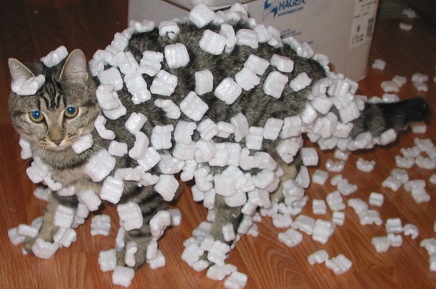
thumb|upright=1.3|alt=A tabby cat covered in packing peanuts.|Foam peanuts clinging to a cat's fur due to [[static electricity. The cat's fur becomes charged due to the triboelectric effect. The electric field of the charged fur causes polarization of the molecules of the foam due to electrostatic induction, resulting in a slight attraction of the light plastic pieces to the fur. This effect is also the cause of static cling in clothes.]]

Coulomb's law
a physical law that states the electric force between two point charges is proportional to the product of the charges and inversely proportional to the square of the distance between them.

Gauss's law
foundational law of electromagnetism

electric potential
line integral of the electric field
Ampère's circuital law
relates the integrated magnetic field around a closed loop to the electric current passing through the loop

static electricity
imbalance of electric charges within or on the surface of a material

Faraday cage
enclosure of conductive mesh used to block electric fields

electroscope
thumb|Gilbert's versorium
The electroscope is an early scientific instrument used to detect the presence of electric charge on a body. It detects this by the movement of a test charge due to the Coulomb electrostatic force on it. The amount of charge on an object is proportional to its voltage. The accumulation of enough charge to detect with an electroscope requires hundreds or thousands of volts, so electroscopes are used with high voltage sources such as static electricity and electrostatic machines. An electroscope can only give a rough indication of the quantity of charge; an instrument t
electric flux
surface integral of the electric flux density; measured in coulombs
electrostatic induction
redistribution of electric charge due to presence of other charges
triboelectric effect
type of contact electrification
oil drop experiment
experiment conducted by R. A. Millikan and H. Fletcher to measure elementary electric charge

xerography
thumb|Schematic drawing of the xerographic photocopying process
Poisson's equation
partial differential equation of elliptic type with broad utility in mechanical engineering and theoretical physics
electrostatic discharge
sudden flow of electricity between two electrically charged objects caused by contact, an electrical short, or dielectric breakdown
electric potential energy
potential energy that results from conservative Coulomb forces
electret
An electret (formed as a portmanteau of electr- from "electricity" and -et from "magnet") is a dielectric material that has a quasi-permanent electrical polarisation. An electret has internal and external electric fields, and is the electrostatic equivalent of a permanent magnet.
Ampère's force law
physical law
electrostatic generator
Device that generates electrical charge on a high voltage electrode
Earnshaw's theorem
Mathematical demonstration applied in electro-magnetism
Paschen's law
physical law about electrical discharge in gases
Method of image charges
calculation technique for classical electrostatics
antistatic agent
compound used for treatment of materials or their surfaces in order to reduce or eliminate buildup of static electricity
Shell theorem
Simplified gravity models for objects inside or outside a spherically symmetrical body
electrostatic lens
LENS PROCESSING
Biefeld–Brown effect
electrical phenomenon
Gaussian surface
closed surface in three-dimensional space through which the flux of a vector field is calculated; usually the gravitational field, the electric field, or magnetic field
electrostatic motor
antistatic bag
type of packaging for electronics and static-sensitive devices

Thomson problem
mathematical problem
ion wind
airflow induced by electrostatic forces
contact electrification
type of electrical phanomenons
Versorium
thumb|right|Illustration of Versorium construction
dielectric barrier discharge
electrical discharge between two electrodes separated by an insulating dielectric barrier
antistatic device
device that reduces or inhibits electrostatic discharge
electrical elastance
Electrical elastance is the reciprocal of capacitance. The SI unit of elastance is the inverse farad (F−1). The concept is not widely used by electrical and electronic engineers, as the value of capacitors is typically specified in units of capacitance rather than inverse capacitance. However, elastance is used in theoretical work in network analysis and has some niche applications, particularly at microwave frequencies.
Coulomb explosion
mechanism for coupling electronic excitation energy from intense electromagnetic fields into the atomic motion

clavecin électrique
early electronic musical instrument
Homoeoid
shell bounded by two concentric, similar ellipses or ellipsoids
Einzel lens
focused beam with lossless energy
static cling
electromechanical phenomenon

Electric field gradient
Rate of change of the electric field of an atomic nucleus
hygroelectricity
Hygroelectricity is a type of static electricity that forms on water droplets and can be transferred from droplets to small dust particles. The phenomenon is common in the Earth's atmosphere but has also been observed in the steam escaping from boilers (see Armstrong effect). It was the basis for a proposal by Nikola Tesla to tap electricity from the air, an idea which has been recently revived. Hygroelectric charge is the likely source of the electric charge which, under certain conditions such as exist in thunderstorms, volcanic eruptions and some dust storms, gives rise to lightning.
NSTAR
spacecraft ion propulsion system
Steinmetz's equation
empirical equation used to calculate the power loss magnetic materials
electrostatic coating