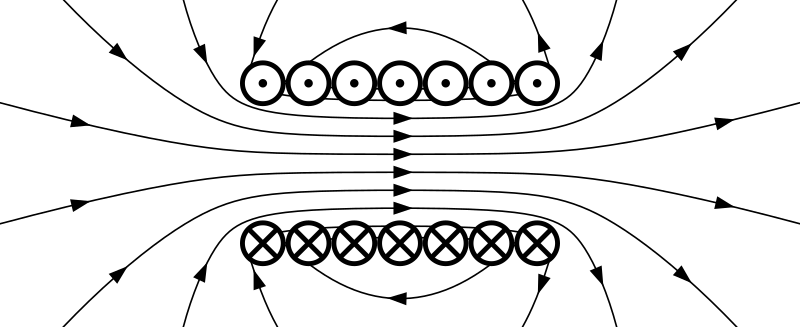
File:VFPt_Solenoid_correct2.svg · Wikimedia Commons · See Wikimedia Commons
electric field
Sign in to savespatial distribution of vectors representing the force applied to a charged test particle
An electric field is the region of space around electric charges where forces act on other charged particles. It matters because it helps us understand and predict how charged particles will move and interact with each other.
AI-generated from the Wikipedia summary — may contain errors.
Described at

1: Electric Fields - Physics LibreTexts
This page highlights the significance of fundamental scientific principles in electrical engineering, stressing that a solid theoretical foundation is crucial for practical applications. It covers …
phys.libretexts.org →So, you might ask, if your primary interest in electricity is to understand how machines, instruments and electrical equipment work, is there any point in studying electricity from the very “academic” and abstract approach that will be used in these notes, completely divorced as they appear to be from the world of practical reality? The answer is that electrical engineers more than anybody must understand the basic scientific principles before they even begin to apply them to the design of practical appliances. So – do not even think of electrical engineering until you have a thorough understanding of the basic scientific principles of the subject. It was long ago noticed that if a sample of amber is rubbed with cloth, the amber became endowed with certain apparently wonderful properties. For example, the amber would be able to attract small particles of fluff to itself. The effect is called the triboelectric effect. The amber, after having been rubbed with cloth, is said to bear an electric charge, and space in the vicinity of the charged amber within which the amber can exert its attractive properties is called an electric field. 1.3: Experiments with Pith Balls/01%3A Electric Fields/1.03%3A Experiments with Pith Balls "1.3: Experiments with Pith Balls") There are two kinds of electric charge, with exactly opposite properties. We observe that like charges (i.e. those of the same sign) repel each other, and unlike charges (i.e. those of opposite sign) attract each other. 1.6B: Spherical Charge Distributions/01%3A Electric Fields/1.06%3A Electric Field E/1.6B%3A Spherical Charge Distributions "1.6B: Spherical Charge Distributions") 1.6C: A Long, Charged Rod/01%3A Electric Fields/1.06%3A Electric Field E/1.6C%3A A Long Charged Rod "1.6C: A Long, Charged Rod") 1.6F: Field of a Uniformly Charged Infinite Plane Sheet/01%3A Electric Fields/1.06%3A Electric Field E/1.6F%3A Field of a Uniformly Charged Infinite Plane Sheet "1.6F: Field of a Uniformly Charged Infinite Plane Sheet") Thumbnail: The electric field lines and equipotential lines for field of two point charges. (CC BY-SA 3.0; Geek3 via Wikipedia ).
Excerpt from a page describing this subject · 8,124 chars · not written by Vinony
Wikidata facts
- Instance of
- mathematical expression
- Subclass of
- field
- Part of
- electromagnetic wave
- Image
- Van de Graaff Generator - Science City - Calcutta 1997 444.JPG
Show 5 more facts
- described by source
- Brockhaus and Efron Encyclopedic Dictionary
- Commons category
- Electric field
- different from
- electric field strength
- on focus list of Wikimedia project
- Wikipedia:Vital articles/Level/4
via Wikidata · CC0
~34 min read
Encyclopedic overview
An electric field (sometimes called E-field) is a physical field that surrounds electrically charged particles such as electrons. In classical electromagnetism, the electric field of a single charge (or group of charges) describes their capacity to exert attractive or repulsive forces on another charged object. Charged particles exert attractive forces on each other when the sign of their charges are opposite, one being positive while the other is negative, and repel each other when the signs of the charges are the same. Because these forces are exerted mutually, two charges must be present for the forces to take place. These forces are described by Coulomb's law, which says that the greater the magnitude of the charges, the greater the force, and the greater the distance between them, the weaker the force. Informally, the greater the charge of an object, the stronger its electric field. Similarly, an electric field is stronger nearer charged objects and weaker further away. Electric fields originate from electric charges and time-varying electric currents. Electric fields and magnetic fields are both manifestations of the electromagnetic field. Electromagnetism is one of the four fundamental interactions of nature.
Electric fields are important in many areas of physics, and are exploited in electrical technology. For example, in atomic physics and chemistry, the interaction in the electric field between the atomic nucleus and electrons is the force that holds these particles together in atoms. Similarly, the interaction in the electric field between atoms is the force responsible for chemical bonding that result in molecules.
Excerpted from Wikipedia’s “electric field” article, available under the CC BY-SA 4.0 licence.
Gallery (12)
Available in 100 languages
- Español
- Français
- Deutsch
- 中文
- 日本語
- Русский
- Português
- Italiano
- العربية
- हिन्दी
- Albanian
- Albanian
- Amharic
- Armenian
- Assamese
- Asturian
- azb
- Azerbaijani
Show 81 more
- Bahasa Indonesia
- Bangla
- Basque
- be_x_old
- Belarusian
- Bhojpuri
- Bosnian
- Bulgarian
- Burmese
- Catalan
- Central Kurdish
- Chuvash
- Croatian
- Czech
- Danish
- Esperanto
- Estonian
- Extremaduran
- Filipino
- Finnish
- Galician
- Georgian
- Greek
- Haitian Creole
- Hebrew
- Hungarian
- Icelandic
- Ido
- Irish
- Kannada
- Kazakh
- Khmer
- Latin
- Latvian
- Limburgish
- Lithuanian
- Macedonian
- Malay
- Malayalam
- Marathi
- Mazanderani
- Mongolian
- Nederlands
- Northern Frisian
- Norwegian
- Norwegian Nynorsk
- Occitan
- Odia
- Pashto
- Piedmontese
- Polski
- Punjabi
- Romanian
- Serbian
- Serbian (Latin)
- Shona
- Sicilian
- simple
- Slovak
- Slovenian
- Sundanese
- Svenska
- Tamil
- Tatar
- Telugu
- Tiếng Việt
- Türkçe
- Ukrainian
- Urdu
- Uzbek
- Waray
- Western Panjabi
- Wolof
- Wu Chinese
- zh_classical
- zh_min_nan
- zh_yue
- Zulu
- فارسی
- ไทย
- 한국어
via Wikidata sitelinks · CC0