Category
page 1Elementary mathematics

natural number
ambiguous mathematical term used either for non-negative or for strictly positive integers, depending on usage

integer
thumb|upright=1.25|The integers arranged on a number line

function
association of a single output to each input

real number
quantity along a continuous line

rational number
quotient of two integers

square root
inverse operation of square for finding the original base number; that base number itself

variable
value that can change, usually with a context of an equation or operation

sequence
thumb|A part of an infinite sequence of real numbers (in blue), indexed by a natural number . This sequence is neither increasing, decreasing, convergent, nor Cauchy. It is, however, bounded (by red dashed lines).
In mathematics, a sequence is a collection of objects possibly with repetition, that come in a specified order. Like a set, it contains members (also called elements, or terms). Unlike a set, the same elements can appear multiple times at different positions in a sequence, and unlike a set, the order does matter. The notion of a sequence can be generalized to an indexed family, defin
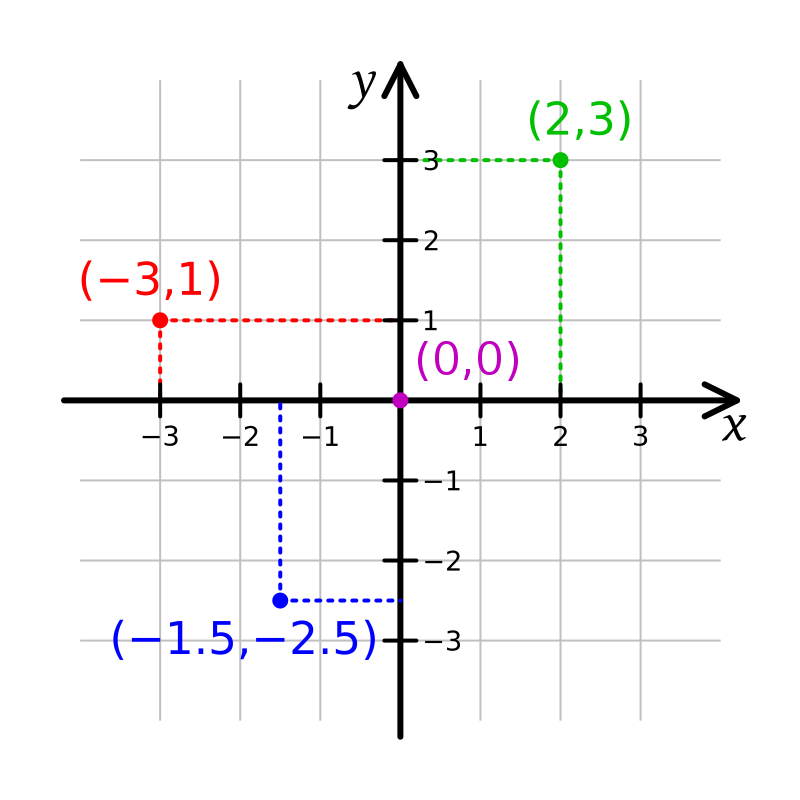
Cartesian coordinate system
coordinate system that specifies each point uniquely by a pair of real numbers called coordinates

slope
right|thumb|Slope: m = \frac{\Delta y}{\Delta x} = \tan(\theta)
constant
mathematical concept; value which cannot be changed or does not change during a process

ratio
thumb|The ratio of width to height of standard-definition television

periodic function
function that repeats its values in regular intervals or periods

mathematical operation
mathematical procedure which produces a result from one or more input values

number line
picture of a graduated straight line that serves as abstraction for real numbers; coordinate system in one-dimensional space

unit vector
vector of length one

zero of a function
element of the domain where function's value is zero

counting
alt=A set of number blocks. The blocks 1, 2, and 3 are in the foreground; six other blocks can be seen in the background|thumb|Number blocks, which can be used for counting
Counting is the process of determining the number of elements of a finite set of objects; that is, determining the size of a set. The traditional way of counting consists of continually increasing a (mental or spoken) counter by a unit for every element of the set, in some order, while marking (or displacing) those elements to avoid visiting the same element more than once, until no unmarked elements are left; if the counte
radix
In a positional numeral system, the radix (radices) or base is the number of unique digits, including the digit zero, used to represent numbers. For example, for the decimal system (the most common system in use today) the radix is ten, because it uses the ten digits from 0 through 9.

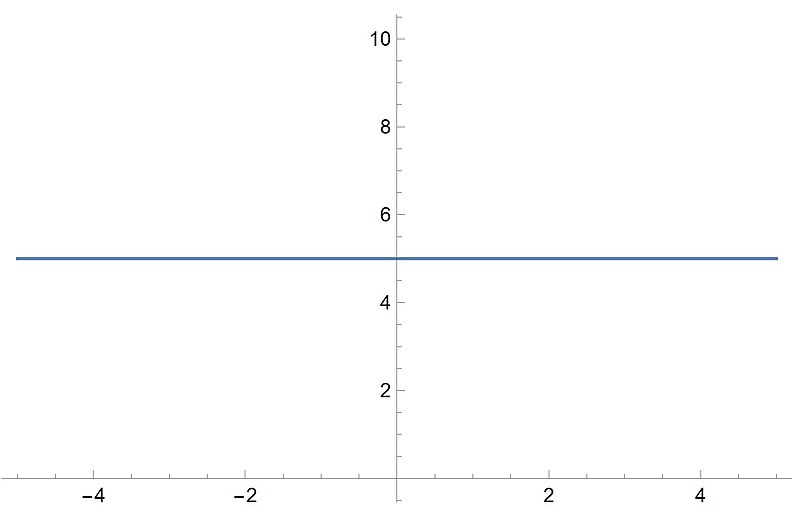
constant function
mathematical function whose (output) value is the same for every input value

coordinate origin
point in a Euclidean space used as a reference for geometric measurements of surrounding space
identity function
function that always returns the same value that was used as its argument

elementary mathematics
areas of basic mathematics commonly taught in primary and secondary school
relative direction
information contained in the relative position of one point of space with respect to another, disregarding distance
order of magnitude
scale of numbers with a fixed ratio
unary numeral system
the simplest numeral system, a non-positional numeral system
Hindu-Arabic numeral system
most common system for writing numbers
magnitude
mathematical concept related to comparison and ordering
missing square puzzle
optical illusion used in mathematics
mathematical beauty
notion that some mathematicians may derive aesthetic pleasure from mathematics
tally mark
numeral form used for counting
subsequence
In mathematics, a subsequence of a given sequence is a sequence that can be derived from the given sequence by deleting some or no elements without changing the order of the remaining elements. For example, the sequence \langle A,B,D \rangle is a subsequence of \langle A,B,C,D,E,F \rangle obtained after removal of elements C, E, and F. The relation of one sequence being the subsequence of another is a partial order.
mathematical problem
problem that can be possibly solved via mathematics
argument of a function
independent variable of math function

y-intercept
thumb|300px|Graph y=f(x) with the x-axis as the horizontal axis and the y-axis as the vertical axis. The y-intercept of f(x) is indicated by the red dot at (x=0, y=1).
In analytic geometry, using the common convention that the horizontal axis represents a variable x and the vertical axis represents a variable y, a y-intercept or vertical intercept is a point where the graph of a function or relation intersects the y-axis of the coordinate system.
arg max and min
points of the domain of some function at which the function values are maximized or minimized
value
notion in mathematics
algebraic operation
mathematical operation
vinculum
overline used as a mathematical symbol
circular shift
shift whose last entry moved to first place (or vice versa)
mathematical anxiety
anxiety about one's ability to do mathematics

clock angle problem
Mathematical question
abscissa and ordinate
names for a system's two axes in coordinate geometry
Glagolitic numerals
numerals based on the letters of the Glagolitic alphabet
Elementary proof
Mathematical proof using only basic techniques.
Spatial-numerical association of response codes
Positive and negative parts
decomposition of real-valued functions