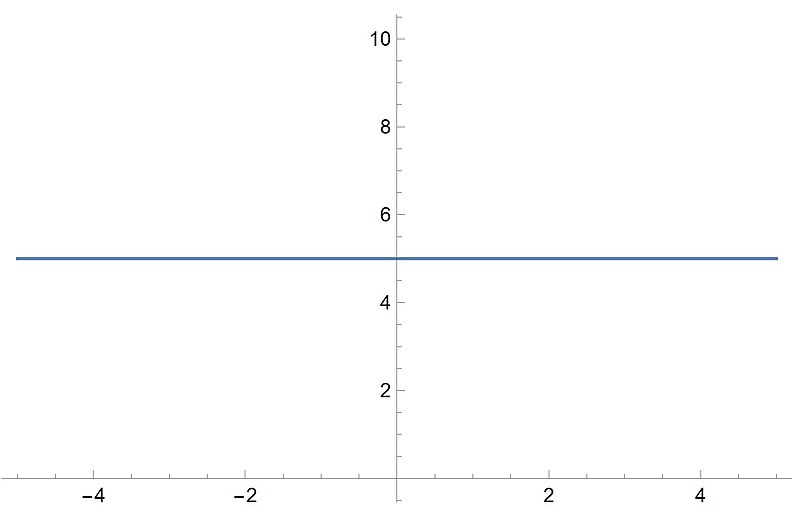
File:Graph_of_a_horizontal_line.jpg · Wikimedia Commons · See Wikimedia Commons
constant
Sign in to savemathematical concept; value which cannot be changed or does not change during a process
A constant is a value in mathematics that stays the same and doesn't change, unlike a variable which can take on different values. Constants matter because they serve as reliable, unchanging reference points that help us describe and solve mathematical problems accurately.
AI-generated from the Wikipedia summary — may contain errors.
Wikidata facts
- Subclass of
- operand
- Said to be same as
- nullary operation
Show 5 more facts
- different from
- physical constant
- opposite of
- variable
- topic's main category
- Category:Constants
- on focus list of Wikimedia project
- Wikipedia:Vital articles/Level/4
- maintained by WikiProject
- WikiProject Mathematics
Sources (1)
via Wikidata · CC0
~5 min read
Encyclopedic overview
In mathematics, the word constant conveys multiple meanings. As an adjective, it refers to non-variance (i.e. unchanging with respect to some other value); as a noun, it has two different meanings:
A fixed and well-defined number or other non-changing mathematical object, or the symbol denoting it. The terms mathematical constant or physical constant are sometimes used to distinguish this meaning.
Excerpted from Wikipedia’s “constant” article, available under the CC BY-SA 4.0 licence.
Available in 66 languages
- Español
- Français
- 中文
- 日本語
- Русский
- Português
- Italiano
- العربية
- हिन्दी
- Afrikaans
- Albanian
- Armenian
- Azerbaijani
- Bahasa Indonesia
- Bangla
- Bashkir
- Basque
- be_x_old
Show 47 more
- Belarusian
- Bulgarian
- Catalan
- Central Kurdish
- Chuvash
- Croatian
- Czech
- Danish
- Esperanto
- Estonian
- Faroese
- Filipino
- Finnish
- Galician
- Greek
- Haitian Creole
- Hungarian
- Icelandic
- Kalmyk
- Kazakh
- Latin
- Lithuanian
- Macedonian
- Malayalam
- Nederlands
- Pashto
- Punjabi
- Romanian
- Scottish Gaelic
- Serbian
- simple
- Slovak
- Slovenian
- Svenska
- Swahili
- Tamil
- Tiếng Việt
- Türkçe
- Ukrainian
- Urdu
- Uzbek
- Welsh
- zh_min_nan
- zh_yue
- فارسی
- ไทย
- 한국어
via Wikidata sitelinks · CC0