Category
page 1Emergency management

state of emergency
legal declaration or de facto acts by a government allowing assumption of extraordinary powers

wildfire
thumb|upright=1.35|Wildfire burning in the Kaibab National Forest, [[Arizona, United States, in 2020. The Mangum Fire burned more than of forest.]]
A wildfire, forest fire, or a bushfire is an unplanned and uncontrolled fire in an area of combustible vegetation. Some natural forest ecosystems depend on wildfire. Modern forest management often engages in prescribed burns to mitigate fire risk and promote natural forest cycles. However, controlled burns can turn into wildfires by mistake.

humanitarian aid
material or logistical assistance for people in need

evacuation
urgent movement of people away from the threat or actual occurrence of a hazard

lockdown
A lockdown () is a restriction policy for people, community or a country to stay where they are, usually due to specific risks that could possibly harm the people if they move and interact freely.
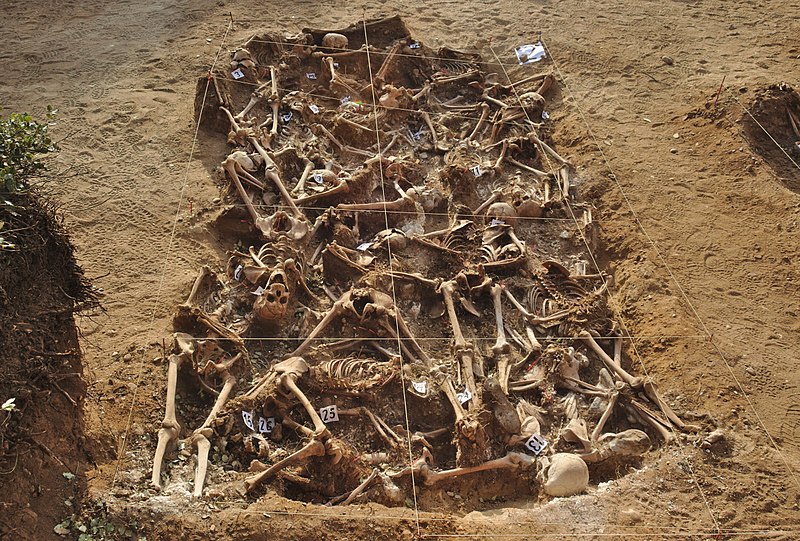
mass grave
grave containing multiple number of human corpses, usually buried anonymously

civil defense
protection of the citizens of a state (generally non-combatants) from military attack

triage
In medicine, triage (, ; ) is a process by which care providers such as medical professionals and those with first aid knowledge determine the order of priority for providing treatment to injured individuals and/or inform the rationing of limited supplies so that they go to those who can most benefit from it. Triage is usually relied upon when there are more injured individuals than available care providers (known as a mass casualty incident), or when there are more injured individuals than supplies to treat them.

emergency
thumb|An emergency medical technician treats a woman who has collapsed in the street in New York. Dangers to life and health are serious enough that emergency response systems are considered vital.
thumb|right|Emergency slides are deployed after the crash landing of British Airways Flight 38
emergency management
discipline of dealing with and avoiding both natural and man-made disasters, with the goal of reducing the harmful effects
public health emergency of international concern
an extraordinary event which is determined to constitute a public health risk to other States through the international spread of disease and to potentially require a coordinated international response, as declared by WHO
crisis management
process by which an organization deals with a major event that threatens to harm the organization, its stakeholders, or the general public
humanitarian crisis
singular event or a series of events that are threatening in terms of health, safety or well being of a community or large group of people
CBRN defense
CBRN
business continuity planning
the process of creating systems of prevention and recovery to deal with potential threats and significant disruption of business operations
COVID-19 pandemic lockdown
states of emergency and regimes of exception decreed by COVID-19
contingency plan
plan in case something unexpected occurs, which is often used for risk management
act of God
usually-natural disaster outside human control, for which no person is at fault
International Mobile Satellite Organization
international organization
normalcy bias
tendency for people to believe that things will always function the way they normally have functioned and therefore to underestimate both the likelihood of a disaster and its possible effects
Sendai Framework for Disaster Risk Reduction
international accord adopted by the United Nations
disaster preparedness
Preparedness is a set of actions that are taken as precautionary measures in the face of potential disasters. Being prepared helps in achieving goals and in avoiding and mitigating negative outcomes.
crash bar
device that allows opening a door by pushing against it
Under-Secretary-General for Humanitarian Affairs and Emergency Relief Coordinator
position
pandemic prevention
measures to reduce causes of new infectious diseases and prevent outbreaks and epidemics from becoming pandemics
mitigation
Mitigation is the reduction of something harmful that has occurred or the reduction of its harmful effects. It may refer to measures taken to reduce the harmful effects of hazards that remain in potentia, or to manage harmful incidents that have already occurred. It is a stage or component of emergency management and of risk management. The theory of mitigation is a frequently used element in criminal law and is often used by a judge to try cases such as murder, where a perpetrator is subject to varying degrees of responsibility as a result of one's actions.
earthquake preparedness
measures to minimise earthquake's effects on human life
crowdmapping
Crowdmapping is a subtype of crowdsourcing by which aggregation of crowd-generated inputs such as captured communications and social media feeds are combined with geographic data to create a digital map that is as up-to-date as possible on events such as wars, humanitarian crises, crime, elections, or natural disasters. Such maps are typically created collaboratively by people coming together over the Internet.

Fire Information for Resource Management System
conflagration mapping platform developed by NASA
tiger team
group of experts assigned to investigate and/or solve technical or systemic problems
Tampere Convention
international multilateral treaty
community resilience
sustained ability of a community to use available resources to respond to, withstand, and recover from adverse situations such as disasters