Category
page 1Etruscans
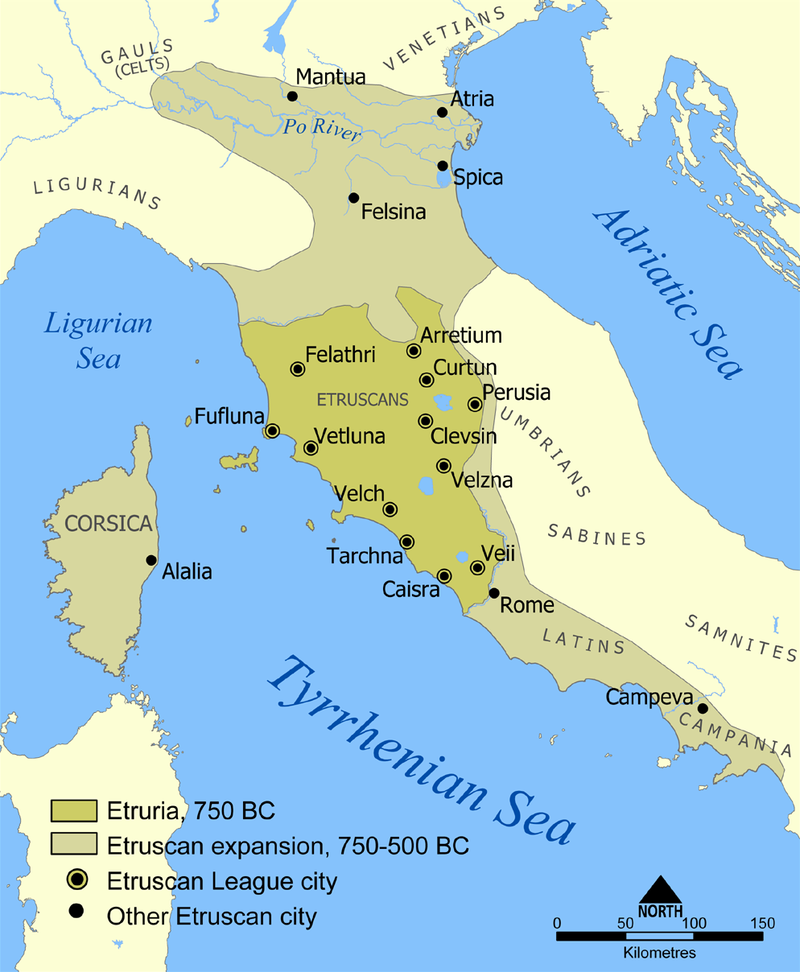
Etruscans
ancient civilization on the Appenine Peninsula

Persius
thumb|Persius
Aulus Persius Flaccus (; 4 December 3424 November 62 AD) was a Roman poet and satirist of Etruscan origin. In his works, poems and satire, he shows a Stoic wisdom and a strong criticism for what he considered to be the stylistic abuses of his poetic contemporaries. His works, which became very popular in the Middle Ages, were published after his death by his friend and mentor, the Stoic philosopher Lucius Annaeus Cornutus.
Etruscan art
art movement
Villanovan culture
archaeological culture in Italy

Tanaquil
thumb|right|A rendering of Tanaquil, wife of Tarquinius Priscus, fifth king of Rome
thumb|Portrait of Tanaquil by Domenico Beccafumi,
Tiras
Tiras ( Ṯīrās) is, according to the Book of Genesis () and 1 Chronicles, the seventh and youngest son of Japheth in the Hebrew Bible. A brother of biblical Javan (associated with the Greek people), its geographical locale is sometimes associated by scholars with the Teresh or Tursha, one of the groups which made up the Sea Peoples, a naval confederacy which terrorized Egypt and other Mediterranean nations around 1200 BCE. These Sea People are referred to as "Tursha" in an inscription of Ramesses III, and as "Teresh of the Sea" on the Merneptah Stele.
Plautia Urgulanilla
first wife of Claudius (married c. 9-24 AD)

Tyrrhenians
Tyrrhenians (Attic Greek: Turrhēnoi) or Tyrsenians (Ionic: Tursēnoi; Doric: Tursānoi) was the name used by the ancient Greeks to refer, in a generic sense, to non-Greek people, in particular pirates. While ancient sources have been interpreted in a variety of ways, the Greeks always called the Etruscans Tyrsenoi, although not all Tyrsenians were Etruscans. The term "Tyrrhenians" was sometimes used by ancient writers to refer to other ethnic groups in central-western Italy, such as the Latins. Dionysius of Halicarnassus stated that the Greeks once called Latins, Umbrians, Ausonians, and others
Etruscan Dodecapolis
Wikimedia list article
Vulca
Vulca of Veii was an Etruscan artist from the town of Veii. The only Etruscan artist mentioned by ancient writers, he worked for the last of the Roman kings, Tarquinius Superbus (supposed to have died in 495 BC). He is responsible for creating a terracotta statue of Jupiter and a four-horse chariot for the Temple of Jupiter Optimus Maximus on the Capitoline Hill, as well as a terracotta statue of Hercules, known as the Hercules Fictilis ("clay Hercules") from its composition. Some have postulated that he also constructred the Apollo of Veii. His statue of Jupiter was reputedly painted with cin
Arruns Tarquinius
son of Tarquin the Proud, slain by Lucius Junius Brutus
Urgulania
Urgulania (fl. 24 AD), was a prominent noblewoman during the reigns of Augustus and Tiberius, due to her friendship with the empress Livia. She was the mother of the Roman general Marcus Plautius Silvanus (consul in 2 BC), who had distinguished himself when fighting with the future Emperor Tiberius during the Great Illyrian Revolt in the Balkans. She was the grandmother to Plautia Urgulanilla, the first wife of the future emperor Claudius, and another Marcus Plautius Silvanus, the suspect in a notorious murder case.
Etruscan architecture
architecture of the Etruscan civilization

Titus Tarquinius
eldest son of Lucius Tarquinius Superbus (died c.496 BC)

Lucumone
thumb|Lauchme (Lucumo) in Etruscan alphabet|Etruscan (retrograde) alphabet, extracted from the Giuseppe Micali's History of the Ancient Italian Peoples (1836), Vol. I, Chapter VII: Etruscans, p. 187
Lucumo, in Etruscan lauchme or lauchume, was a title of Etruscan rulers, equivalent to the Latin rex, or "king". In Roman sources, it is frequently mistaken for a personal name, particularly in the case of Lucius Tarquinius Priscus, the fifth King of Rome, a native of Etruria who is said to have adopted a Roman name in place of his original name, Lucumo. Heurgon compares this to the Etruscan use of

etruscology
thumb|right|180px|Cover of the 4th edition of "Etruscologia" by Massimo Pallottino
Etruscan origins
Academic theories on the origins of the Etruscan civilization
Etruscan sculpture
etruscan ceramics and sculpture
Caelius Vibenna
ally of Romulus
Etruscan coins
Vie Cave
Aulus Vibenna
Etruscan leader
Padanian Etruria
northen Italy's area in ancient times inhabited by etruscans