
File:Aulus_Persius_Flaccus.jpeg · Wikimedia Commons · See Wikimedia Commons
Persius
Sign in to saveAlso known as Aulus Persius Flaccus
thumb|Persius Aulus Persius Flaccus (; 4 December 3424 November 62 AD) was a Roman poet and satirist of Etruscan origin. In his works, poems and satire, he shows a Stoic wisdom and a strong criticism for what he considered to be the stylistic abuses of his poetic contemporaries. His works, which became very popular in the Middle Ages, were published after his death by his friend and mentor, the Stoic philosopher Lucius Annaeus Cornutus.
OverviewAI-generated
Aulus Persius Flaccus was a male poet, writer, and philosopher from Ancient Rome. He was born in Volterra on December 4, 34, and died in Rome on November 24, 62. He wrote in Latin and is associated with the genre of Latin satire.
He studied under Lucius Annaeus Cornutus and Remmius Palaemon. His works include *A. Persii Flacci Satirii VI* and *Œuvres complètes de Juvénal et de Perse suivies des fragments de Turnus et de Sulpicia*. Other listed titles are *Poetical miscellanies* and *Iuuenalis. Persius, Satyres de Perse*. He is described in sources such as the *Brockhaus and Efron Encyclopedic Dictionary*, the *Granat Encyclopedic Dictionary*, *The Nuttall Encyclopædia*, and the *Encyclopædia Britannica 11th edition*.
Synthesized by Vinony from 19 facts across 3 sources: Wikidata, Open Library, Europeana Sparql. Generated from structured data (not the Wikipedia text) and checked against those facts — may still contain errors.
Person · Open Library
- Works
- 229
Top works
- Poetical miscellanies
- Oeuvres completes d'Horace, de Juvénal, de Perse, de Sulpicia, de Turnus, de Catulle, de Properce, de Gallus et Maximien, de Tibulle, de Phèdre et de Syrus
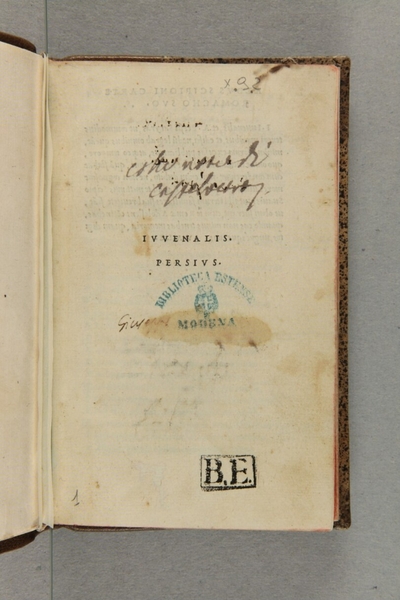
- Iuuenalis. Persius
- Satyres de Perse
- A. Persii Flacci Satirii VI
via Open Library + Wikidata
Wikidata facts
- Instance of
- human
- Gender
- male
- Citizenship
- Ancient Rome
- Place of birth
- Volterra
- Place of death
- Rome
- Occupation
- philosopher
- Languages spoken
- Latin
- Genre
- Latin satire
- Image
- Aulus Persius Flaccus.jpeg
Show 10 more facts
- Commons category
- Aulus Persius Flaccus
- date of birth
- 0034-12-04
- date of death
- 0062-11-24
- Commons Creator page
- Aulus Persius Flaccus
- Commons gallery
- Aulus Persius Flaccus
- praenomen
- Aulus
- described by source
- Pauly–Wissowa
- writing language
- Latin
- cognomen
- Flaccus
- P13311
- 1845
Sources (2)
via Wikidata · CC0
Works in European collections
36 objects attributed to Persius, held across European museums, libraries & archives · via Europeana
Auli Persii Flacci Satirarum liber [Texto impreso] :]cum scholiis antiquis
Aulo Persio Flacco [Texto impreso]

Satire, traduzione del cavaliere Vincenzo Monti

Satires translated in Francais with remarks by M. Selis. Nouv. ed. Latin text year

Satyren. Einleitung Übersetzung und Erklärung von W. S. Teuffel.
Satyrae
![Ivnii Ivvenalis Aqvinatis inter Latinos satyrographos con sumatissimi Satyrae emaculatius impressae Item. Au. Persius satyrus non ignobilis. H.B.P. Vergilium. vt nemo vicit: fera bella: canendo Regnat vt imparibus: naso poeta: modis Vtq [ue] placet lyricis: solus venusinus: in odis Musaq [ue] vt in lepidis: bilbilitana: iocis Vtq [ue] vmbro multum debit Comedia Plauto Emicat vt Outside publius ipse suo Pacuuius docti famam senis. Accius alti Vt capit: in tragico clarus vterq [ue] pede. Sicluuenale meo (nec verba haec testis egebunt)](https://api.europeana.eu/thumbnail/v2/url.json?uri=https%3A%2F%2Fimagines.manuscriptorium.com%2Floris%2FNKCR__-NKCR__G_024994____3MUVIRE-cs%2FIMG00000001%2Ffull%2F!400%2C400%2F0%2Fdefault.jpg&type=IMAGE)
Ivnii Ivvenalis Aqvinatis inter Latinos satyrographos con sumatissimi Satyrae emaculatius impressae Item. Au. Persius satyrus non ignobilis. H.B.P. Vergilium. vt nemo vicit: fera bella: canendo Regnat vt imparibus: naso poeta: modis Vtq [ue] placet lyricis: solus venusinus: in odis Musaq [ue] vt in lepidis: bilbilitana: iocis Vtq [ue] vmbro multum debit Comedia Plauto Emicat vt Outside publius ipse suo Pacuuius docti famam senis. Accius alti Vt capit: in tragico clarus vterq [ue] pede. Sicluuenale meo (nec verba haec testis egebunt)

Satyraecum commentario Johannis Britannici
Untitled
Untitled
Untitled
Untitled
Untitled
Untitled
Untitled
Untitled
Untitled
Untitled
Untitled
Untitled
Untitled

Untitled
Untitled
Untitled

Untitled

Untitled
Untitled
Untitled
Untitled
Untitled
Untitled
Untitled
Untitled
Untitled
Untitled
Untitled
~10 min read
Encyclopedic overview
8 sectionsContents
- Life
- Doubts over his biography
- Work
- Authorities
- Editions
- Notes
- References
- External links
thumb|Persius Aulus Persius Flaccus (; 4 December 3424 November 62 AD) was a Roman poet and satirist of Etruscan origin. In his works, poems and satire, he shows a Stoic wisdom and a strong criticism for what he considered to be the stylistic abuses of his poetic contemporaries. His works, which became very popular in the Middle Ages, were published after his death by his friend and mentor, the Stoic philosopher Lucius Annaeus Cornutus.
==Life== According to the Life contained in the manuscripts, Persius was born into an equestrian family at Volterra (Volaterrae, in Latin), a small Etruscan city in the province of Pisa, of good stock on both parents' side. When he was six years old he lost his father; his stepfather died a few years later. At the age of twelve Persius came to Rome, where he was taught by Remmius Palaemon and the rhetor Verginius Flavus. During the next four years he developed friendships with the Stoic Lucius Annaeus Cornutus, the lyric poet Caesius Bassus and the poet Lucan. Lucan would become a generous admirer of all Persius wrote. He also became close friends with Thrasea Paetus, the husband of Arria, a relative of Persius's; over the next ten years Persius and Thrasea Paetus shared many travels together. Later, he met Seneca, but was not impressed by his genius.
Excerpted from Wikipedia’s “Persius” article, available under the CC BY-SA 4.0 licence.