Category
page 1Etymology

etymology science
Etymology ( ) is the study of the origin and evolution of words—including their constituent units of sound and meaning—across time. In the 21st century, as a subfield within linguistics, etymology has become an increasingly rigorous scientific field of study. It is most directly tied to historical linguistics, philology, and semiotics, and additionally draws upon comparative semantics, morphology, pragmatics, and phonetics in order to construct a comprehensive and chronological catalogue of all meanings that a word (and its related parts) has carried throughout its history. The origin of any p

loanword
thumb|The English language|English word [[tofu is a loanword from the Japanese word , which is itself a loanword from the Chinese word dòufu.]]
calque
In linguistics, a calque () or loan translation is a word or phrase borrowed from another language by literal word-for-word or root-for-root translation. When used as a verb, "to calque" means to borrow a word or phrase from another language while translating its components, so as to create a new word or phrase (lexeme) in the target language. For instance, the English word skyscraper has been calqued in dozens of other languages, combining words for "sky" (or "clouds") and "scrape" in each language, such as in Dutch.

pun
thumb|upright=1.25|Punch (magazine)|Punch, 25 February 1914. The cartoon is a pun on the word "Jamaica", which pronunciation is a [[homonym to the clipped form of "Did you make her?"
]]
derivation
in linguistics, the process of forming a new word on the basis of an existing one
folk etymology
Process of reinterpretive word formation

backronym
A backronym treats an already existing word as an acronym and expands its letters into the words of a phrase, and so is effectively an acrostic. The word is a portmanteau of back and acronym. Backronyms may be invented with either serious or humorous intent, or they may be a type of false etymology or folk etymology.
etymological dictionary
dictionary showing the etymology (origin) of words
endonym and exonym
linguistic terms

Nirukta
thumb|upright=1.25|The opening pages of Yaska's Nirukta Vedanga text (Sanskrit, Devanagari script)
hybrid word
word that etymologically derives from at least two languages

Wanderwort
A ' ( , sometimes pluralized as ', usually capitalized following German practice) is a word that has spread as a loanword among numerous languages and cultures, especially those that are far away from one another. As such, are a curiosity in historical linguistics and sociolinguistics within a wider study of language contact. At a sufficient time depth, it can be very difficult to establish in which language or language family a originated and into which it was borrowed.
metaplasm
A metaplasm is almost any kind of alteration, whether intentional or not, in the pronunciation or the orthography of a word. The change may be phonetic only, such as pronouncing Mississippi as Missippi in English, or acceptance of a new word structure, such as the transformation from calidus in Latin to caldo (hot) in Italian. Orthographic metaplasms have been used in philosophy to advance humanity's conceptual terrain, such as when Derrida adapted Heidegger's Destruktion into deconstruction or the French term différence into différance. Changes at either level may or may not be recognized in
exogeny
In a variety of contexts, exogeny or exogeneity () is the fact of an action or object originating externally. It is the opposite of endogeneity or endogeny, the fact of being influenced from within a system.
internationalism
loanword that occurs in several languages with the same or similar meaning and etymology
false cognate
words that look or sound alike, but are not related
tatsama
Tatsama ( , lit. 'same as that') are Sanskrit loanwords in modern Indo-Aryan languages like Assamese, Bengali, Marathi, Nepali, Odia, Hindi, Gujarati, and Sinhala and in Dravidian languages like Tamil, Kannada and Telugu. They generally belong to a higher and more erudite register than common words, many of which are (in modern Indo-Aryan languages) directly inherited from Old Indo-Aryan (tadbhava). The tatsama register can be compared to the use of loan words of Greek or Latin origin in English (e.g. hubris).
false etymology
popularly held but false belief about the origin or derivation of a specific word
Bohemism
Bohemisms, or Czechisms, are words and expressions borrowed or derived from the Czech language. The former term is derived from the historical name Bohemia for Czech lands.
etymological fallacy
genetic fallacy that holds that the present-day meaning of a word or phrase should necessarily be similar to its historical meaning
rebracketing
Rebracketing (also known as resegmentation or metanalysis) is a process in historical linguistics where a word originally derived from one set of morphemes is broken down or bracketed into a different set. For example, hamburger, originally from Hamburg+er, has been rebracketed into ham+burger, and burger was later reused as a productive morpheme in coinages such as cheeseburger. It is usually a form of folk etymology, or may seem to be the result of valid morphological processes.
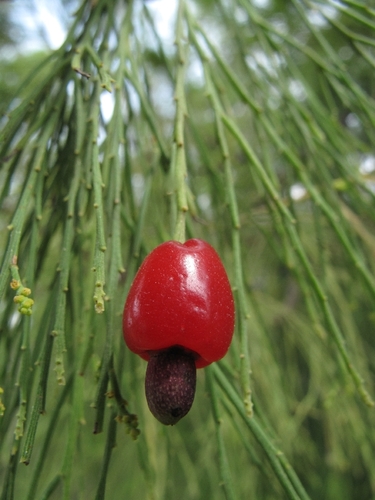
Exocarpos
Exocarpos (from Ancient Greek ἔξω (éxō), meaning "outside", and καρπός (karpós), meaning "fruit", and thus, "outside fruit"), also known as ballart, is a genus of flowering shrubs and small trees in the sandalwood family, Santalaceae. They range from Vietnam through Malesia, New Guinea, and Australia to New Zealand and the Pacific Islands.
Tadbhava
'''''' (Sanskrit: तद्भव, , lit. "arising from that") is the Sanskrit word for one of three etymological classes defined by native grammarians of Middle Indo-Aryan languages, alongside tatsama and deśi words. A "tadbhava" is a word with an Indo-Aryan origin (and thus related to Sanskrit) but which has evolved through language change in the Middle Indo-Aryan stage and eventually inherited into a modern Indo-Aryan language. In this sense, tadbhavas can be considered the native (inherited) vocabulary of modern Indo-Aryan languages.

Slavism
Slavicisms or Slavisms are words and expressions (lexical, grammatical, phonetic, etc.) borrowed or derived from Slavic languages.
Esperanto etymology
origin of words in Esperanto
eggcorn
thumb|Cafe chalkboard advertising a "pre fixed" menu, an eggcorn of the French prix fixe (fixed price)
list of Turkic loanwords in Armenian
Wikimedia list article
varsity team
university sports team
neoclassical compound
compound word composed from combining forms (which act as affixes or stems) derived from classical Latin or ancient Greek roots, such as biology