Category
page 1Euclidean plane geometry

Pythagorean theorem
relation in Euclidean geometry among the three sides of a right triangle

polygon
thumb|400px|right|Some polygons of different kinds: open (excluding its boundary), boundary only (excluding interior), closed (including both boundary and interior), and self-intersecting.
In geometry, a polygon () is a plane figure made up of line segments connected to form a closed polygonal chain.

golden ratio
ratio between two quantities whose sum is at the same ratio to the larger one
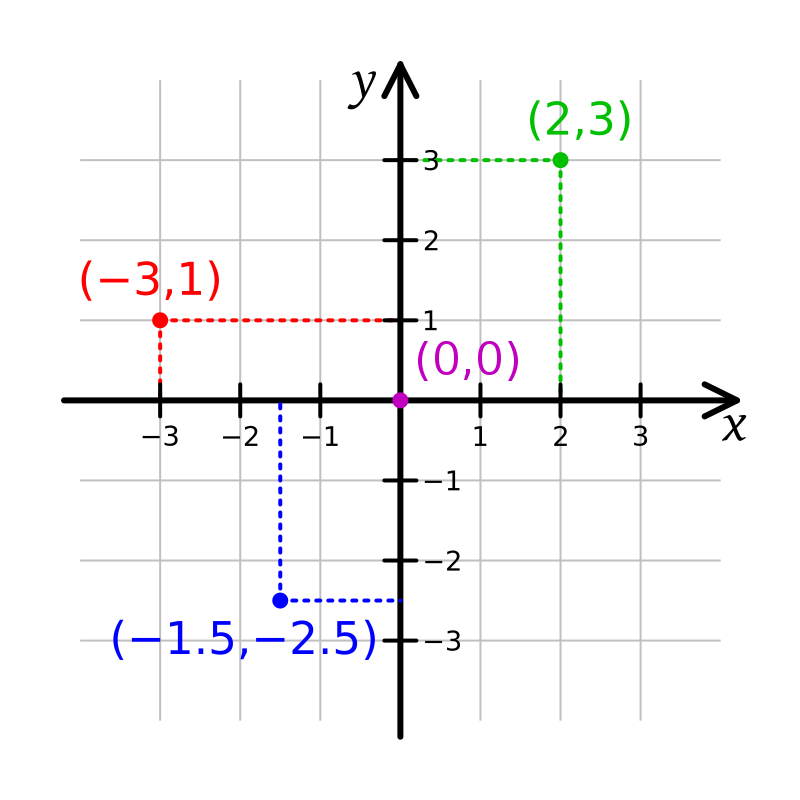
plane
flat, infinite two-dimensional surface

squaring the circle
geometric problem

Thales' theorem
theorem

Ptolemy's theorem
theorem

Ceva's theorem
theorem in planar Euclidean geometry

Menelaus' theorem
theorem

heptadecagon
In geometry, a heptadecagon, septadecagon or 17-gon is a seventeen-sided polygon.

inscribed angle
angle formed in the interior of a circle

doubling the cube
geometric problem of constructing a cube with twice the volume of a given cube
angle trisection
construction of an angle equal to one third a given angle
Stewart's theorem
theorem describing a relation between the lengths of the sides and the length of a cevian in a triangle
2D computer graphics
graphics that use a two-dimensional representation of geometric data
Pascal's theorem
theorem
Pick's theorem
formula that the area of a planar polygon whose vertices all have integer coordinates equals the number of interior integer points plus half the number of boundary integer points minus one
Desargues' theorem
theorem that two triangles are in perspective axially if and only if they are in perspective centrally
power of a point
relative distance of a point from a circle
quadrant
region of the plane defined by the axes of a two-dimensional Cartesian system
Problem of Apollonius
construct circles that are tangent to three given circles in a plane
butterfly theorem
theorem
internal and external angle
term in geometry
projective plane
geometric concept of a 2D space with a "point at infinity" adjoined
Pappus's hexagon theorem
theorem that, if the vertices of a hexagon lie alternately on two lines, then the three pairs of opposite sides meet in three collinear points
Brianchon's theorem
theorem that the three long diagonals of a hexagon that is tangent to a conic section meet in a single point
neusis construction
geometric construction used in Ancient Greek mathematics
Descartes' theorem
theorem
circles of Apollonius
a family of circles where every one intersects every circle in a second family of circles orthogonally
constructible number
real number that can be geometrically constructed with compass and straightedge from a unit segment in a finite number of steps

65537-gon
In geometry, a 65537-gon is a polygon with 65,537 (216 + 1) sides. The sum of the interior angles of any non-self-intersecting is 11,796,300°.
bilinear interpolation
method of interpolating functions on a 2D grid
pole and polar
construction in geometry, which, given to a conic, associates a line (“polar”) to a point and a point (“pole”) to a line
geometric mean theorem
theorem that, in a right triangle, the altitude equals the geometric mean of the the two line segments on the hypotenuse created by the altitude
Happy Ending problem
problem about proving that five points in the plane will have a subset forming the vertices of a convex quadrilateral
Wallace–Bolyai–Gerwien theorem
theorem
Sylvester–Gallai theorem
theorem that every finite set of points in the plane, not all collinear, has a line through exactly two points
Pasch's axiom
statement in plane geometry, used implicitly by Euclid, which cannot be derived from the postulates as Euclid gave them

257-gon
In geometry, a 257-gon is a polygon with 257 sides. The sum of the interior angles of any non-self-intersecting 257-gon is 45,900°.
Japanese theorem for cyclic quadrilaterals
theorem
Japanese theorem for cyclic polygons
theorem that no matter how one triangulates a cyclic polygon, the sum of inradii of triangles is constant
Monge's theorem
theorem that the intersections of the 3 pairs of external tangent lines to 3 circles are collinear
constructible polygon
regular polygon that can be constructed with compass and straightedge
Pappus' area theorem
Relates areas of three parallelograms attached to three sides of an arbitrary triangle
Tarski's circle-squaring problem
mathematical problem

Napoleon's problem
given a circle and its centre, the problem of dividing the circle into four equal arcs using only a compass
Carlyle circle
circle in a coordinate plane associated with a quadratic equation
tiling by regular polygons
subdivision of the plane into polygons that are all regular
Poncelet–Steiner theorem
theorem
special right triangle
right triangle with an additional feature beyond the right angle making calculations on the triangle even easier
hyperbolic sector
type of region of the Cartesian plane
De Bruijn–Erdős theorem
incidence geometry theorem
Pasch's theorem
theorem
Szemerédi–Trotter theorem
bound on the number of incidences between points and lines in the plane
Poncelet point
point defined in a quadrangle
Mixtilinear Incircle
Gabriel graph
graph defined from a set of points in the Euclidean plane
square trisection
Euclidean plane isometry
isometry of the Eluclidean plane
honeycomb conjecture
theorem that states that a regular hexagonal grid is the best way to divide a surface into regions of equal area with the least total perimeter