
File:Pythagorean.svg · Wikimedia Commons · See Wikimedia Commons
Pythagorean theorem
Sign in to saveAlso known as Pythagoras' theorem, Pythagorean proposition, a² + b² = c², a²+b²=c²
relation in Euclidean geometry among the three sides of a right triangle
The Pythagorean theorem describes a mathematical relationship between the three sides of a right triangle, stating that the square of the longest side equals the sum of the squares of the other two sides. This principle is fundamental to geometry and has practical applications in fields like construction, engineering, and navigation where measuring distances and angles in right triangles is essential.
AI-generated from the Wikipedia summary — may contain errors.
Described at
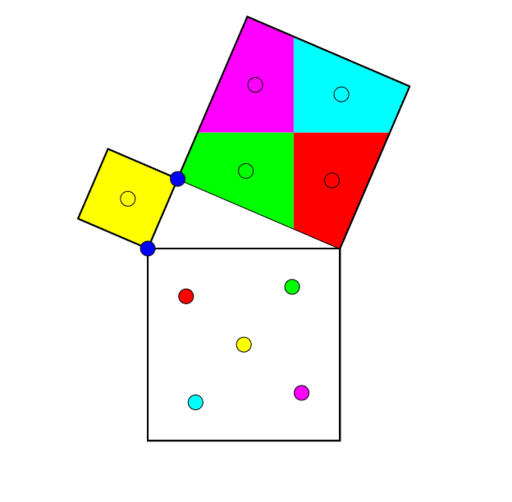
Proof Without Words – GeoGebra
UPDATED : Drag the points in the sketch below. What do you notice? What does this prove? How does this prove it? This is purposefully vague to let k…
geogebra.org →Link to a page describing this subject · 1,968 chars · not written by Vinony
Wikidata facts
- Instance of
- theorem
- Named after
- Pythagoras
- Image
- Pythagorean.svg
Show 9 more facts
- Commons category
- Pythagorean theorem
- topic's main category
- Category:Pythagorean theorem
- statement describes
- right triangle
- described at URL
- www.geogebra.org/m/ZFTGX57r
- on focus list of Wikimedia project
- Wikipedia:Vital articles/Level/4
- described by source
- New International Encyclopedia
- maintained by WikiProject
- WikiProject Mathematics
- generalization of
- parallel postulate
- studied by
- Euclidean geometry
Sources (7)
via Wikidata · CC0
~40 min read
Encyclopedic overview
Three-dimensional
Four - other-dimensional
Excerpted from Wikipedia’s “Pythagorean theorem” article, available under the CC BY-SA 4.0 licence.
Gallery (12)
Available in 140 languages
- Español
- Français
- Deutsch
- 中文
- 日本語
- Русский
- Português
- Italiano
- العربية
- हिन्दी
- abstract
- Afrikaans
- Albanian
- Albanian
- Amharic
- Aragonese
- Armenian
- Assamese
Show 121 more
- Asturian
- Awadhi
- azb
- Azerbaijani
- Bahasa Indonesia
- Balinese
- Bangla
- Bashkir
- Basque
- bat_smg
- Bavarian
- be_x_old
- Belarusian
- Bikol
- Bosnian
- Breton
- Bulgarian
- Burmese
- Catalan
- Central Dusun
- Central Kurdish
- Chuvash
- Corsican
- Croatian
- Czech
- Danish
- Egyptian Arabic
- eml
- Esperanto
- Estonian
- Fiji Hindi
- Filipino
- Finnish
- Galician
- Georgian
- Greek
- Guarani
- Gujarati
- Hebrew
- Hungarian
- Iban
- Icelandic
- Ido
- Interlingua
- Irish
- Kabardian
- Kabyle
- Kazakh
- Khmer
- Kurdish
- Kyrgyz
- Lao
- Latin
- Latvian
- Lingala
- Lingua Franca Nova
- Lithuanian
- Lombard
- Low German
- Macedonian
- Madurese
- Malagasy
- Malay
- Malayalam
- Marathi
- Mazanderani
- Mongolian
- Nederlands
- Nepali
- Northern Frisian
- Northern Sami
- Norwegian
- Norwegian Nynorsk
- Occitan
- Ossetic
- Piedmontese
- Polski
- Punjabi
- pwn
- Romanian
- Santali
- Serbian
- Serbian (Latin)
- Shona
- Sicilian
- Silesian
- simple
- Sindhi
- Sinhala
- skr
- Slovak
- Slovenian
- Somali
- Svenska
- Swahili
- Tamil
- Tatar
- Telugu
- Tiếng Việt
- Toki Pona
- Türkçe
- Turkmen
- Ukrainian
- Upper Sorbian
- Urdu
- Uzbek
- Veps
- Waray
- Welsh
- Western Panjabi
- Wu Chinese
- Yakut
- Yiddish
- Yoruba
- Zaza
- zh_classical
- zh_min_nan
- zh_yue
- فارسی
- ไทย
- 한국어
via Wikidata sitelinks · CC0