Category
page 1Events that forced the climate

Cretaceous-Paleogene mass extinction
extinction event ending the Mesozoic Era

Permian-Triassic mass extinction
mass extinction event at the end of the Permian Period approximately 250 million years ago
.jpg)
Laki
Laki () or Lakagígar (, Craters of Laki) is a volcanic fissure in the western part of Vatnajökull National Park, Iceland, not far from the volcanic fissure of Eldgjá and the small village of Kirkjubæjarklaustur. The fissure is properly referred to as Lakagígar, while Laki is a mountain that the fissure bisects. Lakagígar is part of a volcanic system centered on the volcano Grímsvötn and including the volcano Þórðarhyrna. It lies between the glaciers of Mýrdalsjökull and Vatnajökull, in an area of fissures that run in a southwest to northeast direction.
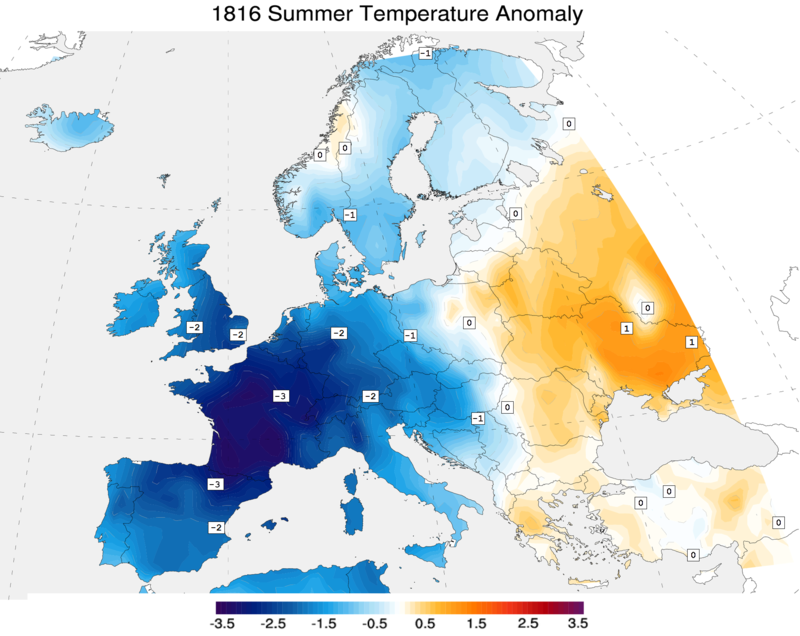
Year Without a Summer
1816, a volcanic winter event during the Little Ice Age
Siberian Traps
large igneous province in Siberia
volcanic winter
temperature anomaly event caused by a volcanic eruption

Huaynaputina
Huaynaputina ( ; ) is a volcano in a volcanic high plateau in southern Peru. Lying in the Central Volcanic Zone of the Andes, it was formed by the subduction of the oceanic Nazca Plate under the continental South American Plate. Huaynaputina is a large volcanic crater, which lacks an identifiable mountain profile, with an outer stratovolcano and three younger volcanic vents within an amphitheatre-shaped structure that is either a former caldera or a remnant of glacial erosion. The volcano has erupted dacitic magma.
Triassic-Jurassic mass extinction
mass extinction at the end of the Triassic
Minoan eruption
major volcanic eruption around 1600 BCE
Deccan Traps
large igneous province located on the Deccan Plateau
1883 eruption of Krakatoa
catastrophic volcanic eruption
Cretaceous–Paleogene boundary
geological signature, usually a thin band of rock, marking the transition from the end of the Cretaceous Period and the beginning of the Paleogene Period, dated with radiometric methods, at the age of 66.043 ± 0.011 Ma
1815 eruption of Mount Tambora
catastrophic volcanic eruption in present-day Indonesia
Azolla event
hypothetical geoclimactic event
Carnian Pluvial Event
global climate change and biotic turnover that occurred during the Carnian or early Late Triassic
Youngest Toba eruption
volcanic supereruption 74,000 years ago in Indonesia
Hatepe eruption
major volcanic eruption in New Zealand
1257 Samalas eruption
major eruption of the Samalas volcano in Indonesia
Campanian Ignimbrite eruption
VEI 7 Volcanic eruption around 40,000 years BP
Oruanui eruption
world's most recent supereruption, of Taupo Volcano, New Zealand

1991 eruption of Mount Pinatubo
volcanic eruption in the Philippines in 1991
Medea hypothesis
hypothesis that multicellular life, understood as a superorganism, is suicidal, and that microbial-triggered mass extinctions are attempts to return the Earth to a microbial-dominated state
Island Park Caldera
caldera in Idaho and Wyoming, United States
Mid-Pleistocene Transition
change in glacial cycles occurring 1 Mya (Pleistocene), from 41000-year glacial cycles (Milankovitch forcing) to 100000-year asymmetric cycles