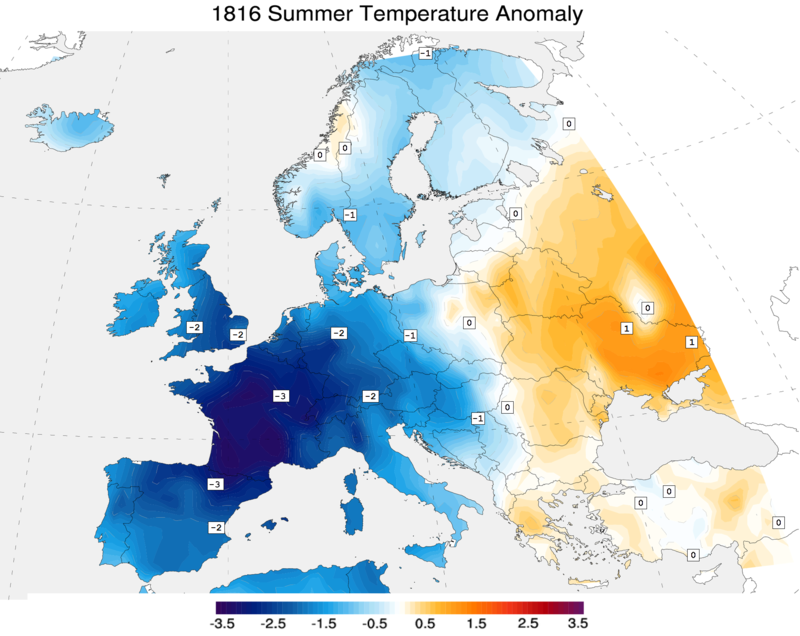
File:1816_summer.png · Wikimedia Commons · See Wikimedia Commons
Year Without a Summer
Sign in to saveAlso known as Poverty Year, Summer that Never Was, Year There Was No Summer, Eighteen Hundred and Froze to Death
1816, a volcanic winter event during the Little Ice Age
Key facts
- Volcano
- Mount Tambora
- Start date
- Eruption occurred on April 10, 1815
- Type
- Ultra-Plinian
- Location
- Lesser Sunda Islands , Dutch East Indies (now Republic of Indonesia )
- Impact
- Caused by a volcanic winter that dropped temperatures by 0.4–0.7 °C (or 0.7–1 °F) worldwide
via Wikipedia infobox
Wikidata facts
- Instance of
- volcanic winter
- Location
- Northern Europe
- Image
- 1816 summer.png
- Said to be same as
- 1816
Show 3 more facts
- has cause
- 1815 eruption of Mount Tambora
- point in time
- 1816-00-00
- Commons category
- Year without a summer
Sources (1)
via Wikidata · CC0
~21 min read
Encyclopedic overview
The year 1816 is known as the Year Without a Summer because of severe climate abnormalities that caused average global temperatures to decrease by 0.4–0.7 °C (0.7–1 °F). Summer temperatures in Europe that year were the coldest of any on record between 1766 and 2000, resulting in crop failures and major food shortages across the Northern Hemisphere.
Evidence suggests that the anomaly was predominantly a volcanic winter event caused by the massive eruption of Mount Tambora in the Dutch East Indies (modern-day Indonesia) in April 1815. This eruption was the largest in at least 1,300 years (after the hypothesized eruption causing the volcanic winter of 536); its effect on the climate may have been exacerbated by the 1814 eruption of Mayon in the Philippines. The significant amount of volcanic ash and gases released into the atmosphere blocked sunlight, leading to global cooling.
Excerpted from Wikipedia’s “Year Without a Summer” article, available under the CC BY-SA 4.0 licence.