Category
page 1Evolutionary biology concepts
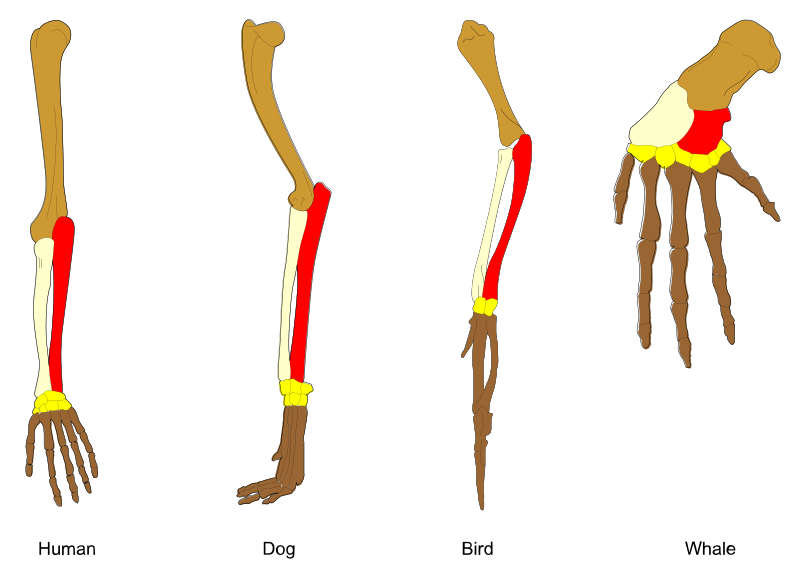
homology
existence of shared ancestry between a pair of structures, or genes, in different taxa
hygroscopy
Hygroscopy is the phenomenon of attracting and holding water molecules via either absorption or adsorption from the surrounding environment, which is usually at normal or room temperature. If water molecules become suspended among the substance's molecules, adsorbing substances can become physically changed, e.g. changing in volume, boiling point, viscosity or some other physical characteristic or property of the substance. For example, a finely dispersed hygroscopic powder, such as a salt, may become clumpy over time due to collection of moisture from the surrounding environment.

living fossil
organismic taxon that closely resembles an extinct entity, with few related living taxa

vestigial structure
thumb|In humans, the vermiform appendix was originally thought to be vestigial. Though, recent research has determined it still has useful functionality.
synergy
Synergy is the concept that a combined effect of two or more entities is greater than the sum of their individual effects. The term synergy comes from the Attic Greek word συνεργία ' from ', , meaning "working together". Synergy is similar in concept to emergence.

fitness
quantitative representation of natural and sexual selection within evolutionary biology
molecular clock
technique to deduce the time in prehistory when two or more life forms diverged

microevolution
Microevolution is the change in allele frequencies that occurs over time within a population. This change is due to four different processes: mutation, selection (natural and artificial), gene flow and genetic drift. This change happens over a relatively short (in evolutionary terms) amount of time compared to the changes termed macroevolution.
transitional fossil
fossilized remains of a life form that exhibits traits common to both an ancestral group and its derived descendant group
gene duplication
duplication of a gene sequence within a genome
survival of the fittest
phrase to describe the mechanism of natural selection
Anagenesis
Anagenesis is the gradual evolution of a species that continues to exist as an interbreeding population. This contrasts with cladogenesis, which occurs when branching or splitting occurs, leading to two or more lineages and resulting in separate species. Anagenesis does not always lead to the formation of a new species from an ancestral species. When speciation does occur as different lineages branch off and cease to interbreed, a core group may continue to be defined as the original species. The evolution of this group, without extinction or species selection, is anagenesis.
r/K selection theory
ecological theory concerning the selection of life history traits
Red Queen hypothesis
hypothesis
island gigantism
evolutionary phenomena leading to an increase of the size of species with insularity
deep-sea gigantism
tendency for deep-sea species to be larger than their shallower-water relatives across a large taxonomic range

cladogenesis
thumb|right|260px|An example of cladogenesis today is the Hawaiian Islands|Hawaiian archipelago, to which stray organisms traveled across the ocean via ocean currents and winds. Most of the species on the islands are not found anywhere else on Earth due to evolutionary divergence.

The Extended Phenotype
essay by Richard Dawkins

heterochrony
thumb|upright=1.3|Giraffes acquired their long necks through heterochrony, extending the development period of the seven neck [[vertebrae's growth in the embryo to add length to the bones, not by adding more bones.]]

homoplasy
Homoplasy, in biology and phylogenetics, is the term used to describe a feature that has been gained or lost independently in separate lineages over the course of evolution. This is different from homology, which is the term used to characterize the similarity of features that can be parsimoniously explained by common ancestry. Homoplasy can arise from both similar selection pressures acting on adapting species, and the effects of genetic drift. thumb|Homoplasy is the similarity in a feature that is not parsimoniously explained by descent from a common ancestor.
Muller's ratchet
irreversible accumulation of deleterious mutations in the absence of genetic recombination
biological specificity
tendency of a characteristic such as a behavior or a biochemical variation to occur in a particular species
spandrel
phenotypic characteristic that is a byproduct of the evolution of some other characteristic
Mosaic evolution
evolution of characters at various rates both within and between species
C-value enigma
human vestigiality
human traits which lost their original function through evolution

genetic admixture
result of interbreeding between two or more previously isolated populations within a species
grade
non-monophyletic grouping of organisms united by morphological or physiological characteristics

inclusive fitness
measure of evolutionary success based on the number of offspring the individual supports
frequency-dependent selection
biological selection that depends on the abundance of each phenotype in the population
wallace effect
process of speciation where natural selection increases the reproductive isolation between two populations of species
Arctometatarsal
thumb|Tyrannosaurus foot showing the compressed arctometatarsalian condition of the middle [[metatarsal, compared to that of Allosaurus]]
An arctometatarsalian organism is one in which the proximal part of the middle metatarsal is pinched between the surrounding metatarsals. The trait appears to be highly homoplastic, common in certain sorts of dinosaurs accustomed to running (among them the tyrannosauroids, ornithomimosaurs, and troodontids), to evenly transmit force to the metatarsals.
genetic load
measure in population genetics
heterologous expression
the expression of a gene or part of a gene in a host organism that does not naturally have the gene or gene fragment in question
universal adaptive strategy theory
evolutionary theory developed by J. P. Grime based on the trade-off between growth, maintenance and regeneration
density dependence
density-dependent processes occur when population growth rates are regulated by the density of a population
Bet-hedging
Biological theorem
Evolutionary trap
cases in which an evolved, and presumably adaptive, trait has suddenly become maladaptive
Operational sex ratio
A quantitative ratio of sexually active population