File:Homology_vertebrates-en.svg · Wikimedia Commons · See Wikimedia Commons
homology
Sign in to saveAlso known as homologous organs
existence of shared ancestry between a pair of structures, or genes, in different taxa
Homology is the similarity between structures or genes in different species that exists because they inherited them from a common ancestor. It matters because recognizing these shared features helps scientists understand how different species are related to each other and how life evolved over time.
AI-generated from the Wikipedia summary — may contain errors.
Wikidata facts
- Subclass of
- similarity
Show 5 more facts
- Commons category
- Homology
- Commons gallery
- Homology
- opposite of
- analogy
- has cause
- common descent
- different from
- analogy
via Wikidata · CC0
~19 min read
Encyclopedic overview
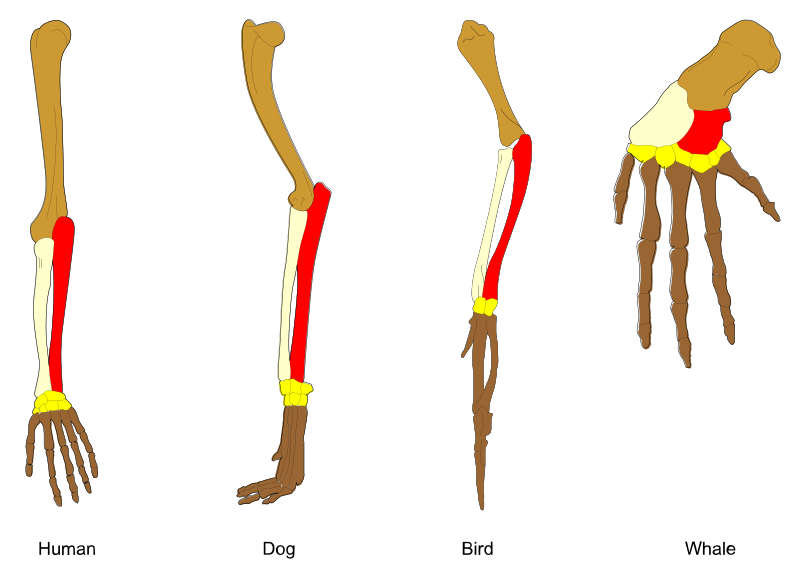
The principle of homology: The biological relationships (shown by colours) of the bones in the forelimbs of vertebrates were used by Charles Darwin as an argument in favor of evolution. In biology, homology is similarity in anatomical structures or genes between organisms of different taxa due to shared ancestry, regardless of current functional differences. Evolutionary biology explains homologous structures as retained heredity from a common ancestor after having been subjected to adaptive modifications for different purposes as the result of natural selection.
The term was first applied to biology in a non-evolutionary context by the anatomist Richard Owen in 1843. Homology was later explained by Charles Darwin's theory of evolution in 1859, but had been observed before this from Aristotle's biology onwards, and it was explicitly analysed by Pierre Belon in 1555. A common example of homologous structures is the forelimbs of vertebrates, where the wings of bats and birds, the arms of primates, the front flippers of whales, and the forelegs of four-legged vertebrates like horses and crocodilians are all derived from the same ancestral tetrapod structure.
Excerpted from Wikipedia’s “homology” article, available under the CC BY-SA 4.0 licence.