Category
page 1Evolutionary biology terminology

conservation status
indication of the chance of a species' extinction, regardless of authority used

adaptation
In biology, adaptation has three related meanings. Firstly, it is the dynamic evolutionary process of natural selection that fits organisms to their environment, enhancing their evolutionary fitness. Secondly, it is a state reached by the population during that process. Thirdly, it is a phenotypic trait or adaptive trait, with a functional role in each individual organism, that is maintained and has evolved through natural selection.

clade
thumb|400px| Cladogram (a branching tree diagram) illustrating the relationships of organisms within groups of taxa known as clades. The vertical line (stem) at the base (bottom) represents the [[last common ancestor. The blue and red subgroups are clades, each defined by a common ancestor stem at the base of its respective subgroup (branch). The green subgroup alone, however, is not a clade; it is a paraphyletic group relative to the blue subgroup because it excludes the blue branch, which shares the same common ancestor. Together, the green and blue subgroups form a clade.]]
.jpg)
endemism
thumb|Both the orange-breasted sunbird (Anthobaphes violacea) and the [[Kniphofia uvaria plant it feeds on are found exclusively in South Africa.]]
thumb|Bicolored frog (Clinotarsus curtipes) is endemic to the [[Western Ghats of India.]]
thumb|Montezuma Well in the [[Verde Valley of Arizona contains at least five endemic species found exclusively in the sinkhole.]]

convergent evolution
independent evolution of similar features in species of different lineages; creates analogous structures
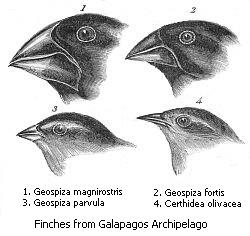
adaptive radiation
evolutionary radiation to fill many ecological niches
Anagenesis
Anagenesis is the gradual evolution of a species that continues to exist as an interbreeding population. This contrasts with cladogenesis, which occurs when branching or splitting occurs, leading to two or more lineages and resulting in separate species. Anagenesis does not always lead to the formation of a new species from an ancestral species. When speciation does occur as different lineages branch off and cease to interbreed, a core group may continue to be defined as the original species. The evolution of this group, without extinction or species selection, is anagenesis.
synapomorphy
heritable trait shared by two or more taxa and thus thought to have evolved in their most recent common ancestor
biological function
reason some object or process occurred in a system that evolved through a process of natural selection

autapomorphy
thumb|279px|Phylogenies showing the terminology used to describe different patterns of ancestral and derived character or trait states (such as the evolution of a [[flatfish).]]
In phylogenetics, an autapomorphy is a distinctive feature, known as a derived trait, that is unique to a given taxon. That is, it is found only in one taxon, but not found in any others or outgroup taxa, not even those most closely related to the focal taxon (which may be a species, family or in general any clade). It can therefore be considered as an apomorphy in relation to a single taxon. The word autapomorphy, int
Evolutionary radiation
increase in taxonomic diversity or morphological disparity, due to adaptive change or the opening of ecospace

cephalization
thumb|upright=1.5|A lobster is heavily cephalized, with eyes, antennae, multiple mouthparts, and the brain (inside the armoured [[exoskeleton), all concentrated at the animal's head end.]]
grade
non-monophyletic grouping of organisms united by morphological or physiological characteristics
hybrid speciation
form of speciation where hybridization between two different species leads to a new species, reproductively isolated from the parent species