Category
page 1Exotic matter

dark matter
mysterious non-luminous matter (and/or radiation) comprising most of the matter in our observable universe

neutrino
A neutrino ( ; denoted by the Greek letter Nu (letter)|) is an elementary particle that interacts via the weak interaction and gravity. The neutrino is so named because it is electrically neutral and because its rest mass is so small (-ino) that it was long thought to be zero. The rest mass of the neutrino is much smaller than that of the other known elementary particles (excluding massless particles).

neutron star
collapsed core of a massive star consisting mainly of neutrons

white dwarf
type of stellar remnant composed mostly of electron-degenerate matter

superconductivity
thumb|A high-temperature superconductor levitating above a magnet. A persistent electric current flows on the surface of the superconductor, acting to exclude the magnetic field of the magnet (Meissner effect). This current effectively forms an electromagnet that repels the magnet.

wormhole
thumb|upright=1.3|A wormhole visualized as a two-dimensional surface. Route (a) is the shortest path through normal space between points 1 and 2; route (b) is a shorter path through a wormhole.

Bose–Einstein condensate
state of matter of a dilute gas of bosons cooled to temperatures very near absolute zero

degenerate matter
collection of free, non-interacting particles with a pressure and other physical characteristics determined by quantum mechanical effects
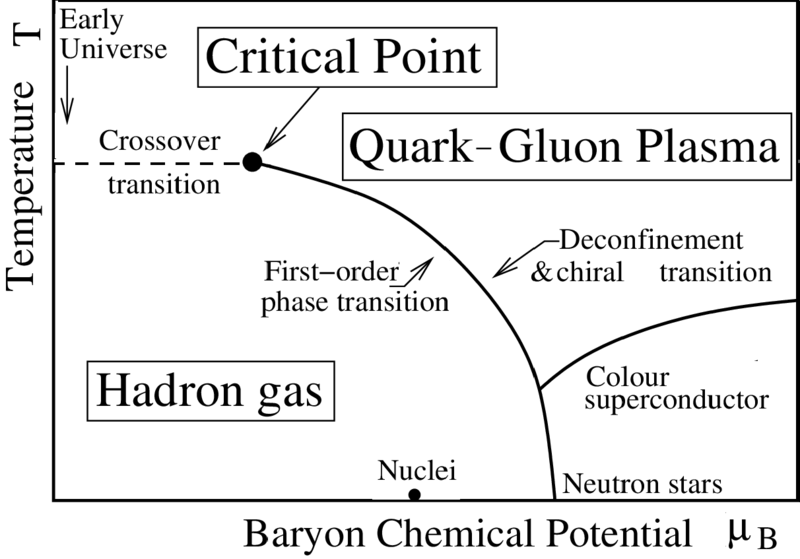
quark–gluon plasma
phase of quantum chromodynamics characterised by an assembly of quarks and gluons at thermal and chemical equilibrium

compact object
classification in astronomy

hyperon
In particle physics, a hyperon is any baryon containing one or more strange quarks, but no charm, bottom, or top quarks. This form of matter may exist in a stable form within the core of some neutron stars. Hyperons are sometimes generically represented by the symbol Y.
quark star
hypothetical type of exotic star
neutronium
Neutronium (or element zero) is a hypothetical substance made purely of neutrons. The word was coined by scientist Andreas von Antropoff in 1926 (before the 1932 discovery of the neutron) for the hypothetical "element of atomic number zero" (with no protons in its nucleus) that he placed at the head of the periodic table (denoted by -).
helium flash
brief thermal runaway nuclear fusion in the core of low mass stars
fermionic condensate
non-classical state of matter
dark flow
possible non-random component of the peculiar velocity of galaxy clusters

glueball
In particle physics, a glueball (also gluonium, gluon-ball) is a hypothetical composite particle. It consists solely of gluons, without valence quarks. Such a state is possible because gluons carry color charge and experience the strong interaction between themselves. Glueballs are extremely difficult to identify in particle accelerators, because they mix with ordinary meson states. In pure gauge theory, glueballs are the only states of the spectrum and some of them are stable.
weakly interacting massive particle
dark matter candidate
exotic matter
unusual or hypothetical physical substance or state
strange matter
Degenerate matter made from strange quarks
negative mass
hypothetical type of exotic matter whose mass is of opposite sign to the mass of normal matter
massive compact halo object
astronomical body that might explain the apparent presence of dark matter in galaxy halos
hypernucleus
A hypernucleus is similar to a conventional atomic nucleus, but contains at least one hyperon in addition to the normal protons and neutrons. Hyperons are a category of baryon particles that carry non-zero strangeness quantum number, which is conserved by the strong and electromagnetic interactions.
strangelet
A strangelet (pronounced ) is a hypothetical particle consisting of a bound state of roughly equal numbers of up, down, and strange quarks. An equivalent description is that a strangelet is a small fragment of strange matter, small enough to be considered a particle. The size of an object composed of strange matter could, theoretically, range from a few femtometers across (with the mass of a light nucleus) to arbitrarily large. Once the size becomes macroscopic (on the order of meters across), such an object is usually called a strange star. The term "strangelet" originates with Edward Farhi a
nuclear pasta
degenerate matter within the crusts of neutron stars which forms complex structures said to resemble pasta
quantum fluid
system that exhibits quantum mechanical effects at the macroscopic level, such as superfluids, superconductors, ultracold atoms, etc.
strange star
quark star made of strange quark matter

macroscopic quantum phenomena
processes showing quantum behavior at the macroscopic scale, rather than at the atomic scale where quantum effects are prevalent; macroscopic scale quantum coherence leads to macroscopic quantum phenomena
Rydberg matter
an exotic phase of matter formed by Rydberg atoms