File:PhasDiagQGP.png · Wikimedia Commons · See Wikimedia Commons
quark–gluon plasma
Sign in to saveAlso known as QGP, quark soup, quark-gluon plasma
phase of quantum chromodynamics characterised by an assembly of quarks and gluons at thermal and chemical equilibrium
Wikidata facts
- Subclass of
- QCD matter
- Has part
- antiquark
- Image
- Quark-gluon-plasma.jpg
Show 9 more facts
- facet of
- hadron
- short name
- QGP
- Commons category
- Quark-gluon plasma
- research site
- CERN
- location of discovery
- CERN
- time of discovery or invention
- 2000-02-10
- has characteristic
- color confinement
- on focus list of Wikimedia project
- Wikipedia:Vital articles/Level/4
- Stack Exchange tag
- physics.stackexchange.com/tags/quark-gluon-plasma
via Wikidata · CC0
~22 min read
Encyclopedic overview
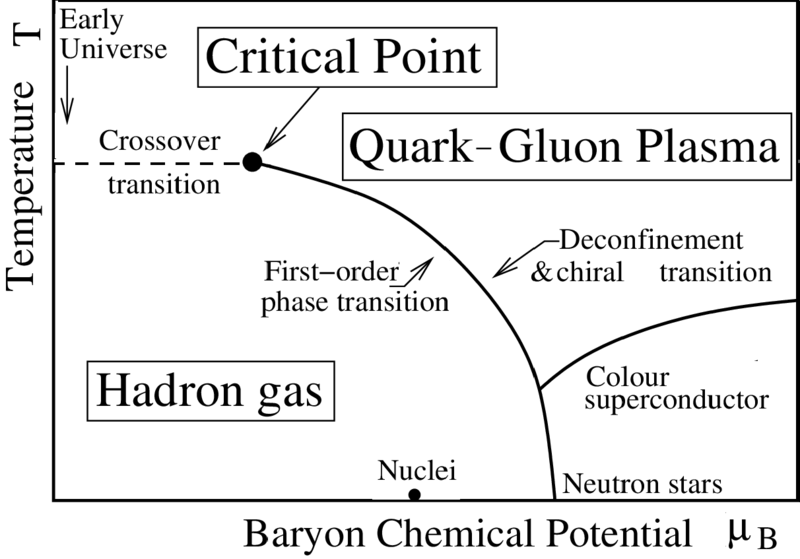
QCD phase diagram. Adapted from original made by R.S. Bhalerao. Quark–gluon plasma (QGP or quark soup) is an interacting localized assembly of quarks and gluons in chemical equilibrium and local thermal equilibrium. The word plasma signals that free color charges are allowed. In normal matter quarks are confined; in the QGP quarks are deconfined. Quark–gluon plasma (QGP) occurs at energy densities high enough to melt the protons and neutrons that make up the nuclei of normal matter. It is a very low viscosity liquid composed of the elementary particles, quarks and gluons, a state of matter new to physics when it was discovered.
Quark–gluon plasma is studied to understand the characteristics of the universe at about 20 μs after the Big Bang, when the universe was extremely hot and dense. Experimental groups use ultrarelativistic beams of ions colliding with other ions or protons to create this plasma in particle accelerators.
Excerpted from Wikipedia’s “quark–gluon plasma” article, available under the CC BY-SA 4.0 licence.