Category
page 1Extant Late Triassic first appearances

Odonata
Odonata is an order of predatory flying insects that includes the dragonflies and damselflies (as well as the Epiophlebia damsel-dragonflies). The two major groups are distinguished with dragonflies (Anisoptera) usually being bulkier with large compound eyes together and wings spread up or out at rest, while damselflies (suborder Zygoptera) are usually more slender with eyes placed apart and wings folded together along body at rest. Adult odonates can land and perch, but rarely walk.
%20Scottsdale.jpg)
monotreme
Monotremes () are mammals of the order Monotremata. They are the only mammals still in existence which lay eggs, rather than bearing live young. The five extant monotreme species are the platypus and the four species of echidnas. Monotremes are typified by structural differences in their brains, jaws, digestive tracts, reproductive tracts, and other body parts, compared to the more common mammalian types. Although they are different from other living mammals in that they lay eggs, female monotremes are like other mammals in that they nurse their young with milk.

Q122422
Squamata (, Latin squamatus, 'scaly, having scales') is the largest order of reptiles; most members of which are commonly known as lizards, with the group also including snakes. With over 11,991 species, it is also the second-largest order of extant (living) vertebrates, after the perciform fish. Squamates are distinguished by their skins, which bear horny scales or shields, and periodically undergo molting. They also possess movable quadrate bones, making possible movement of the upper jaw relative to the neurocranium. This is particularly visible in snakes, which are able to open their mouth

Dermaptera
Earwigs make up the insect order Dermaptera. With about 2,000 species in 12 families, they are one of the smaller insect orders. Earwigs have characteristic cerci, a pair of forceps-like pincers on their abdomen, and membranous wings folded underneath short, rarely used forewings, hence the scientific order name, "skin wings". Some groups are tiny parasites on mammals and lack the typical pincers. Earwigs are found on all continents except Antarctica.

Sciadopitys verticillata
species of plant
Psychodidae
Psychodidae, also called drain flies, sink flies, filter flies, sewer flies, or sewer gnats, is a family of true flies. Some genera have short, hairy bodies and wings, giving them a "furry" moth-like appearance, hence one of their common names, moth flies. Members of the sub-family Phlebotominae, which are hematophagous (feed on blood), may be called sand flies in some countries, although this term is also used for other unrelated flies, such as horse flies (Tabanidae) and no-see-ums (Ceratopogonidae).

Cicadoidea
The cicadas () are a superfamily, the Cicadoidea, of insects in the order Hemiptera (true bugs). They are in the suborder Auchenorrhyncha, along with smaller jumping bugs such as leafhoppers and froghoppers. The superfamily is divided into two families, the Tettigarctidae, with two species in Australia, and the Cicadidae, with more than 3,000 species described from around the world; many species remain undescribed. Nearly all cicada species are annual cicadas with the exception of the few North American periodical cicada species, genus Magicicada, which in a given region emerge en masse every

Crocodylomorpha
Crocodylomorpha is a group of pseudosuchian archosaurs that includes the crocodilians and their extinct relatives. They were the only members of Pseudosuchia to survive the end-Triassic extinction. Extinct crocodylomorphs were considerably more ecologically diverse than modern crocodilians. The earliest and most primitive crocodylomorphs are represented by "sphenosuchians", a paraphyletic assemblage containing small-bodied, slender forms with elongated limbs that walked upright, which represents the ancestral morphology of Crocodylomorpha. These forms persisted until the end of the Jurassic. D
Mammaliaformes
Mammaliaformes ("mammalian forms") is a clade of synapsid tetrapods that includes the crown group mammals and their closest extinct relatives; the group radiated from earlier probainognathian cynodonts during the Late Triassic. It is defined as the clade originating from the most recent common ancestor of Morganucodonta and the crown group mammals; the latter is the clade originating with the most recent common ancestor of extant Monotremata, Marsupialia and Placentalia. Besides Morganucodonta and the crown group mammals, Mammaliaformes also includes Docodonta and Hadrocodium.

Anomura
Anomura (sometimes Anomala) is a group of decapod crustaceans, including hermit crabs and others. Several groups such as the king crabs and porcelain crabs within the Anomura have independently undergone carcinisation, acquiring the armoured crab body plan with a concealed tail. It is the sister group to the "true crabs" or Brachyura.
%2C%20Vohimana%20reserve%2C%20Madagascar%20(13569458513).jpg)
Belostomatidae
Belostomatidae is a family of freshwater hemipteran insects known as giant water bugs or colloquially as toe-biters, Indian toe-biters, electric-light bugs (because they fly to lights in large numbers), alligator ticks, or alligator fleas (in Florida). They are the largest insects in the order Hemiptera. There are about 170 species found in freshwater habitats worldwide, with more than 110 in the Neotropics, more than 20 in Africa, almost as many in the Nearctic, and far fewer elsewhere. These predators are typically encountered in freshwater ponds, marshes and slow-flowing streams. Most speci

Coccosphaerales
thumb|upright=1.1|Coccolithophore cells are covered with protective calcified (chalk) scales called coccoliths

Grylloidea
Grylloidea is the superfamily of insects, in the order Orthoptera, known as crickets. It includes the "true crickets", scaly crickets, wood crickets and many other subfamilies, now placed in six extant families; some genera are only known from fossils.

Dipluridae
The family Dipluridae, known as curtain-web spiders (or confusingly as funnel-web tarantulas, a name shared with other distantly related families) are a group of spiders in the infraorder Mygalomorphae, that have two pairs of booklungs, and chelicerae (fangs) that move up and down in a stabbing motion. A number of genera, including that of the Sydney funnel-web spider (Atrax), used to be classified in this family but have now been moved to Atracidae.

Proganochelys
Proganochelys is a genus of extinct, primitive stem-turtle. Proganochelys was named by Georg Baur in 1887 as the oldest turtle in existence at the time. The name Proganochelys comes from the Greek word ganos meaning 'brightness', combined with prefix pro, 'before', and Greek base chelys meaning 'turtle'. Proganochelys is believed to have been around 1 meter in size and herbivorous in nature. Proganochelys had been known as the most primitive stem-turtle for over a century, until the novel discovery of Odontochelys in 2008. Odontochelys and Proganochelys share unique primitive features that are

Euechinoidea
The subclass Euechinoidea includes almost all living species of sea urchin, with fossil forms going back as far as the Triassic.
Testudinata
Testudinata is the group of all tetrapods with a true turtle shell. It includes both modern turtles (Testudines) and many of their extinct, shelled relatives (stem-turtles), though excluding Odontochelys and Eorhynchochelys, which are placed in the more inclusive Pantestudines.

Aporrhais
Aporrhais is a genus of medium-sized sea snails, marine gastropod mollusks in the family Aporrhaidae and the superfamily Stromboidea.
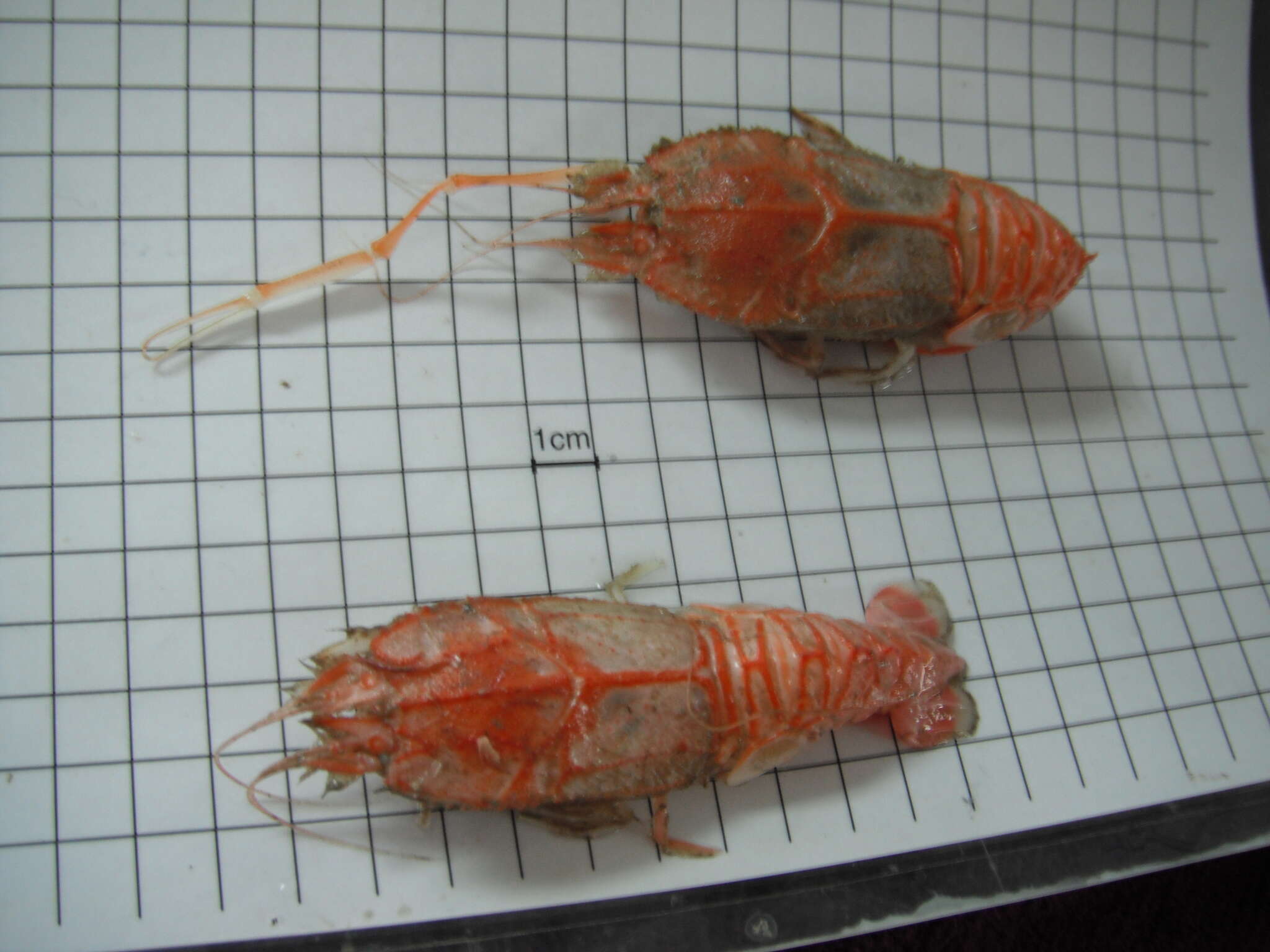
Polychelida
Polychelida is an infraorder of decapod crustaceans. Fossil representatives are known dating from as far back as the Upper Triassic. A total of 38 extant species, all in the family Polychelidae, and 55 fossil species have been described.
Prozostrodontia
Prozostrodontia is a clade of cynodonts including mammaliaforms and their closest relatives such as Tritheledontidae and Tritylodontidae. It was erected as a node-based taxon by Liu and Olsen (2010) and defined as the least inclusive clade containing Prozostrodon brasiliensis, Tritylodon langaevus, Pachygenelus monus, and Mus musculus (the house mouse). Prozostrodontia is diagnosed by several characters, including:
Reduced prefrontal and postorbital bones, with the disappearance of a strut of bone called the postorbital bar separating the eye socket from the temporal region
Unfused symphysis
Diadematacea
The Diadematacea are a superorder of sea urchins. Unlike most other sea urchins, they generally have hollow spines. The tubercles on their tests are perforated, and most species possess gills.
Yinotheria
Yinotheria is a proposed basal subclass clade of crown mammals uniting the Shuotheriidae, an extinct group of mammals from the Jurassic of Eurasia, with Australosphenida, a group of mammals known from the Jurassic to Cretaceous of Gondwana, which possibly include living monotremes. Today, there are only five surviving species of monotremes which live in Australia and New Guinea, consisting of the platypus and four species of echidna. Fossils of yinotheres have been found in Britain, China, Russia, Madagascar and Argentina. Contrary to other known crown mammals, they retained postdentary bones

Omma
Omma is a genus of beetles in the family Ommatidae. Omma is an example of a living fossil. The oldest species known, O. liassicum, lived during the final stage of the Triassic (Rhaetian), over 200 million years ago, though the placement of this species in Omma has been questioned. Numerous other fossil species are known from the Jurassic and Cretaceous of Europe and Asia. The only living species is Omma stanleyi, which is endemic to Australia. Three other extant species endemic to Australia that were formerly part of this genus were moved to the separate genus Beutelius in 2020. Omma stanleyi
Mammaliamorpha
Mammaliamorpha is a clade of cynodonts. It contains the clades Tritylodontidae and Mammaliaformes, as well as a few genera that do not belong to either of these groups. The family Tritheledontidae has also been placed in Mammaliamorpha by some phylogenetic analyses, but has been recovered outside the clade by others. According to a 2022 study based on inner ear anatomy, Mammaliamorpha may be the clade in which endothermy ("warm-bloodedness") first appeared in the mammalian lineage.