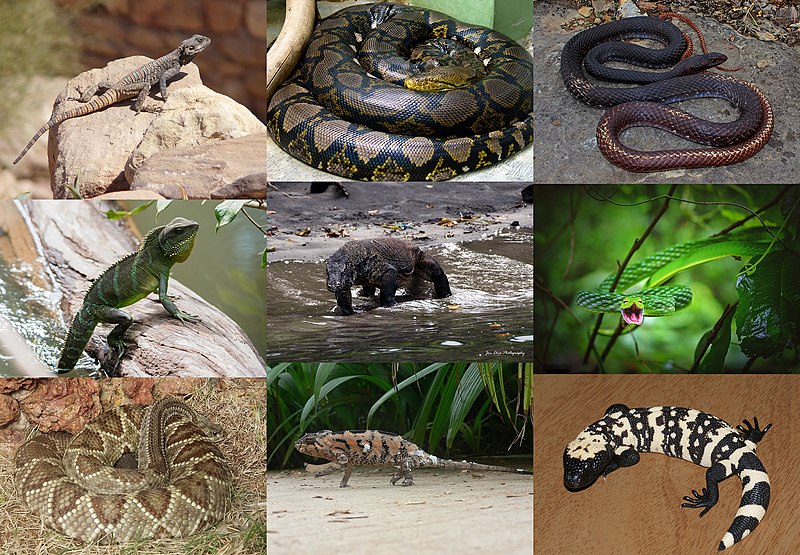
File:Squamata-01.jpg · Wikimedia Commons · See Wikimedia Commons
Squamata
Sign in to saveAlso known as scaled reptile
Squamata (, Latin squamatus, 'scaly, having scales') is the largest order of reptiles; most members of which are commonly known as lizards, with the group also including snakes. With over 11,991 species, it is also the second-largest order of extant (living) vertebrates, after the perciform fish. Squamates are distinguished by their skins, which bear horny scales or shields, and periodically undergo molting. They also possess movable quadrate bones, making possible movement of the upper jaw relative to the neurocranium. This is particularly visible in snakes, which are able to open their mouth
Squamata is the largest order of reptiles, encompassing over 11,991 species of lizards and snakes, making it the second-largest group of living vertebrates overall. These animals are defined by their scaly skin that sheds periodically and by a special jaw structure that allows their upper jaw to move independently—a feature especially notable in snakes, which can open their mouths extremely wide.
AI-generated from the Wikipedia summary — may contain errors.
Species
Лускаті
Order
- PhylumChordata
- OrderSquamata
via
Wikidata facts
- Instance of
- taxon
- Subclass of
- Reptilia
- Parent taxon
- Lepidosauria
- Image
- Anole and snake.jpg
Show 10 more facts
- taxon rank
- order
- taxon name
- Squamata
- Commons category
- Squamata
- Code of nomenclature
- International Code of Zoological Nomenclature
- topic's main category
- Category:Squamata
- taxon common name
- Чешуйчатые
- start time
- 199000000-
- described by source
- Granat Encyclopedic Dictionary
- IPA transcription
- skwəˈmɑtə
- temporal range start
- Late Triassic
via Wikidata · CC0
~22 min read
Encyclopedic overview
13 sectionsContents
- Evolution
- Reproduction
- Facultative parthenogenesis
- Inbreeding avoidance
- Evolution of venom
- Humans and squamates
- Bites and fatalities
- Conservation
- Classification and phylogeny
- List of extant families
- References
- Further reading
- External links
Squamata (, Latin squamatus, 'scaly, having scales') is the largest order of reptiles; most members of which are commonly known as lizards, with the group also including snakes. With over 11,991 species, it is also the second-largest order of extant (living) vertebrates, after the perciform fish. Squamates are distinguished by their skins, which bear horny scales or shields, and periodically undergo molting. They also possess movable quadrate bones, making possible movement of the upper jaw relative to the neurocranium. This is particularly visible in snakes, which are able to open their mouths very widely to accommodate comparatively large prey. Squamates are the most variably sized living reptiles, ranging from the dwarf gecko (Sphaerodactylus ariasae) to the reticulated python (Malayopython reticulatus). The now-extinct mosasaurs reached lengths over .
Among other reptiles, squamates are most closely related to the tuatara, the last surviving member of the once diverse Rhynchocephalia, with both groups being placed in the superorder Lepidosauria.
Excerpted from Wikipedia’s “Squamata” article, available under the CC BY-SA 4.0 licence.
Gallery (52)
Available in 88 languages
- Español
- Français
- Deutsch
- 中文
- 日本語
- Русский
- Português
- Italiano
- العربية
- हिन्दी
- Afrikaans
- Aragonese
- Armenian
- Asturian
- azb
- Azerbaijani
- Bahasa Indonesia
- Balinese
Show 69 more
- Basque
- be_x_old
- Belarusian
- Bosnian
- Breton
- Bulgarian
- Catalan
- Cebuano
- Chuvash
- Croatian
- Czech
- Danish
- Egyptian Arabic
- Esperanto
- Estonian
- Extremaduran
- Filipino
- Finnish
- Galician
- Georgian
- Greek
- Hebrew
- Hungarian
- Icelandic
- Interlingua
- Javanese
- Kabyle
- Kazakh
- Kurdish
- Kyrgyz
- Latin
- Latvian
- Limburgish
- Lithuanian
- Luxembourgish
- Macedonian
- Malay
- Nederlands
- Northern Frisian
- Norwegian
- Norwegian Nynorsk
- Occitan
- Ossetic
- Polski
- Romanian
- Scots
- Serbian
- simple
- Slovak
- Slovenian
- Sundanese
- Svenska
- Tamil
- Tiếng Việt
- Türkçe
- Ukrainian
- Uzbek
- Waray
- West Flemish
- Western Frisian
- Western Mari
- Western Panjabi
- Wu Chinese
- Zeelandic
- zh_min_nan
- zh_yue
- فارسی
- ไทย
- 한국어
via Wikidata sitelinks · CC0