Category
page 1Extant Middle Jurassic first appearances

mammal
A mammal () is a vertebrate animal of the class Mammalia (). Mammals are characterised by the presence of milk-producing mammary glands for feeding their young, a broad neocortex region of the brain, fur or hair, and three middle ear bones. These characteristics distinguish them from reptiles and birds, from which their ancestors diverged in the Carboniferous period over 300 million years ago. Around 6,640 extant species of mammals have been described and divided into 27 orders. The study of mammals is called mammalogy.
%3B%20adult%2C%20pupa%2C%20egg%20and%20lar%20Wellcome%20V0022501EL.jpg)
flea
Flea, the common name for the order Siphonaptera, includes 2,500 species of small flightless insects that live as external parasites of mammals and birds. Fleas live by ingesting the blood of their hosts. Adult fleas grow to about long, are usually dark in color, and have bodies that are "flattened" sideways or narrow, enabling them to move through their hosts' fur or feathers. They lack wings; their hind legs are extremely well adapted for jumping. Their claws keep them from being dislodged, and their mouthparts are adapted for piercing skin and sucking blood. Some species can leap 50 times t

Equisetum
Equisetum (; horsetail) is the only living genus in Equisetaceae, a family of vascular plants that reproduce by spores rather than seeds.

Theria
Theria ( or ; ) is a subclass of mammals amongst the Theriiformes. Theria contains the eutherians (which includes placental mammals) and the metatherians (which includes marsupials) but excludes the egg-laying monotremes and various extinct mammals evolving prior to the common ancestor of placentals and marsupials.

Lucanidae
family of beetles

Cryptobranchidae
family of salamanders

Hexanchiformes
The Hexanchiformes /hɛkˈsæŋkɪfɔːrmiːz/ are a primitive order of sharks, numbering just five extant species in two families, Chlamydoselachidae and Hexanchidae. Chlamydoselachidae are also known as frilled sharks, these sharks are very rare fishes and typically reside in deeper waters. Hexanchidae are also known as cow sharks and are the lesser known of the two types of Hexanchiformes and also reside in deep waters.
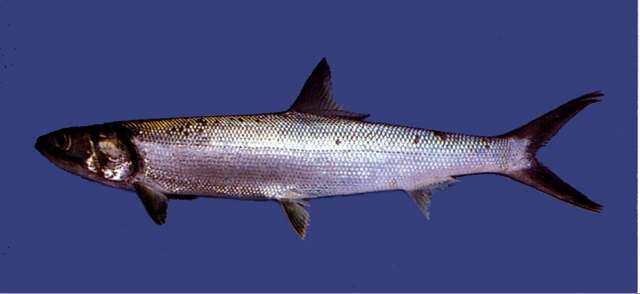
Elopiformes
The Elopiformes are the order of ray-finned fish including the tarpons, tenpounders, and ladyfish, as well as a number of extinct types. They have a long fossil record, easily distinguished from other fishes by the presence of an additional set of bones in the throat.
%20male%20Toliara.jpg)
Opluridae
The Opluridae, or Madagascan iguanas, are a family of moderately-sized lizards native to Madagascar and Grande Comore. There are eight species across two genera, with most of them being under Oplurus. The other genus, Chalarodon, is easily distinguishable from Oplurus as it contains species with a dorsal crest, particularly distinct in males, and has a smoother tail covered in similarly sized scales. Genus Oplurus has large segmented spiny scales, and no dorsal crest along the spine.
.jpg)
Scincomorpha
Scincomorpha is an infraorder and clade of lizards including skinks (Scincidae) and their close relatives. These include the living families Cordylidae (girdled lizards), Gerrhosauridae (plated lizards), and Xantusiidae (night lizards), as well as many extinct taxa. Other roughly equivalent terms include the suborder Scinciformata, or the superfamily Scincoidea, though different authors use these terms in a broader or more restricted usage relative to true skinks. They first appear in the fossil record about 170 million years ago, during the Jurassic period.

Unionidae
The Unionidae are a family of freshwater mussels, the largest in the order Unionida, the bivalve molluscs sometimes known as river mussels, or simply as unionids.

Margaritiferidae
Margaritiferidae is a family of medium-sized freshwater mussels, aquatic bivalve molluscs in the order Unionida. It is the most threatened of all unionid families.
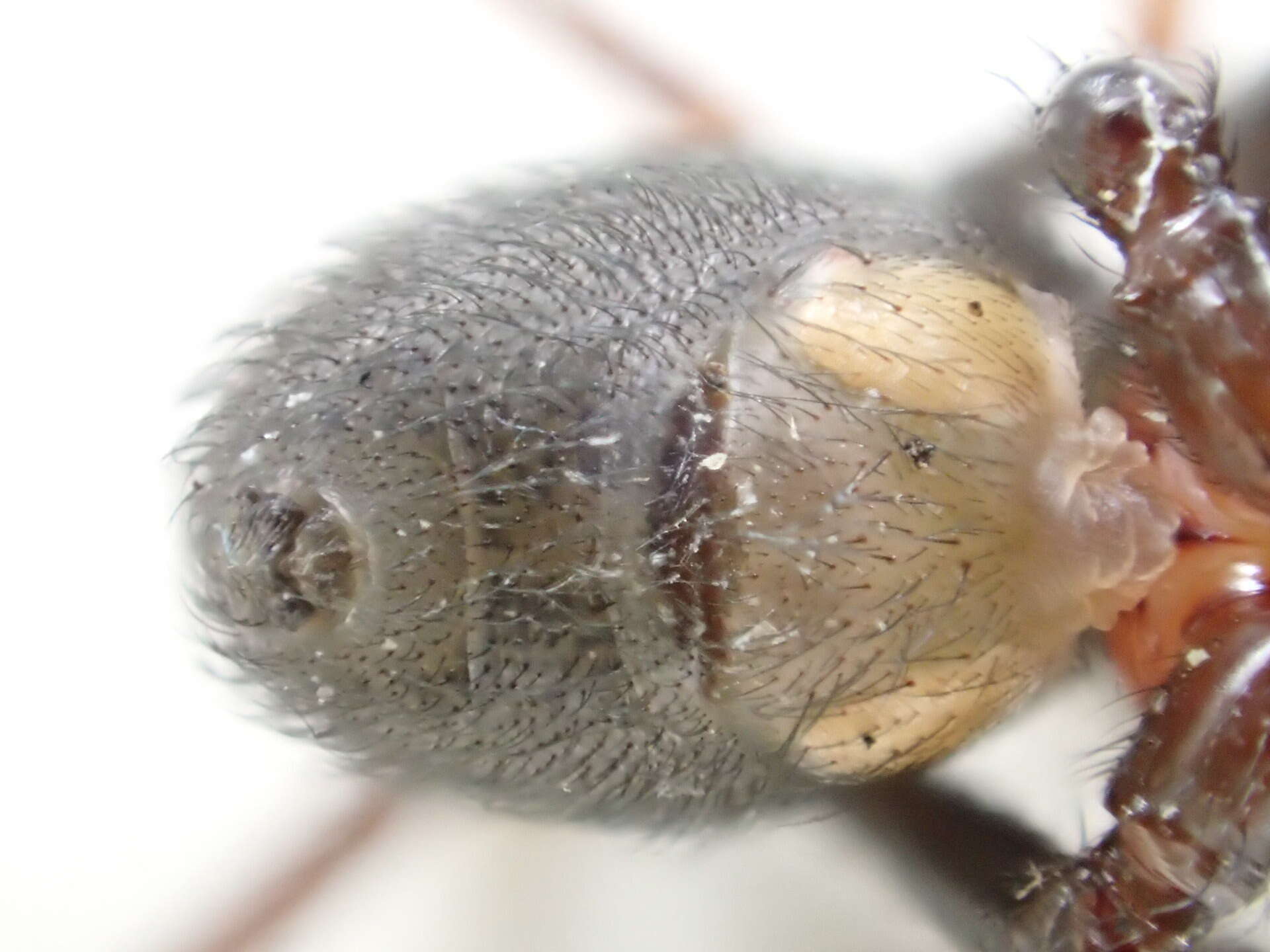
Plectreuridae
Plectreuridae, also called plectreurid spiders, is a small spider family confined to the Southwestern United States, Mexico, and the Caribbean. Only two living genera are known—the nominate genus Plectreurys and Kibramoa.

Cladotheria
Cladotheria is a clade (sometimes ranked as a legion) of mammals. It contains modern therian mammals (marsupials and placental mammals) and several extinct groups, such as the "dryolestoids", amphitheriids and peramurids. The clade was named in 1975 by Malcolm McKenna. In 2002, it was defined as a node-based taxon containing "the common ancestor of dryolestids and living therians, plus all its descendants". A different, stem-based definition was given in 2013, in which Cladotheria contains all taxa that are closer to Mus musculus (the house mouse) than to the "symmetrodont" Spalacotherium tric

Trechnotheria
Trechnotheria is a group of mammals that includes the therians and some fossil mammals from the Mesozoic Era. It includes both the extinct symmetrodonts and the living Cladotheria.

Vampyroteuthidae
Vampyroteuthidae is a family of vampyromorph cephalopods containing the extant vampire squid, Vampyroteuthis infernalis, and the extinct genera Necroteuthis, Provampyroteuthis and Vampyronassa.
Brachaelurus
Brachaelurus (blind sharks) is the sole genus of sharks in the family Brachaeluridae in the order Orectolobiformes. Only two extant species of blind sharks occur, both of which are native to shallow coastal waters up to deep, off the eastern coast of Australia.

Haplogynae
thumb|Pholcus phalangioides
The Haplogynae or haplogynes are one of the two main groups into which araneomorph spiders have traditionally been divided, the other being the Entelegynae. Morphological phylogenetic studies suggested that the Haplogynae formed a clade; more recent molecular phylogenetic studies refute this, although many of the ecribellate haplogynes do appear to form a clade, Synspermiata.

Akera
Akera is a marine genus of sea hare in the family Akeridae, known from the late Callovian (Jurassic) to the recent periods.

Ophidia
__FORCETOC__
Ophidia (also known as Pan-Serpentes) is a group of squamate reptiles including modern snakes and reptiles more closely related to snakes than to other living groups of lizards.

Echinothuriidae
The Echinothuriidae are a family of sea urchins in the order Echinothurioida. These echinoderms are typical of the Indo-Pacific these softer-bodied "leather urchins" are found from abyssal to shallow littoral zones in the ocean. While common in the Indo-Pacific these colourful urchins can be found across the world. Some individuals within Echinothuriidae such as species in the genus Asthenosoma are also known as "fire urchins" due to their bright colours and painful, venomous sting.
Nevrorthidae
The Nevrorthidae (often incorrectly spelled "Neurorthidae") are a small family of lacewings in the order Neuroptera. There are 19 extant species in four genera, with a geographically disjunct distribution: Nevrorthus, comprising 5 species with scattered distributions around the Mediterranean; Austroneurorthus, with two species known from southeastern Australia; Nipponeurorthus, comprising 11 species known from China and Japan; and Sinoneurorthus, known from a single species described from Yunnan Province, China. They are traditionally placed in the Osmyloidea, alongside Osmylidae and the spong
Coleorrhyncha
Coleorrhyncha or Peloridiomorpha, also known as moss bugs or beetle bugs, are a suborder of Hemiptera and represent an ancient lineage of moss-feeding insects. They show some similarities to the Heteroptera but have been considered distinct. It has a single extant family, the Peloridiidae. They are in length, and feed on moss and liverworts. They have wings in some species which are reduced in others but all species are flightless and live in damp moss habitats and are associated with the distribution of Nothofagus trees in Australia, New Zealand, New Caledonia, and South America, which all we

Echinothurioida
The Echinothurioida are an order of sea urchins in the class Echinoidea. Echinothurioids are distinguished from other sea urchins by the combination of a flexible test and hollow spines. The membrane around the mouth contains only simple plates, in contrast to the more complex mouth parts of their close relatives, the Diadematoida. They are nearly all deepsea dwellers.
Aeshnoidea
Aeshnoidea is a superfamily of dragonflies that contains two extant families, Aeshnidae and Austropetaliidae.
Arbacioida
Arbacioida are an order of sea urchins, consisting of a single extant family, the Arbaciidae. They are distinguished from other sea urchins by the presence of five separate plates around the anus. Unlike their close relatives, the Salenioida, all of the tubercles on their tests are of similar size.
Plagioeciidae
Plagioeciidae is a family of bryozoans, containing many genera once assigned to Diastoporidae. Extant representatives include Microecia.
Salenioida
The Salenioida are an order of sea urchins.
Pythonomorpha
REDIRECT Mosasauria#Pythonomorpha

Vermetus
Vermetus is a genus of sea snails, marine gastropod mollusks in the family Vermetidae, the worm snails or worm shells.
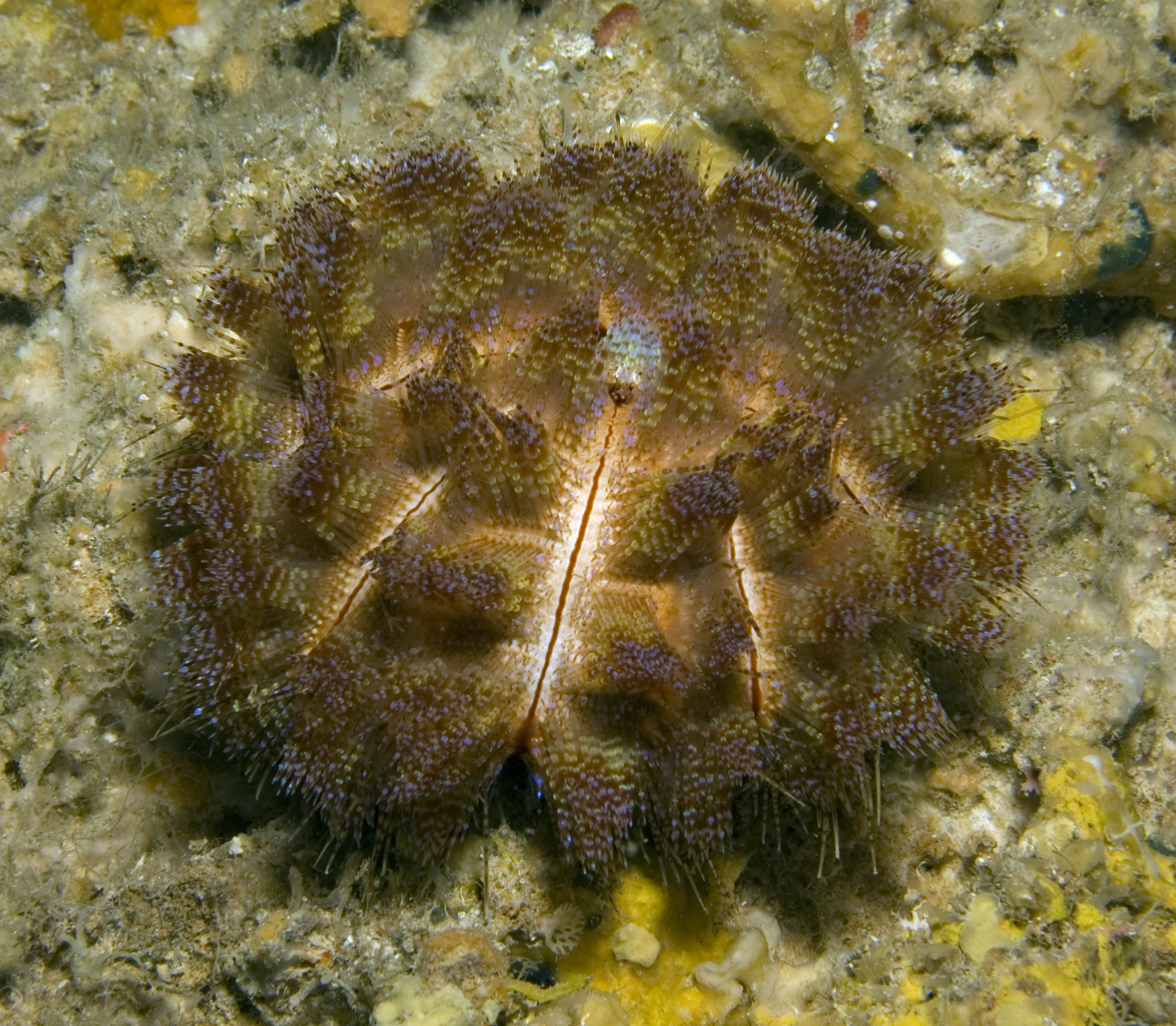
Asthenosoma
Asthenosoma is a genus of sea urchins in the family Echinothuriidae. Their spines are covered with harmful venom capsules.
Stomatoporina
Stomatoporina is a genus of stenolaematan bryozoans. The type species is Stomatoporina incurvata. Like almost all bryozoans, it is colonial.