Category
page 1Extragalactic stars

R136a1
R136a1 (short for RMC 136a1) is the most massive and luminous star known, at around 291 solar masses () and around 7.2 million times the Sun's luminosity (). It is a Wolf–Rayet star at the center of R136, the central concentration of stars of the large NGC 2070 open cluster in the Tarantula Nebula (30 Doradus) in the Large Magellanic Cloud. The cluster can be seen in the far southern celestial hemisphere with binoculars or a small telescope, at magnitude 7.25. R136a1 itself is 100 times fainter than the cluster and can only be resolved using speckle interferometry.
==Discovery==
thumb|left|upr
WOH G64
red hypergiant star in the constellation Dorado, possibly the largest well-defined star known by radius
.jpg)
Earendel
WHL0137-LS, also known as Earendel, is a star cluster or a star located in the constellation of Cetus. Discovered in 2022 with the Hubble Space Telescope, it has a comoving distance of 28 billion light-years (8.6 billion parsecs), making it the most distant known star if it is a single object. The previous farthest known star, MACS J1149 Lensed Star 1, also known as Icarus, at a comoving distance of , was discovered by Hubble in 2018. However, further observations from the James Webb Space Telescope (JWST) in the 2020s revealed that Earendel is more likely a star cluster. Objects like Earendel
S Doradus
variable star in the Large Magellanic Cloud
MACS J1149 Lensed Star 1
blue supergiant, the most distant star detected at 9 billion light years from Earth
HD 269810
star in the constellation Dorado
VFTS 352
contact binary star system
Sanduleak -69° 202
supernova in the constellation Dorado
HE 0437-5439
hypervelocity star in the constellation Dorado
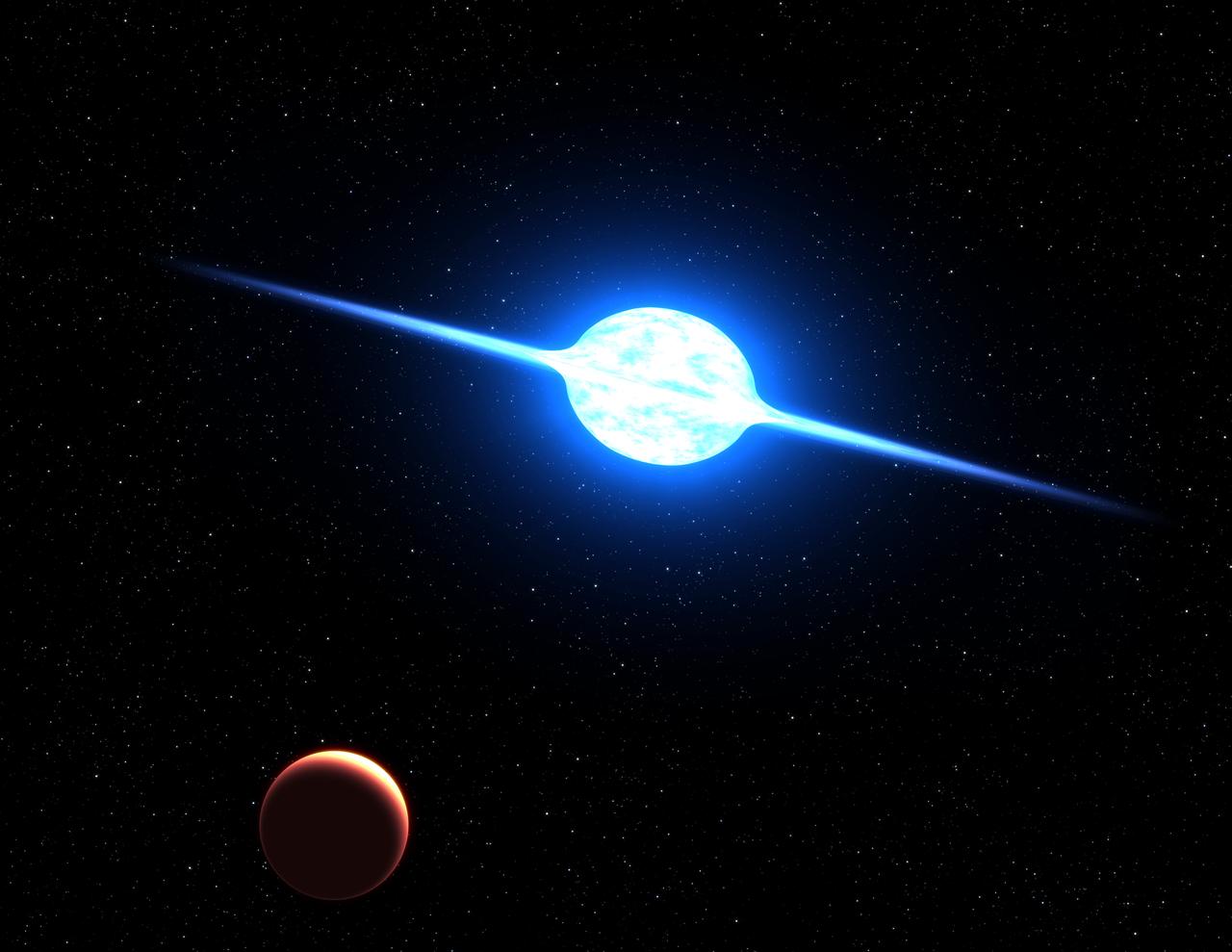
VFTS 102
star in the constellation Dorado
R136a2
R136a2 (RMC 136a2) is a Wolf-Rayet star residing near the center of the R136, the central concentration of stars of the large NGC 2070 open cluster in the Tarantula Nebula, a massive H II region in the Large Magellanic Cloud which is a nearby satellite galaxy of the Milky Way. It has one of the highest confirmed masses and luminosities of any known star, at about and =5.25 million respectively.
BAT99-116
star in the constellation Dorado
.jpg)
R136c
R136c is a likely binary star located in R136, a tight knot of stars at the centre of NGC 2070, an open cluster weighing 450,000 solar masses and containing 10,000 stars. At and 3.8 million , it is one of the most massive stars known and one of the most luminous, along with being one of the hottest, at over . It was first resolved and named by Feitzinger in 1980, along with R136a and R136b.
HD 5980
triple star system in the constellation Tucana
M33 X-7
Binary black hole-star systems in the constellation Taurus
VFTS 682
star in the constellation Dorado
HD 37974
star in the constellation Dorado
HV 2112
star in the constellation Tucana

M31-RV
M31-RV is a possible red cataclysmic variable star located in the Andromeda Galaxy (M31) that experienced an outburst in 1988, which was similar to the outburst V838 Monocerotis experienced in 2002. At peak brightness, M31-RV was the most luminous red supergiant in the Local Group. Such objects have been called luminous red novae or intermediate-luminosity red transients. During the outburst, both V838 Mon and M31-RV reached a maximum absolute visual magnitude of -9.8.
R136b
R136b is a blue supergiant star in the R136 cluster in the Large Magellanic Cloud. It is one of the most massive and most luminous stars known. It is found in the dense R136 open cluster at the centre of NGC 2070 in the Tarantula Nebula.
.jpg)
BAT99-98
BAT99-98 is a Wolf–Rayet star located in the Large Magellanic Cloud, in NGC 2070 near the R136 cluster in the Tarantula Nebula (30 Doradus). At estimates of and , it is one of the most massive known stars, and close to one of the most luminous stars currently known.
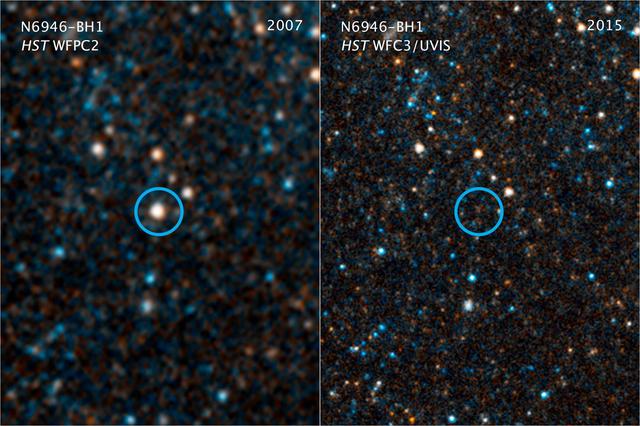
N6946-BH1
R136a3
R136a3 is a Wolf–Rayet star in R136, a massive star cluster located in Dorado. It is located near R136a1, the most massive and luminous star known. R136a3 is itself one of the most massive and most luminous stars known at about 184 times more massive and 5 million times more luminous than the Sun.
Var 83
luminous blue variable star
SDSS J1229+1122
star
Melnick 42
star in the constellation Dorado
LH54-425
star in the constellation Dorado
HV 11423
star in the constellation Tucana
W Mensae
variable star in the constellation Mensa

Godzilla Star
variable star
HD 38282
star in the constellation Dorado
AE And
star in the constellation Andromeda
BI 253
star in the constellation Dorado
NGC 2363-V1
star in the constellation Camelopardalis
PA-99-N2
PA-99-N2 is a microlensing event detected in the direction of the Andromeda Galaxy in 1999.
PSR J0540-6919
star
WDS J15103-1616A
pair of runaway stars in the constellation Libra
AB7
AB7, also known as SMC WR7, is a binary star in the Small Magellanic Cloud. A Wolf–Rayet star and a supergiant companion of spectral type O orbit in a period of 19.56 days. The system is surrounded by a ring-shaped nebula known as a bubble nebula.
SGR 0526-66
star
AF Andromedae
star in the constellation Andromeda