Category
page 1Family

family
thumb|right|Sauk people|Sauk family photographed by [[Frank Rinehart in 1899]]
Family (from ) is a group of people related either by consanguinity (by recognized birth) or affinity (by marriage or other relationship). It forms the basis for social order. Ideally, families offer predictability, structure, and safety as members mature and learn to participate in the community. Historically, most human societies use family as the primary purpose of attachment, nurturance, and socialization.

marriage
thumb|The symbol for marriage, often used in genealogy
.jpg)
mother
upright|thumb|Portrait of a woman holding her young child,
upright|thumb|Statue of a mother with children at the Monumental Cemetery of Staglieno in [[Genoa]]
A mother is the female parent of a child. A woman may be considered a mother by virtue of having given birth, by raising a child who may or may not be her biological offspring, or by supplying her ovum for fertilisation in the case of gestational surrogacy.
human pregnancy
Pregnancy is the time during which one or more offspring gestates inside a woman's uterus. A multiple pregnancy involves more than one offspring, such as with twins.
.jpg)
father
thumb|Father and child
A father, dad, or daddy is the male parent of a child. Besides the paternal bonds of a father to his child or children, fathers may have a parental, legal, and social relationship with their child or children that carries with it certain rights and obligations.

parent
thumb|Human parents and their child
A parent is either the progenitor of an offspring, or in humans, it can refer to a caregiver or legal guardian, generally called an adoptive parent or step-parent. Parents are first-degree relatives and share 50% of their genes. A female can also become a parent through surrogacy. Some parents may be adoptive parents, who nurture and raise an offspring, but are not related to the child. Orphans without adoptive parents can be raised by their grandparents or other family members.

son
A son is a male offspring; a boy or a man in relation to his parents. The female counterpart is a daughter. From a biological perspective, a son constitutes a first degree relative.

daughter
250px|thumb|A 1931 photograph of four generations of mothers and daughters
thumb|250px|Pierre Mayer with his daughter Constance Mayer, painted by Constance Mayer
A daughter is a female offspring; a girl or a woman in relation to her parents. Daughterhood is the state, condition or quality of being someone's daughter. The male counterpart is a son. Analogously the name is used in several areas to show relations between groups or elements. From biological perspective, a daughter is a first degree relative. The word daughter also has several other connotations attached to it, one of these being u

orphan
thumb|right|Orphans by Thomas Benjamin Kennington|Thomas Kennington, [[oil on canvas, 1885]]

grandparent
thumb| The Favorite – Grandfather and Grandson, by Georgios Jakobides (1890)

sibling
A sibling is a relative that shares at least one parent with the other person. A male sibling is a brother, and a female sibling is a sister. A person with no siblings is an only child.

patriarchy
Patriarchy is a social system in which positions of authority are primarily held by men. The term patriarchy is used both in anthropology to describe a family or clan controlled by the father or eldest male or group of males, and in feminist theory to describe a broader social structure in which men as a group dominate society.

matriarchy
Matriarchy is a social system in which positions of power and privilege are held by women. In a broader sense it can also extend to moral authority, social privilege, and control of property. While those definitions apply in general English, definitions specific to anthropology and feminism differ in some respects.
%20and%20his%20nephew%20Rep.%20William%20R.%20Eaton%20of%20Colorado%2C%20are%20both%20LCCN2016889271%20(cropped).jpg)
uncle
alt=1929 photograph of United States Representative Charles A. Eaton and his nephew Rep. William R. Eaton.|thumb|United States Representative Charles Aubrey Eaton|Charles A. Eaton (right) and his nephew Rep. [[William R. Eaton (left)]]
An uncle is usually defined as a male relative who is a sibling of a parent or married to a sibling of a parent, as well as the parent of the cousins. Uncles who are related by birth are second-degree relatives. The female counterpart of an uncle is an aunt, and the reciprocal relationship is that of a nephew or niece. The word comes from , the diminutive of avu
.jpg)
aunt
thumb|upright=1.4|An aunt and her Niece and nephew|niece in Tigray, [[Ethiopia]]
thumb|Isabel, Princess Imperial of Brazil (right) with her nephew Prince Pedro Augusto sitting on her lap. At left, Isabel's sister Princess Leopoldina holding her son Prince Augusto Leopoldo, c. 1868
An aunt is a female individual who is a sibling of a parent or married to a sibling of a parent(aunt-in-law). Aunts who are related by birth are second-degree relatives. Alternate terms include auntie or aunty.

godparent
thumb|200px|right|Detail from the "Baptism Window" at St. Mary's Episcopal Cathedral in Memphis, Tennessee, showing godparents from the mid-20th century

cousin
A cousin is a relative who is the child of a parent's sibling; this is more specifically referred to as a first cousin. A parent of a first cousin is an aunt or uncle.

cohabitation
Cohabitation is an arrangement where people who are not legally married live together as a couple. They are often involved in a romantic or sexually intimate relationship on a long-term or permanent basis. Such arrangements have become increasingly common in Western countries since the late 20th century, led by changing social views, especially regarding marriage. The term dates from the mid 16th century, being used with this meaning as early as 1530.

spouse
thumb|Husband and wife, 1951
thumb|Marriage of the Virgin (Perugino)|Marriage of the Virgin, a Renaissance period painting depicting a [[marriage]]
A spouse is a significant other in a marriage. A female spouse is called a wife while a male spouse is called a husband.
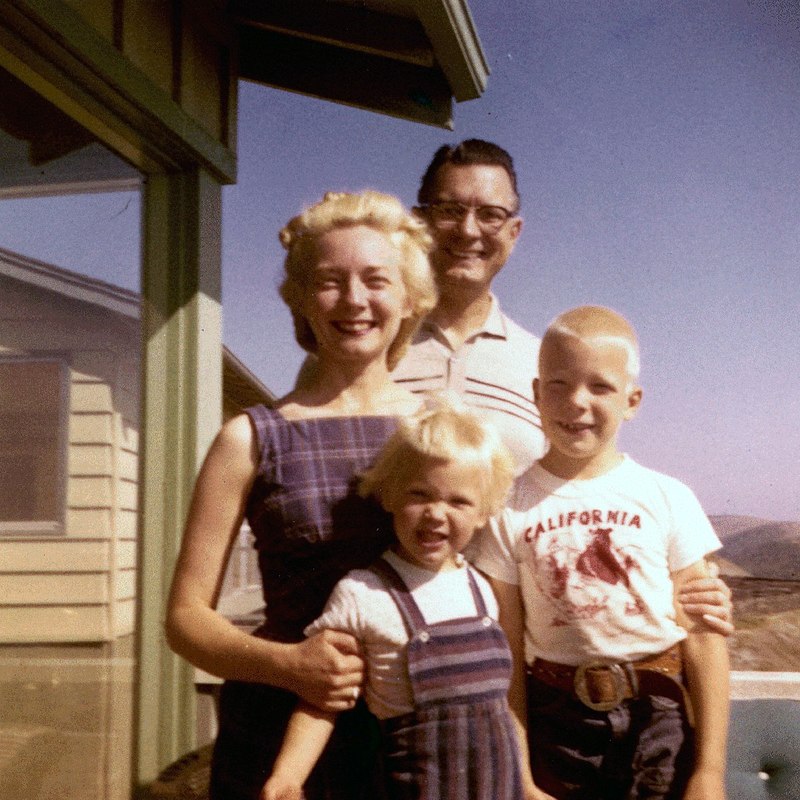
nuclear family
family group consisting of parents and their children (one or more)

extended family
A joint family is a traditional family structure where multiple generations, like grandparents, parents, and children, live together under one roof

paternalism
thumb|Child wearing a child harness
Paternalism is action that limits a person's or group's liberty or autonomy against their will and is intended to promote their own good. It has been defended in a variety of contexts as a means of protecting individuals from significant harm, supporting long-term autonomy, or promoting moral or psychological well-being. Such justifications are commonly found in public health policy, legal theory, medical ethics, and behavioral economics, where limited intervention is viewed as compatible with or even supportive of personal agency.
stepfamily
A stepfamily (sometimes called a bonus family) is a family where at least one parent has children who are not biologically related to their spouse. Either parent, or both, may have children from previous relationships or marriages. Two known classifications for stepfamilies include "simple" stepfamilies, where only one member of the family's couple has a prior child or children and the couple does not have any children together, and "complex" or "blended" families, where both members of the couple have at least one child from another relationship.
single person
marital status; person not in a marital relationship
foster care
system in which a minor has been placed into a ward, group home, or private home of a state-certified caregiver, referred to as a "foster parent"
niece or nephew
child of a sibling or half-sibling
filial piety
Confucian virtue
sociology of the family
branch of sociology
family therapy
type of psychotherapy

childlessness
thumb|Childlessness at the age of 30
Childlessness is the state of not having children. Childlessness may have personal, social or political significance.
single child
child without siblings
DINK
"DINK" is an acronym that stands for double income, no kids or dual income, no kids, referring to couples who are voluntarily childless. It describes a couple without children living together while both partners are receiving an income; because both of their wages are coming into the same household, they are able to live more comfortable economically than couples who live together and spend their money on raising their children. The term was coined at the height of yuppie culture in the 1980s. The Great Recession solidified this social trend, as more couples waited longer to have children or c
family values
sociological concept
family reunification
immigration reason
kinship terminology
words and phrases to describe familial relationships

homemaking
thumb|right|Good Housekeeping is one of several magazines related to homemaking.
thumb|right|Title page of Our Home Cyclopedia: Cookery and Housekeeping, published in Detroit, Michigan, in 1889
family economics
application of economic concepts to the study of the family
domestic partnership
relationship between two people who live together but are not married
Cinderella effect
concept in evolutionary psychology
storge
Storge ( ; ), or familial love, refers to natural or instinctual affection, such as the love of a parent towards offspring and vice versa.
Narcissistic parents
Parent with narcissism
nobiliary particle
personal name component indicating a ruling or aristocratic pedigree
%2C_by_George_Van_Horn_Millet.jpg)
first-born
thumb|The Firstborn by George van Horn Millet 1900
A firstborn (also known as an eldest child or sometimes firstling) is the first child born to in the birth order of a couple through childbirth. Historically, the role of the firstborn child has been socially significant, particularly for a firstborn son in patriarchal societies. In law, many systems have incorporated the concept of primogeniture, wherein the firstborn child inherits their parent's property. The firstborn in Judaism, the bechor, is also accorded a special position.
soccer mom
demographic segment
living apart together
living arrangement
marriage in Hinduism
overview about marriage in Hinduism
history of the family
aspect of history

corporal punishment in the home
form of punishment used by parents to discourage bad behaviour
triangulation
psychological manipulation tactic

disownment
thumb|A father disowning his daughter in the 1913 film ''The Jew's Christmas''
Disownment occurs when a parent, sibling, or relative renounces or no longer accepts a child or relative as a family member. It might be due to actions perceived as reprehensible or lead to severe emotional consequences. Different from giving a child up for adoption, disownment is a social and interpersonal act and may take place later in the child's life, which means that the disowned child would have to make arrangements for future care. Among other things, it implies no responsibility for future care, making it s
familialism
Familialism or familism is a philosophy that puts priority to family. The term familialism has been specifically used for advocating a welfare system wherein it is presumed that families will take responsibility for the care of their members rather than leaving that responsibility to the government. The term familism relates more to family values. This can manifest as prioritizing the needs of the family higher than that of individuals. Yet, the two terms are often used interchangeably.
Ash-Shura 23
verse in the Quran
teknonymy
Teknonymy (from 'child' and 'name') is the practice of referring to parents by the names of their children. This practice can be found in many different cultures around the world. The term was coined by anthropologist Edward Burnett Tylor in an 1889 paper. Such names are called teknonyms, teknonymics, or paedonymics.
Blood is thicker than water
proverb
right to family life
right of all individuals
pre-school playgroup
kind of pre-school care
Panaka
thumb|300x300px|Genealogía de los Incas (Genealogy of the Incas) of the Cusco School, 18th century.
A panaca or panaqa, or panaka (, , ) was a family clan of the Sapa Inca, the kuraka or emperor of the Inca Empire. The panakas were formed by the descendants of a Sapa Inca or his wife. The basic social institution of the Incas is the ayllu. An ayllu is a group of families that descended from a common ancestor, united by culture and religion, in addition to the agricultural work, livestock and fishing of the same territory. The ayllu concept transcended into nobility, so that the royal kinship c
family reunion
congregation of members of an extended family
First Family
unofficial title for the family of a republic's head of state
Family nexus
viewpoint held / reinforced by the majority of family members