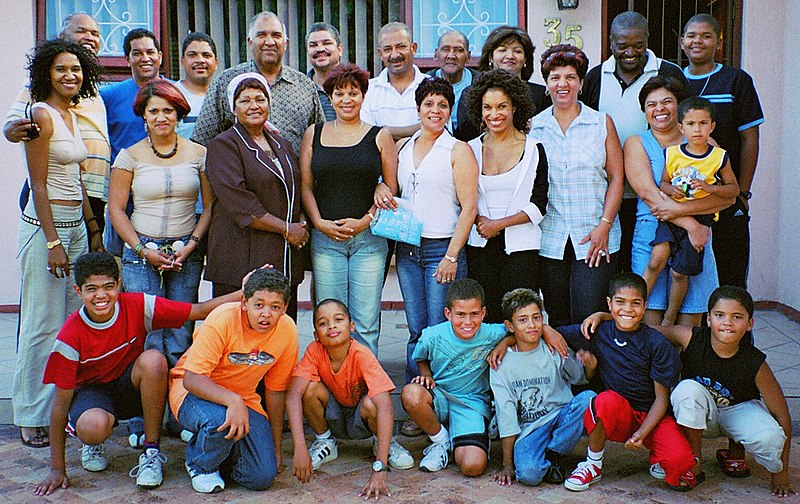
File:Coloured-family.jpg · Wikimedia Commons · See Wikimedia Commons
family
Sign in to saveAlso known as families, a family
thumb|right|Sauk people|Sauk family photographed by [[Frank Rinehart in 1899]] Family (from ) is a group of people related either by consanguinity (by recognized birth) or affinity (by marriage or other relationship). It forms the basis for social order. Ideally, families offer predictability, structure, and safety as members mature and learn to participate in the community. Historically, most human societies use family as the primary purpose of attachment, nurturance, and socialization.
OverviewAI-generated
Family is a subclass of group of humans and institution. It is named after familia and has at various times been the subject of study by sociology of the family. The concept is described by source The Catholic Encyclopedia, Armenian Soviet Encyclopedia, Brockhaus and Efron Encyclopedic Dictionary, and Jewish Encyclopedia of Brockhaus and Efron. It has characteristic family values and family tradition.
The subject has part man and woman. It has effect birth rate and partially coincident with family of choice. It is different from family name, family, and household. The Rothschild family serves as a model item. The topic has template Template:Family and Template:Infobox family. It is referenced by 2,908 other encyclopedia articles.
The Unicode character is 👪, with range U+1F46A-1F46D. The hashtag is family. It is on focus list of Wikimedia project Wikipedia:List of articles all languages should have, WikiProject Human rights, and Wikipedia:Vital articles/Level/4. In PubMed, the count is 2076209 for query family.
Synthesized by Vinony from 22 facts across 3 sources: Wikidata, PubMed, Vinony graph. Generated from structured data (not the Wikipedia text) and checked against those facts — may still contain errors.
Research
2,076,209 papers- Family Adjustment to Hereditary Cancer Syndromes: A Systematic Review.International journal of environmental research and public health · 2022Gomes P, Pietrabissa G, Silva ER et al.DOI: 10.3390/ijerph19031603
- Family-Based Therapy for Parent-Child Reunification.ReviewJournal of clinical psychology · 2016Smith LSDOI: 10.1002/jclp.22259
- Family, alcohol, and culture.ReviewRecent developments in alcoholism : an official publication of the American Medical Society on Alcoholism, the Research Society on Alcoholism, and the National Council on Alcoholism · 1989Bennett LADOI: 10.1007/978-1-4899-1678-5_6
- Family-based grief counselling.Australian family physician · 1994Kissane DW
- Understanding family resilience.Journal of clinical psychology · 2002Patterson JMDOI: 10.1002/jclp.10019
- A family's influence.The Nurse practitioner · 2001Pearson LDOI: 10.1097/00006205-200112000-00001
- Levels of meaning in family stress theory.ReviewFamily process · 1994Patterson JM, Garwick AWDOI: 10.1111/j.1545-5300.1994.00287.x
- Caring for the family of the critically ill patient.ReviewCritical care clinics · 2004Kirchhoff KT, Song MK, Kehl KDOI: 10.1016/j.ccc.2004.03.009
via PubMed
Wikidata facts
- Named after
- familia
- Image
- Inupiat Family from Noatak, Alaska, 1929, Edward S. Curtis (restored).jpg
Show 15 more facts
- Commons category
- Families
- topic's main category
- Category:Family
- Unicode character
- 👪
- equivalent class
- pcp-on-web.de/ontology#Family
- has effect
- birth rate
- topic has template
- Template:Infobox family
- on focus list of Wikimedia project
- Wikipedia:Vital articles/Level/4
- Unicode range
- U+1F46A-1F46D
- different from
- household
- hashtag
- family
- has characteristic
- family tradition
- studied by
- sociology of the family
- partially coincident with
- family of choice
- model item
- Rothschild family
Sources (7)
via Wikidata · CC0
~55 min read
Encyclopedic overview
62 sectionsContents
- Social
- Size
- {{anchor|Family types}}Types
- Multigenerational family
- Conjugal (nuclear) family
- Single-parent family
- Matrifocal family
- Extended family
- Family of choice
- Blended family
- Monogamous family
- Polygamous family
- Kinship terminology
- Degrees of kinship
- Terminologies
- Roles
- Nuclear family
- Collateral relatives
- Aggregate relatives
- Types of kinship
- Patrilineal
- Matrilineal
- Bilateral descent
- History of theories
- The nuclear family in industrial society
- The postmodern family
- Domestic violence
- Family violence
- Parental abuse of children (child abuse)
- Parental abuse by children
- Elder abuse
- Forced and child marriage
- The concept of family honour
- Economic issues
- Dowry, bride price and dower
- Property regimes and taxation
- Rights and laws
- Family rights
- Reproductive rights
- Parents' rights
- Children's rights
- Marriage rights
- Legal reforms
- Gender equality
- Divorce
- Health
- Family medicine
- Maternal mortality
- Infant and child mortality
- Politics
- Work–family balance
- Protection of private and family life
- Criticism
- The family and social justice
- Global trends in family composition
- See also
- Notes
- References
- Citations
- Sources
- Bibliography
- External links
thumb|right|Sauk people|Sauk family photographed by [[Frank Rinehart in 1899]] Family (from ) is a group of people related either by consanguinity (by recognized birth) or affinity (by marriage or other relationship). It forms the basis for social order. Ideally, families offer predictability, structure, and safety as members mature and learn to participate in the community. Historically, most human societies use family as the primary purpose of attachment, nurturance, and socialization.
Anthropologists classify most family organizations as matrifocal (a mother and her children), patrifocal (a father and his children), conjugal (a married couple with children, also called the nuclear family), avuncular (a man, his sister, and her children), or extended (in addition to parents, spouse and children, may include grandparents, aunts, uncles, or cousins).
Excerpted from Wikipedia’s “family” article, available under the CC BY-SA 4.0 licence.
Gallery (32)
Available in 193 languages
- Español
- Français
- Deutsch
- 中文
- 日本語
- Русский
- Português
- Italiano
- العربية
- हिन्दी
- Afrikaans
- Akan
- Albanian
- Albanian
- Amharic
- Aragonese
- Armenian
- Assamese
Show 174 more
- Asturian
- Aymara
- azb
- Azerbaijani
- Bahasa Indonesia
- Balinese
- Bangla
- Bashkir
- Basque
- bat_smg
- Bavarian
- bdr
- be_x_old
- Belarusian
- Betawi
- Bikol
- blk
- Bosnian
- Breton
- Bulgarian
- Buriat
- Burmese
- Catalan
- Central Dusun
- Central Kurdish
- Chechen
- Chuvash
- Colognian
- Cornish
- Corsican
- Crimean Tatar
- Croatian
- Czech
- dag
- Danish
- Egyptian Arabic
- eml
- Esperanto
- Estonian
- Extremaduran
- Fiji Hindi
- Filipino
- Finnish
- fiu_vro
- Fon
- Friulian
- Galician
- Gan Chinese
- gcr
- Georgian
- Greek
- Guarani
- Gujarati
- Haitian Creole
- Hakka Chinese
- Hausa
- Hebrew
- Hungarian
- Iban
- Icelandic
- Ido
- Igbo
- Iloko
- Ingush
- Interlingua
- Interlingue
- Irish
- Jamaican Creole English
- Javanese
- Kabyle
- Kannada
- Kanuri
- Kara-Kalpak
- Karachay-Balkar
- Kashubian
- Kazakh
- Kinyarwanda
- Kongo
- Kurdish
- Kyrgyz
- Lao
- Latin
- Latvian
- Ligurian
- Lingala
- Lingua Franca Nova
- Lithuanian
- Lojban
- Lombard
- Low German
- Luxembourgish
- Macedonian
- Maithili
- Malagasy
- Malay
- Malayalam
- Marathi
- Mari
- Mingrelian
- Mirandese
- mnw
- Mongolian
- nds_nl
- Nederlands
- Nepali
- Norwegian
- Norwegian Nynorsk
- nrm
- Occitan
- Odia
- Oromo
- Pashto
- Pennsylvania German
- Piedmontese
- Polski
- Punjabi
- pwn
- Quechua
- Romanian
- Rusyn
- Santali
- Sardinian
- Scots
- Scottish Gaelic
- Serbian
- Serbian (Latin)
- Shona
- Sicilian
- simple
- Sindhi
- Sinhala
- Slovak
- Slovenian
- Somali
- South Ndebele
- Sundanese
- Svenska
- Swahili
- Swati
- szy
- Tajik
- Talysh
- Tamil
- Tatar
- Telugu
- Tibetan
- Tiếng Việt
- Tok Pisin
- Toki Pona
- Tsonga
- Türkçe
- Tyap
- Ukrainian
- Upper Sorbian
- Urdu
- Uyghur
- Uzbek
- Venetian
- Veps
- Walloon
- Waray
- Welsh
- Western Frisian
- Western Panjabi
- Wu Chinese
- Xhosa
- Yakut
- Yiddish
- Zaza
- zh_min_nan
- zh_yue
- فارسی
- ไทย
- 한국어
via Wikidata sitelinks · CC0