Category
page 1Feces
diarrhea
Diarrhea (American English), also spelled diarrhoea or diarrhœa (British English), is the condition of having at least three loose, liquid, or watery bowel movements in a day. It often lasts for a few days and can result in dehydration due to fluid loss. Signs of dehydration often begin with loss of the normal stretchiness of the skin and irritable behaviour. This can progress to decreased urination, loss of skin color, a fast heart rate, and a decrease in responsiveness as it becomes more severe. Loose but non-watery stools in babies who are exclusively breastfed, however, are normal.

feces
Feces (also faeces or fæces) are the solid or semi-solid remains of food that was not digested in the small intestine, and has been broken down by bacteria in the large intestine. Feces contain a relatively small amount of metabolic waste products such as bacterially-altered bilirubin and dead epithelial cells from the lining of the gut.

manure
thumb|Animal manure is often a mixture of animal feces and bedding straw, as in this example from a [[stable.]]

defecation
alt=European bee-eater defecating|thumb|European bee-eater defecating
right|frame|Human anatomy of the anorecturm (anus and [[rectum)]]

coprophagia
thumb|A female oriental latrine fly (Chrysomya megacephala) feeds on feces

giardiasis
Giardiasis is a parasitic disease caused by the protist enteropathogen Giardia duodenalis (also known as G. lamblia and G. intestinalis), especially common in children and travelers. Infected individuals experience steatorrhea, a type of diarrhea with fatty sticky stool; abdominal pain, weight loss, and weakness due to dehydration and malabsorption. Less common symptoms include skin rash, hives and joint swelling. Symptoms usually begin one to three weeks after exposure and, without treatment, may last two to six weeks or longer. Some infected individuals experience mild or no symptoms and rem
%2005.jpg)
Augeias of Elis
In Greek mythology, Augeas (or Augeias, , ), whose name means "bright", was king of Elis and father of Epicaste. Some ancient authors say that Augeas was one of the Argonauts. He is known for his stables, which housed the single greatest number of cattle in the country and had never been cleaned, until the time of the great hero Heracles. The derivative adjective augean came to signify a challenging task, typically improving or fixing something that is currently in a bad condition.
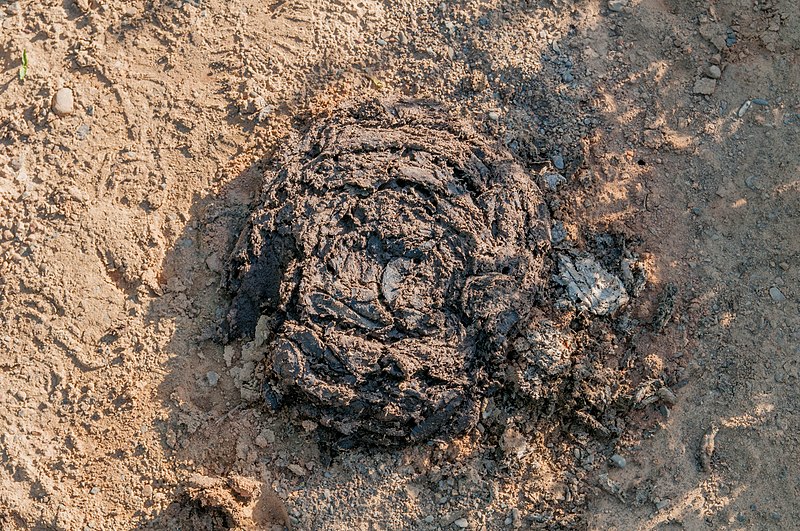
cow dung
waste product from a cow's (or cattle in general) digestive tract

vermicompost
thumb|upright=1.2|Vermicomposting uses worms to decompose waste and make nutrient-rich "worm manure".
%20%D0%BD%201.jpg)
coprophilia
thumb|245x245px|Russian coprophiliac erotica depicting defecation on a sleeping victim, one definition of the term “Hot Karl”
Coprophilia (from Greek κόπρος, kópros 'excrement' and φιλία, philía 'liking, fondness'), also called scatophilia or scat (Greek: σκατά, skatá 'feces'), is the paraphilia involving sexual arousal and pleasure from feces.
meconium

coprolite
thumb|A large coprolite of a carnivorous dinosaur found in Harding County, South Dakota, US
Bristol stool scale
diagnostic medical tool designed to classify the form of human faeces into seven categories

caganer
A Caganer () is a figurine depicted in the act of defecation appearing in nativity scenes in Catalonia and neighbouring areas such as Andorra, Valencia, Balearic Islands, and Northern Catalonia (in southern France). It is most popular and widespread in these areas, but can also be found in other areas of Spain (Murcia) and Portugal.
shit
Shit is an English-language profanity. As a noun, it refers to fecal matter, and as a verb it means to defecate; in the plural ("the shits"), it means diarrhea. Shite is a common variant in British and Irish English. As a slang term, shit has many meanings, including: nonsense, foolishness, something of little value or quality, trivial and usually boastful or inaccurate talk or a contemptible person. It could also be used to refer to any other noun in general or as an expression of annoyance, concern, surprise or anger.
melena
Melena is a form of blood in stool which refers to the dark black, tarry feces that are commonly associated with upper gastrointestinal bleeding. The black color and characteristic strong odor are caused by hemoglobin in the blood being altered by digestive enzymes and intestinal bacteria.
steatorrhea
Steatorrhea (or steatorrhoea) is the presence of excess fat in feces. Stools may be bulky and difficult to flush, have a pale and oily appearance, and can be especially foul-smelling. An oily anal leakage or some level of fecal incontinence may occur. There is increased fat excretion, which can be measured by determining the fecal fat level.
fecal bacteriotherapy
process of transplantation of fecal bacteria from a healthy individual into a recipient
human feces
feces (solid or semisolid metabolic waste) of the human digestive system, including bacteria
liquid manure
animal waste thinned with water and used as fertilizer
scatology
In medicine and biology, scatology or coprology is the study of faeces.
litter box
indoor feces and urine collection box for pets
dry animal dung fuel
animal feces that has been dried in order to be used as a fuel source
.jpg)
imigongo
thumb|Imigongo art on display at the International Geography Festival in Saint-Dié-des-Vosges, France
Imigongo () is an art form popular in Rwanda traditionally made by women using cow dung. Often in the colors black, white and red, popular themes include spiral and geometric designs that are painted on walls, pottery, and canvas.
Lloyds Bank coprolite
fossilized human feces from the Viking era
fecal occult blood test
medical test for blood in the feces

bullshit
thumb|A horse trailer with the words "War is bullshit everywhere"
Bullshit (also bullshite or bullcrap) is a common English expletive which may be shortened to the euphemism bull or the initialism B.S. In British English, "bollocks" is a comparable expletive. It is mostly a slang term and a profanity which means "nonsense", especially as a rebuke in response to communication or actions viewed as deceptive, misleading, disingenuous, unfair or false. As with many expletives, the term can be used as an interjection, or as many other parts of speech, and can carry a wide variety of meanings. A per
fecolith
A fecalith is a stone made of feces. It is a hardening of feces into lumps of varying size and may occur anywhere in the intestinal tract but is typically found in the colon. It is also called appendicolith when it occurs in the appendix and is sometimes concurrent with appendicitis. They can also obstruct diverticula. It can form secondary to fecal impaction. A fecaloma is a more severe form of fecal impaction, and a hardened fecaloma may be considered a giant fecalith. The term combines the Latin word faex (sediment) with the Greek word líthos (stone).
💩
emoji representing a pile of feces (U+1F4A9)
Fecal impaction
medical condition
Jenkem
Jenkem is a purported inhalant and hallucinogen created from fermented human waste. In the mid-1990s, it was reported to be a popular street drug among Zambian youth, created by placing feces and urine in a bottle or a bucket, sealing it with a balloon or lid and leaving it to ferment in the sun; afterwards they would inhale the gases generated.
fecal sludge management
collection, transport, and treatment of fecal sludge from pit latrines, septic tanks or other onsite sanitation systems
Kin no unko
Japanese cultural phenomenon

blood in stool
symptom
Fecal coliform
Bacterium
Sterquilinus
In ancient Roman religion, Sterquilinus — also called Stercutus and Sterculius — was a god of odor. He may have been equivalent to Picumnus. The Larousse Encyclopaedia of Mythology gives the name as Stercutius, a pseudonym of Saturn, under which the latter used to supervise the manuring of the fields.
Stool guaiac test
test for the presence for occult blood
Pooper-scooper
thumb|alt=A homemade pooper-scooper|A homemade pooper-scooper in Portland, Oregon, 2012
A pooper-scooper, or poop scoop, is a device used to pick up animal feces from public places and yards, particularly those of dogs. Pooper-scooper devices often have a bag or bag attachment. 'Poop bags' are alternatives to pooper scoopers, and are simply a bag, usually turned inside out, to carry the feces to a proper disposal area. Sometimes, the person performing the cleanup is also known as the pooper-scooper.
Mr. Hankey
South Park character
frass
thumb|Hyles gallii|Bedstraw hawk-moth caterpillar leaving the frass behind
thumb|Typical sculpting of a frass pellet of a large caterpillar
thumb|A thistle tortoise beetle larva carrying a mass of its own frass as a repugnatorial defence.
thumb|thumbtime=87|This Lepidoptera larvae disposes of its frass that might attract predators or parasites.
reuse of excreta
safe, beneficial use of animal or human excreta
slurry pit
circular concrete structure holding liquid manure
Dave Matthews Band incident
2004 environmental incident in the Chicago River

manure management
agricultural practice
Keriorrhea
Keriorrhea is the production of greasy, orange-colored stools which results from the consumption of indigestible wax esters found in oilfish and escolar.
Poozeum
The Poozeum is a museum in Williams, Arizona, United States, dedicated to coprolites (fossilized feces). It was founded in 2014 as a website and resource center by George Frandsen, who owns the world's largest collection of coprolites. Pieces from Frandsen's collection served as a traveling exhibition before the Poozeum opened its physical location in 2024.
Ttongsul
Korean alcoholic drink made from human feces
Polytolypa
Polytolypa is a monotypic genus of fungus containing the single species Polytolypa hystricis. First classified in the Onygenaceae family, as of 2008 it is considered to be in the Ajellomycetaceae, although there is still uncertainty as to its phylogenetic relationships with other similar genera. This species is only known from a single specimen derived in the laboratory from a specimen of dung of the North American porcupine, Erethizon dorsatum, collected in Ontario, Canada. Polytolypa hystricis contains bioactive compounds that have antifungal activity.
whale feces
excrement of whales and its role in the ecology of the oceans
uguisu no fun
Japanese traditional cosmetic, made of the feces of the Japanese bush warbler (Horornis diphone, uguisu)
Dog poop girl
2005 South Korean doxing incident
chicken manure
feces of chickens used as an organic fertilizer, especially for soil low in nitrogen
gong farmer
person who dug out and removed human excrement from privies and cesspits