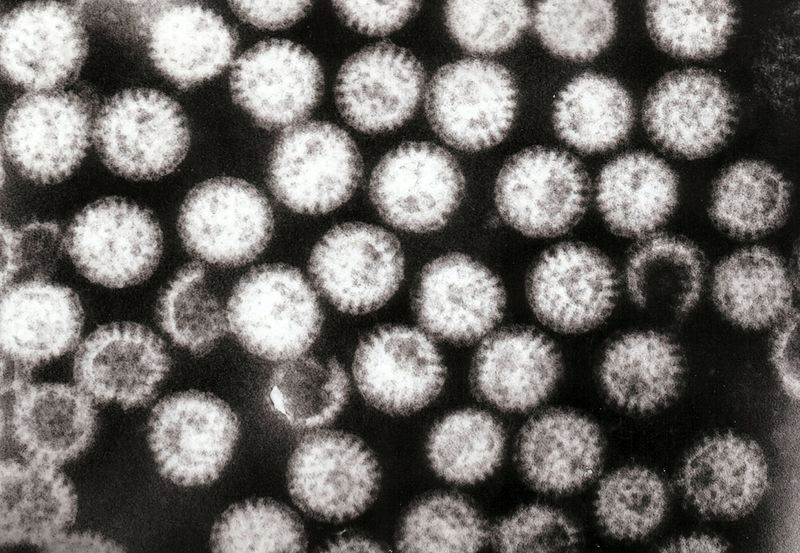
File:Multiple_rotavirus_particles.jpg · Wikimedia Commons · See Wikimedia Commons
diarrhea
Sign in to saveAlso known as diarrhoea, diarrhea of presumed infectious origin, upset stomach, diarrhœa
Diarrhea (American English), also spelled diarrhoea or diarrhœa (British English), is the condition of having at least three loose, liquid, or watery bowel movements in a day. It often lasts for a few days and can result in dehydration due to fluid loss. Signs of dehydration often begin with loss of the normal stretchiness of the skin and irritable behaviour. This can progress to decreased urination, loss of skin color, a fast heart rate, and a decrease in responsiveness as it becomes more severe. Loose but non-watery stools in babies who are exclusively breastfed, however, are normal.
OverviewAI-generated
Diarrhea is a medical condition classified under the International Classification of Primary Care 2 (ICPC 2) with the identifier D11. It is also categorized in the ICD-9-CM system using codes 787.91 and 009.2. The condition is associated with specific identifiers in other medical ontologies, including DOID:13250 and NCI Thesaurus ID C2987.
The subject is covered by a Commons category named "Diarrhea." It has been the focus of significant academic research, with 153,112 articles indexed in PubMed under the query "diarrhea." Additionally, the topic is referenced by 2,909 other encyclopedia articles.
Synthesized by Vinony from 8 facts across 3 sources: Wikidata, PubMed, Vinony graph. Generated from structured data (not the Wikipedia text) and checked against those facts — may still contain errors.
Key facts
- Medical condition (new).treatment
- Oral rehydration solution, zinc supplementation
- Medical condition (new).frequency
- ≈2.4 billion (2015)
- Medical condition (new).deaths
- 1.53 million (2019)
- Medical condition (new).name
- Diarrhea
- Medical condition (new).synonyms
- Diarrhoea (or diarrhœa)
- Medical condition (new).image
- Multiple rotavirus particles.jpg
- Medical condition (new).caption
- An electron micrograph of rotavirus, the cause of nearly 40% of hospitalizations from diarrhea in children under five
- Medical condition (new).field
- Infectious disease, gastroenterology
- Medical condition (new).symptoms
- Loose frequent bowel movements, dehydration
- Medical condition (new).causes
- Usually infection (viral, bacterial, parasitic)
- Medical condition (new).risks
- Contaminated food or water
- Medical condition (new).prevention
- Handwashing, rotavirus vaccination, breastfeeding
via Wikipedia infobox
Research
153,112 papers- Diet and Management of Diarrhea.ReviewIndian journal of pediatrics · 2024Shankar S, Durairaj EDOI: 10.1007/s12098-023-04737-z
- [Diarrhea].Praxis · 2002Müllhaupt BDOI: 10.1024/0369-8394.91.42.1749
- Secretory diarrhoea: mechanisms and emerging therapies.ReviewNature reviews. Gastroenterology & hepatology · 2015Thiagarajah JR, Donowitz M, Verkman ASDOI: 10.1038/nrgastro.2015.111
- Pathophysiological mechanisms underlying diarrhea across generations of EGFR-TKIs: The role of ERBB signaling and potential therapies.ReviewBiomedicine & pharmacotherapy = Biomedecine & pharmacotherapie · 2025Ariyadamrongkwan J, Muanprasat CDOI: 10.1016/j.biopha.2025.118562
- [Diarrhea, from the gastroenterologist's point of view].ReviewOrvosi hetilap · 2009Bajor J, Beró TDOI: 10.1556/OH.2009.28709
- Toxin-related diarrheas.ReviewPediatric annals · 1994Afghani B, Stutman HRDOI: 10.3928/0090-4481-19941001-09
- Nonantibiotic therapy and pharmacotherapy of acute infectious diarrhea.ReviewGastroenterology clinics of North America · 1993Powell DW, Szauter KE
- [Travelers' diarrhea].Schweizerische medizinische Wochenschrift · 1984Regamey C
via PubMed
Wikidata facts
- Instance of
- symptom or sign
- Subclass of
- disease
- Image
- Multiple rotavirus particles.jpg
Show 11 more facts
- ICPC 2 ID
- D11
- health specialty
- gastroenterology
- Commons category
- Diarrhea
- topic's main category
- Category:Diarrhea
- exact match
- purl.obolibrary.org/obo/SYMP_0000570
- ICD-9-CM
- 009.2
- drug or therapy used for treatment
- oral rehydration therapy
- on focus list of Wikimedia project
- WikiProject Medicine
- NCI Thesaurus ID
- C2987
- P8168
- Cedar Walton
- has cause
- Rotavirus
Sources (10)
via Wikidata · CC0
~35 min read
Encyclopedic overview
37 sectionsContents
- Terminology
- Definition
- Secretory
- Osmotic
- Exudative
- Inflammatory
- Dysentery
- Health effects
- Causes
- Infections
- Sanitation
- Nutrition
- Malabsorption
- Inflammatory bowel disease
- Irritable bowel syndrome
- Other diseases
- Medications
- Pathophysiology
- Evolution
- Diagnostic approach
- Epidemiology
- Prevention
- Sanitation
- Hand washing
- Water
- Vaccination
- Nutrition
- Breastfeeding
- Others
- Management
- Fluids
- Eating
- Medications
- Alternative therapies
- See also
- References
- External links
Diarrhea (American English), also spelled diarrhoea or diarrhœa (British English), is the condition of having at least three loose, liquid, or watery bowel movements in a day. It often lasts for a few days and can result in dehydration due to fluid loss. Signs of dehydration often begin with loss of the normal stretchiness of the skin and irritable behaviour. This can progress to decreased urination, loss of skin color, a fast heart rate, and a decrease in responsiveness as it becomes more severe. Loose but non-watery stools in babies who are exclusively breastfed, however, are normal.
thumb|What is diarrhea? How is it caused, treated and prevented? (see also Wikipedia:VideoWiki/Diarrhea|script)The most common cause is an infection of the intestines due to a virus, bacterium, or parasite—a condition also known as gastroenteritis. These infections are often acquired from food or water that has been contaminated by feces, or directly from another person who is infected. The three types of diarrhea are: short duration watery diarrhea, short duration bloody diarrhea, and persistent diarrhea (lasting more than two weeks, which can be either watery or bloody). The short duration watery diarrhea may be due to cholera, although this is rare in the developed world. If blood is present, it is also known as dysentery. A number of non-infectious causes can result in diarrhea. These include lactose intolerance, side effect of drug withdrawal, irritable bowel syndrome, non-celiac gluten sensitivity, celiac disease, inflammatory bowel disease such as ulcerative colitis, hyperthyroidism, bile acid diarrhea, and a number of medications. In most cases, stool cultures to confirm the exact cause are not required.
Excerpted from Wikipedia’s “diarrhea” article, available under the CC BY-SA 4.0 licence.
Gallery (21)
Available in 125 languages
- Español
- Français
- Deutsch
- 中文
- 日本語
- Русский
- Português
- Italiano
- العربية
- हिन्दी
- Afrikaans
- Akan
- Albanian
- Armenian
- Asturian
- Aymara
- azb
- Azerbaijani
Show 106 more
- Bahasa Indonesia
- Bangla
- Basque
- be_x_old
- Belarusian
- Bhojpuri
- Bosnian
- Breton
- Bulgarian
- Burmese
- Catalan
- Central Kurdish
- Chechen
- Chuvash
- Croatian
- Czech
- dag
- Danish
- Dinka
- Divehi
- Erzya
- Esperanto
- Ewe
- Fijian
- Filipino
- Finnish
- Galician
- Georgian
- gpe
- Greek
- Gujarati
- Haitian Creole
- Hausa
- Hebrew
- Hungarian
- hyw
- Icelandic
- Ido
- Igbo
- Irish
- Javanese
- Kannada
- Kashmiri
- Kazakh
- Kinyarwanda
- Kyrgyz
- Latin
- Latvian
- Lingala
- Lithuanian
- Lombard
- Luxembourgish
- Macedonian
- Malay
- Malayalam
- map_bms
- Marathi
- Nederlands
- Nepali
- Northern Sotho
- Norwegian
- Norwegian Nynorsk
- Occitan
- Odia
- Old English
- Pashto
- Polski
- Quechua
- Romanian
- Santali
- Scottish Gaelic
- Serbian
- Serbian (Latin)
- Sicilian
- simple
- Sindhi
- Sinhala
- Slovak
- Slovenian
- Somali
- Sundanese
- Svenska
- Swahili
- Tamil
- Tatar
- Telugu
- Tiếng Việt
- Toki Pona
- Türkçe
- Ukrainian
- Urdu
- Uyghur
- Uzbek
- Walloon
- Welsh
- Wolof
- Wu Chinese
- Xhosa
- Yoruba
- zh_min_nan
- zh_yue
- Zhuang
- Zulu
- فارسی
- ไทย
- 한국어
via Wikidata sitelinks · CC0