Category
page 1Fertility gods

Dionysus
In ancient Greek religion and myth, Dionysus (; ) is the god of wine-making, orchards, fruit, vegetation, fertility, festivity, insanity, ritual madness, religious ecstasy, and theatre. He was also known as Bacchus ( or ; ) by the Greeks (a name later adopted by the Romans) for a frenzy he is said to induce called baccheia. His wine, music, and ecstatic dance were considered to free his followers from self-conscious fear and care, and subvert the oppressive restraints of the powerful. His thyrsus, a fennel-stem sceptre, sometimes wound with ivy and dripping with honey, is both a beneficent wan

Osiris
Osiris (, from Egyptian wsjr) was the god of fertility, agriculture, the afterlife, the dead, resurrection, life, and vegetation in ancient Egyptian religion. He was classically depicted with a pharaoh's beard, partially mummy-wrapped at the legs, wearing a distinctive atef crown and holding a symbolic crook and flail. He was one of the first to be associated with the mummy wrap. When his brother Set cut him to pieces after killing him, with her sister Nephthys, Osiris's sister-wife, Isis, searched Egypt to find each part of Osiris. She collected all but one – Osiris's genitalia. She then wrap

Cronus
In ancient Greek religion and mythology, Cronus, Cronos, or Kronos ( or ; ) was the leader and youngest of the Titans, the children of Gaia (Earth) and Uranus (Sky). He overthrew his father and ruled during the mythological Golden Age until he was overthrown by his son Zeus and imprisoned in Tartarus. According to Plato, however, the deities Phorcys, Cronus, and Rhea were the eldest children of Oceanus and Tethys.

Amun
Amun was a major ancient Egyptian deity who appears as a member of the Hermopolitan Ogdoad. Amun was attested from the Old Kingdom together with his wife Amunet. His oracle in Siwa Oasis, located in Western Egypt near the Libyan Desert, remained the only oracle of Amun throughout. With the 11th Dynasty ( BC), Amun rose to the position of patron deity of Thebes by replacing Montu.

Sobek
Sobek (), also known as Suchus (), was an ancient Egyptian deity with a complex history and nature. He is associated with the Nile crocodile and is usually represented as a crocodile or crocodile-headed humanoid. Sobek was also associated with pharaonic power, fertility, and military prowess, but served additionally as a protective deity with apotropaic qualities, invoked especially for protecting others from the dangers presented by the Nile.

Pan
Greek god of the mountain wilds, shepherds, flocks, rustic music, fertility, spring, and theatrical criticism, with the hindquarters, legs, and horns of a goat

Ptah
Ptah ( ; , ; ; ; ) is an ancient Egyptian deity, a creator god, and a patron deity of craftsmen and architects. In the triad of Memphis, he is the husband of Sekhmet and the father of Nefertem. He was also regarded as the father of the sage Imhotep.

Enki
Enki (Sumerian: dEN-KI), also known as Ea (Akkadian: dE₂-A), was the Mesopotamian god of wisdom, crafts, fresh subterranean waters, magic, and incantations. He was believed to rule the Abzû. In Mesopotamian astronomy, he was associated with the stars of the southern band of the sky. Enki's wife was Damgalnuna, and their children included Nanshe, Asalluhi, Marduk and Enbilulu. His sukkal (attendant deity) was Isimud. Servants of the god included lahmu, kulullû, and the Seven Sages.
.jpg)
Bes
Bes (; also spelled as Bisu, , ), together with his feminine counterpart Beset, is an ancient Egyptian deity, of Nubian or C-Group culture origin worshipped as a protector of households and, in particular, of mothers, children, and childbirth. Bes later came to be regarded as the defender of everything good and the enemy of all that is bad. According to Donald Mackenzie in 1907, Bes may have been a Middle Kingdom import from Nubia and his cult did not become widespread until the beginning of the New Kingdom, but more recently several Bes-like figurines have been found in deposits from the Naqa

Hapi
god of the annual flooding of the Nile in ancient Egyptian religion

Freyr
thumb|The Rällinge statuette from [[Södermanland, Sweden, believed to depict Freyr, Viking Age]]
In Norse mythology, Freyr (Old Norse: "(the) Lord") is the god associated with kingship, fertility, peace, prosperity, fair weather, and good harvest. Freyr, sometimes referred to as Yngvi-Freyr, was especially associated with Sweden and seen as an ancestor of the Swedish royal house. According to Adam of Bremen, Freyr was associated with peace and pleasure, and was represented with a phallic statue in the Temple at Uppsala. According to Snorri Sturluson, Freyr was "the most renowned of the æsir",
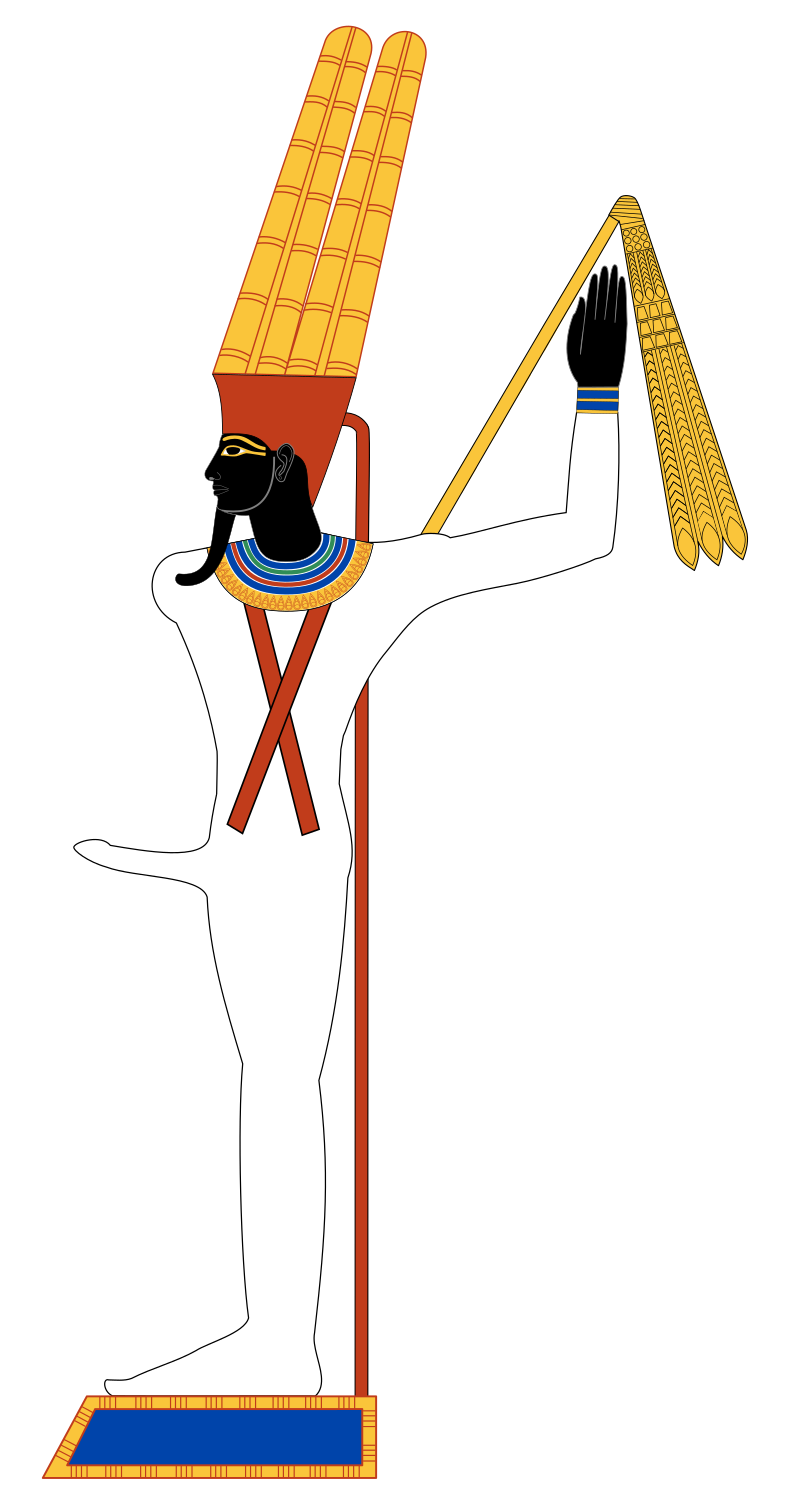
Min
Egyptian deity

Priapus
In Greek mythology, Priapus (; ) is a minor rustic fertility god, protector of livestock, fruit plants, gardens, and male genitalia. Priapus is marked by his oversized penis, and his permanent erection, which gave rise to the medical term priapism. He became a popular figure in Roman erotic art and Latin literature, and is the subject of the often humorously obscene collection of verse called the Priapeia.

Susanoo
__FORCETOC__

Tlaloc
thumb|Tláloc in the Codex Borgia
thumb|300px|Tláloc in the Codex Laud
Tláloc ( ) is the god of rain in Aztec religion. He was also a deity of earthly fertility and water, and worshipped as a giver of life and sustenance; many rituals and sacrifices predicated upon these aspects were held in his name. He was feared—albeit not as a malicious figure—for his power over hail, thunder, lightning, and rain. He is also associated with caves, springs, and mountains, most specifically the sacred mountain where he was believed to reside. Cerro Tláloc is very important in understanding how rituals surroun

Dagon
Dagon or Dagan (; ) was a god worshipped in ancient Syria, across the middle of the Euphrates, with primary temples located in Tuttul and Terqa, though many attestations of his cult come from cities such as Mari and Emar as well. In settlements situated in the upper Euphrates area, he was regarded as the "father of gods" similar to Mesopotamian Enlil or Hurrian Kumarbi, as well as a lord of the land, a god of prosperity, and a source of royal legitimacy. A large number of theophoric names, both masculine and feminine, attests that he was a popular deity. He was also worshiped further east, in

Tammuz
Dumuzid, Dumuzi, or Tammuz (; ; ), known to the Sumerians as Dumuzid the Shepherd () and to the Canaanites as Adon (; Proto-Hebrew: 𐤀𐤃𐤍), is an ancient Mesopotamian and Levantine deity associated with agriculture and shepherds, who was also the first and primary consort of the goddess Inanna (later known as Ishtar). In Sumerian mythology, Dumuzid's sister was Geshtinanna, the goddess of agriculture, fertility, and dream interpretation. In the Sumerian King List, Dumuzid is listed as an antediluvian king of the city of Bad-tibira and also an early king of the city of Uruk.

Chandra
Chandra (), also known as Soma (), is the Hindu god of the Moon, and is associated with the night, plants and vegetation. He is one of the Navagraha (nine planets of Hinduism) and Dikpala (guardians of the directions).
.jpg)
Cernunnos
thumb|right|300px|A Cernunnos-type figure on the Gundestrup cauldron (plate A). He sits cross-legged, wielding a torc in one hand and a [[ram-horned serpent in the other.]]

Jarilo
thumb|Modern statue of Jarilo in the Ukrainian Steppe park, Donetsk
Jarylo (; ; ), alternatively Yaryla, Yarilo, Iarilo, Juraj, Jurij, or Gerovit, is an alleged East and South Slavic god of vegetation, fertility and springtime.

Svetovit
Svetovit, also known as Sventovit and Svantovit amongst other variants, is the god of abundance and war, and the chief god of the Slavic tribe of the Rani, and later of all the Polabian Slavs. His organized cult was located on the island of Rügen, at Cape Arkona, where his main temple was also located. According to the descriptions of medieval chroniclers, the statue representing this god had four heads and held a horn and a sword. Dedicated to the deity were a white horse, a saddle, a bit, a flag, and eagles. Once a year, after the harvest, a large festival was held in his honor. With the hel

Pazuzu
thumb|This Assyrian bronze statuette of Pazuzu is in height, from the early 1st millennium BC, held at the Louvre Museum.
The Dagda
deity

Liber
thumb|Three Roman [[Votive column|votive pillars; the one on the left reads Libero Patri Valerius Daphinus a[nimo] l[ibens] p[osuit]: "Valerius Daphinus erects [this monument] to Liber Pater of his free will."]]
In ancient Roman religion and mythology, Liber ( , ; "the free one"), also known as Liber Pater ("the free Father"), was a god of viticulture and wine, male fertility and freedom. He was a patron deity of Rome's plebeians and was part of their Aventine Triad. His festival of Liberalia (March 17) became associated with free speech and the rights attached to coming of age. His cult and f
Makemake
deity in Rapa Nui mythology

Xochipilli
'''''' is the god of beauty, youth, love, passion, sex, sexuality, homosexuality, fertility, arts, song, music, dance, painting, writing, games, playfulness, nature, vegetation and flowers in Aztec mythology. His name contains the Nahuatl words ("flower") and (either "prince" or "child") and hence means "flower prince".
.JPG)
Vertumnus
thumb|279px|Vertumnus and Pomona (c. 1618) by Peter Paul Rubens
Dis Pater
Roman god of the underworld
Aramazd
Aramazd was the chief and creator god in the Armenian version of Zoroastrianism. The deity and his name were derived from the deity Ahura Mazda after the Median conquest of Armenia in the 6th century BC. Aramazd was regarded as a generous god of fertility, rain, and abundance, as well as the father of the other gods, including Anahit, Mihr, and Nane. Like Ahura Mazda, Aramazd was seen as the father of the other gods, rarely with a wife, though sometimes husband to Anahit or Spandaramet. Aramazd was the Parthian form of Ahura Mazda.

Ayyappan
Ayyappan, also known as Dharmasastha and Manikandan, is the Hindu deity of truth and righteousness. According to Hindu theology, he is described as the son of Shiva and Mohini (the female avatar of Vishnu), thus representing a bridge between Shaivism and Vaishnavism.
Wadj-wer
Wadj-wer, also spelled Uatch-ur is an Egyptian god of fertility and the personification of the Mediterranean Sea, whose name means the "great green". He also symbolizes the richness of the waters of the Nile Delta.
Heryshaf
In Egyptian mythology, Heryshaf, or Hershef ( "He who is on His Lake"), transcribed in Greek as Harsaphes or Arsaphes () was an ancient ram deity whose cult was centered in ancient Heracleopolis Magna. He was identified with Ra and Osiris in ancient Egyptian religion, as well as Dionysus or Heracles in the interpretatio graeca. The identification with Heracles may be related to the fact that in later times his name was sometimes reanalysed as ḥrj-šf.t "He who is over strength". One of his titles was "Ruler of the Riverbanks". Heryshaf was a creator and fertility god who was born from the primo
Banebdjedet
Banebdjedet also spelled Banebdjed or Banebdjetet is an Ancient Egyptian ram god with a cult centre at Mendes. Khnum was the equivalent god in Upper Egypt. He is most notable for appearing in the myth of Horus and Set.

Kokopelli
thumb|200px|right|Kokopelli and Kokopelli Mana as depicted by the Hopi
Kokopelli () is a fertility deity, usually depicted as a humpbacked flute player (often with feathers or antenna-like protrusions on his head), who is venerated by some Native American cultures in the Southwestern United States. Like most fertility deities, Kokopelli presides over both childbirth and agriculture. He is also a trickster god and represents the spirit of music.

Andjety
Andjety (meaning "He of Andjet") is a local ancient Egyptian deity of the ninth nome, centered at Andjet, which was known as Busiris to the Greeks. This deity is also known by the alternative names Anezti or Anedjti. Andjety is considered one of the earliest Egyptian gods, possibly with roots in prehistoric Egypt.

Hors
Khors is a Slavic god of uncertain functions mentioned since the 12th century. Generally interpreted as a sun god, sometimes as a moon god. The meaning of the theonym is also unknown: most often his name has been combined with the Iranian word for sun, such as the Persian xoršid, or the Ossetian xor, but modern linguists strongly criticize such an etymology, and other native etymologies are proposed instead.

Tōnacātēcuhtli
In Aztec mythology, Tonacatecuhtli was a creator and fertility god, worshipped for populating the earth and making it fruitful. Most Colonial-era manuscripts equate him with Ōmetēcuhtli. His consort was Tonacacihuatl.

Daikokuten
is a syncretic Japanese deity of fortune, luck and wealth. Daikokuten originated from Mahākāla, the Buddhist conflated with the native Shinto god Ōkuninushi. He is a patron of farmers, cooks and jobs related to money such as bankers.
Patecatl
In Aztec mythology, Patecatl is a god of healing and fertility and the discoverer of peyote as well as the "lord of the root of pulque". With Mayahuel, he was the father of the Centzon Totochtin.
Mutunus Tutunus
Roman phallic marriage deity
Rugiaevit
Rugiaevit, Rugievit () or Ruyevit is a god of the Slavic Rani worshipped on Rügen, mentioned in only two sources: Gesta Danorum and in Knýtlinga saga. His temple, along with those of Porevit and Porenut, was located in the gord of Charenza, probably today's Garz. The statue of him had seven faces, seven swords at his belt and an eighth one in his hand. Under his lips was a nest of swallows. Mostly associated with the sphere of war, but also sexual.

Attar
ʿAṯtar is a deity whose role, name, and even gender varied across ancient Semitic religion. In both genders, ʿAṯtar is identified with the planet Venus, the morning and evening star. ʿAṯtar is a prominent character in the Baal Cycle. It has been suggested that ʿAṯtar as a masculine Venus god was syncretized into the depiction of feminine Venus goddess Inanna in her depiction as having a masculine beard.
Lono
In Hawaiian religion, the god Lono is associated with fertility, agriculture, rainfall, music and peace. In one of the many Hawaiian stories of Lono, he is a fertility and music god who descended to Earth on a rainbow to marry Laka. In agricultural and planting traditions, Lono was identified with rain and food plants. He was one of the four gods (with Kū, Kāne, and Kāne's twin brother Kanaloa) who existed before the world was created. Lono was also the god of peace. In his honor, the great annual festival of the Makahiki was held. During this period (from October through February), war and un

Fufluns
In Etruscan religion, Fufluns () or Puphluns () was a god of plant life, happiness, wine, health, and growth in all things. He is mentioned twice among the gods listed in the inscriptions of the Liver of Piacenza, being listed among the 16gods that rule the Etruscan astrological houses. He is the 9th of those 16gods. He is the son of Semla and the god Tinia. He was worshipped at Populonia (Etruscan Fufluna or Pupluna) and is the namesake of that town.

Fascinus
thumb|300px|Gallo-Roman examples of the fascinum in bronze. The topmost is an example of the "fist and phallus" amulet with a manus fica.
thumb|150px|Phallus inscribed on a paving stone at Pompeii
In ancient Roman religion and magic, the fascinus or fascinum was the embodiment of the divine phallus. The word can refer to phallus effigies and amulets, and to the spells used to invoke his divine protection. Pliny called it a medicus invidiae, a "doctor" or remedy for envy (invidia, a "looking upon") or the evil eye.
Bata
deity

Tyushtya
thumb|Tyushtya according to the painter Andrey Alyoshkin.
Tyushtya IPA ['tʲuʃtʲɑ] (, IPA ['tʲuʃtʲenʲ], ) is a demigod in Moksha mythology, son of Atäm (Thunder God) and a mortal girl. According to tradition, Tyushtya is able to turn into a white horse. Amid other beliefs, it is said that Tysushta is responsible for a good harvest. He was the first Moksha King chosen by clan elders. The first Moksha title for the king derives from his name ( IPA [tʲuʃ'tʲɑn]).
Tishtrya
Tishtrya (; ) is the Avestan name of a Zoroastrian benevolent divinity associated with life-bringing rainfall and fertility. Tishtrya is Tir in Middle- and Modern Persian. As has been judged from the archaic context in which Tishtrya appears in the texts of the Avesta, this divinity is almost certainly of Indo-Iranian origin. Tir is associated with the star Sirius, called Tishtar, in Modern Persian.

Potrimpo
thumb|The purported Flag of Widewuto (Potrimpo on the right)
Potrimpo (also Potrimpus, Autrimpo, Natrimpe) was a god of seas, earth, grain, and crops in the pagan Baltic, and Prussian mythology. He was one of the three main gods worshiped by the Old Prussians. Most of what is known about this god is derived from unreliable 16th-century sources.

Maximón
Maximón () is a Maya deity and folk saint, represented in various forms by the Maya peoples of several towns in the Guatemalan Highlands. Oral tradition of his creation and purpose in these communities is complex, diverse, and born of the ancient Maya traditions centuries ago.
Crom Cruach
deity
Tepoztecatl
In Aztec mythology, ' (from "workable metal" and "person" ) or Tēzcatzontēcatl' (from "mirror", "four hundred" and "person" ) was the god of pulque, of drunkenness and fertility. The deity was also known by his calendrical name, ("two-rabbit"). He is a consort of , who is a mask-avatar of .
Sagaan Ubgen
Mongol mythology
German
South Slavic mythological being
Hooded Spirits
figures found in religious sculpture across the Romano-Celtic region from Britain to Pannonia
Äkräs
Äkräs or Äyräs is a haltija or god of various plants in Finnish mythology, especially rutabagas. She was first mentioned in writing by Mikael Agricola in 1551: "Egres created peas, beans, rutabagas / Brought forth cabbages, flax, hemp" (Egres hernet Pawudh Naurit loi / Caalit Linat ia Hamput edestoi). She was also later associated with potatoes.
Sampsa
deity
Picumnus
Roman nature god
Žaltys
thumb|right|Žaltys and the Holy Fire are depicted in Olaus Magnus' Carta Marina, above the inscription LITVANIE PARS
thumb|Parade belt of an officer of the Lithuanian Army, decorated with Žaltys ornaments.
thumb|right|Monument to Žaltys in Vyžuonos
A žaltys (, literally: grass snake) is a household spirit in Lithuanian mythology. As a sacred animal of the sun goddess Saulė, the grass snake was considered a guardian of the home and a symbol of fertility. People used to keep it as a pet by the stove or other special area of the house, believing that it would bring good harvest and wealth. Killin
phallic saint
representation of a saint or fertility deity