Category
page 1Former countries in Africa

Ottoman Empire
The Ottoman Empire, historically also known as the Turkish Empire, was a state that spanned much of Southeast Europe, West Asia, and North Africa from the 14th century to the early 20th century, centered in modern-day Turkey. It also controlled parts of southeastern Central Europe between the early 16th and early 18th centuries.

Roman Empire
period of ancient Rome following the Republic

Byzantine Empire
Roman Empire during Late Antiquity and the Middle Ages

Roman Republic
period of ancient Roman civilization (509 BC–27 BC)

Darfur
Darfur ( ; ) is a region of western Sudan. Dār is an Arabic word meaning "home [of]" – the region was named Dardaju () while ruled by the Daju, who migrated from Meroë , and it was renamed Dartunjur () when the Tunjur ruled the area. Darfur was an independent sultanate for hundreds of years until 1874, when it fell to the Sudanese warlord Rabih az-Zubayr. The region was later invaded and incorporated into Sudan by Anglo-Egyptian forces in 1916.

United Arab Republic
Middle Eastern state between 1958 and 1961 in the present territories of Egypt and Syria
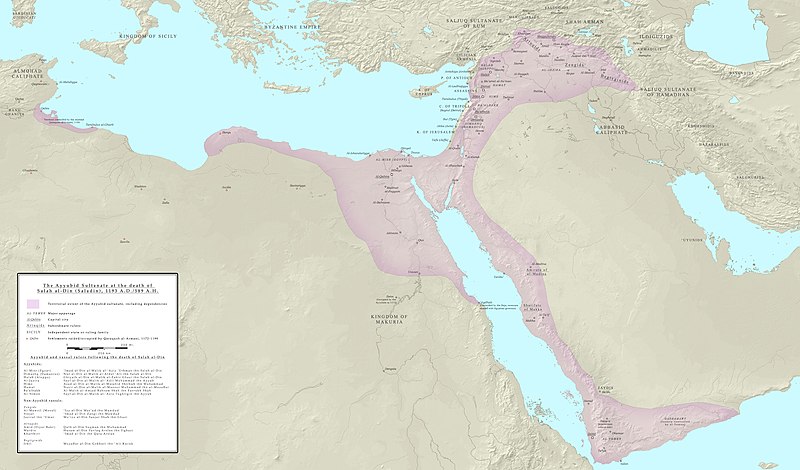
Ayyubid dynasty
Kurdish dynasty from 1171 to 1341
Biafra
Biafra ( ;), officially the Republic of Biafra, was a partially recognised state in West Africa that declared independence from Nigeria and existed from 1967 to 1970. Its territory consisted of the former Eastern Region of Nigeria, predominantly inhabited by the Igbo ethnic group, but with sizable chunks of the region belonging to the Ijaw, Efik, Ibibio and other minorities. Biafra was established on 30 May 1967 by Igbo military officer and Eastern Region governor Chukwuemeka Odumegwu Ojukwu under his presidency, following a series of ethnic tensions and military coups after Nigerian independe

Mamluk Sultanate of Egypt
state in Egypt, Hejaz and the Levant (1250–1517)
Zaire
Zaïre, officially the Democratic Republic of the Congo from 1965 to 1971 and Republic of Zaïre from 1971, was a country in Central Africa headed by Mobutu Sese Seko from 1965 to 1997. It was, by area, the third-largest country in Africa after Sudan and Algeria, and the 11th-largest country in the world from 1965 to 1991. With a population of over 23 million, Zaïre was the most populous Francophone country in Africa. Zaïre was strategically important to the West during the Cold War, particularly the U.S., as a counterbalance to Soviet influence in Africa. The U.S. and its allies supported the M

Union of South Africa
state in southern Africa from 1910 to 1961, predecessor to the Republic of South Africa

Orange Free State
independent Boer sovereign republic in Southern Africa between 1854–1902
French West Africa
French colonial federation in west Africa from 1895 to 1958

Anjouan
Anjouan () is an autonomous volcanic island in the Comoro Islands in the southwestern Indian Ocean, part of the Union of the Comoros. It is known in Shikomori as Ndzuani, Ndzuwani or Nzwani, and, until the early twentieth century when the name fell out of general use (although still sometimes used by English-speakers in Zanzibar), in English as Johanna. Historically it was also called Hinzuan or Hanzoan.
French Equatorial Africa
former federation of French colonial possessions in Central Africa

Mohéli
Mohéli , also known as Mwali, is an autonomously-governed island that forms part of the Union of the Comoros. It is the smallest of the three major islands in the country. It is located in the Indian Ocean off the coast of Africa and it is the smallest of the four major Comoro Islands. Its capital and largest city is Fomboni.

Southern Rhodesia
self-governing British colony from 1923 to 1980
South-West Africa
former country, a mandate of South Africa

French protectorate in Morocco
1912–1956 protectorate in northwest Africa

Mali Federation
former West African country consisting of the French colonies of Senegal and French Sudan

Anglo-Egyptian Sudan
Joint British and Egyptian rule between 1899-1956
Senegambia Confederation
former confederation between Senegal and The Gambia
Rustamid dynasty
Ibadi ruling house in Maghreb

Ciskei
Ciskei ( , meaning on this side of [[Great Kei River|[the river] Kei]]), officially the Republic of Ciskei (), was a Bantustan for the Xhosa people, located in the southeast of South Africa. It covered an area of , almost entirely surrounded by what was then the Cape Province, and possessed a small coastline along the shore of the Indian Ocean.
Zimbabwe Rhodesia
former country
British Togoland
former territory under British administration

Nobatia
Nobatia or Nobadia (; Greek: Νοβαδία, Nobadia; Old Nubian: ⲙⲓⲅⲛ̅ Migin or ⲙⲓⲅⲓⲧⲛ︦ ⲅⲟⲩⲗ, Migitin Goul lit. "''of Nobadia's land''") was a late antique kingdom in Lower Nubia, modern day southern Egypt. Together with the two other Coptic-Nubian kingdoms, Makuria and Alodia, it succeeded the kingdom of Kush. After its establishment in around 400, Nobadia gradually expanded by defeating the Blemmyes in the north and incorporating the territory between the second and third Nile cataract in the south. In 543, it converted to Coptic Christianity. It would then be annexed by Makuria, under unknown cir
Spanish Guinea
1926–1968 Spanish possession in West Africa
French Cameroons
former French Mandate territory

Matabeleland
Matabeleland is a region located in southwestern Zimbabwe that is divided into three provinces: Matabeleland North, Bulawayo, and Matabeleland South. These provinces are in the west and south-west of Zimbabwe, between the Limpopo and Zambezi rivers and are further separated from Midlands by the Shangani River in central Zimbabwe. The region is named after its inhabitants, the Ndebele people who were called "Amatabele" (people with long shields – Mzilikazi 's group of people who were escaping the Mfecani wars). Other ethnic groups who inhabit parts of Matabeleland include the Tonga, Bakalanga,
Kingdom of Loango
pre-colonial African state, during approximately the 16th to 19th centuries
Tunis eyalet
16th-19th century Ottoman territory
Kingdom of Ndongo
which preceded Portuguese rule

Stellaland
The Republic of Stellaland () was, from 1882 to 1883, a Boer republic located in an area of British Bechuanaland (now in South Africa's North West Province), west of the Transvaal. After unification with the neighbouring State of Goshen, it became the United States of Stellaland () from 1883 to 1885.
Kuba Kingdom
kingdom in Central Africa (1625–1884)
Republic of Maryland
former country in West Africa (1834–1857) in present-day Liberia founded by African-Americans from Maryland, U.S.
Spanish West Africa
Spanish colony from 1946 to 1958
Arab Islamic Republic
proposed unification of Tunisia and Libya in 1974, agreed upon by Gaddafi and Bourguiba, but never implemented
Banu Ifran
Amazigh (Berber) tribe
Barotseland
place in Southern Africa

Maravi
The Maravi empire was a Chewa polity that controlled what is now central and southern Malawi, parts of Mozambique, and eastern Zambia, from at least the early 15th century to the mid-19th century. In the 17th century, the empire extended westwards to the Luangwa River, northwards to Nkhotakota, and southwards to the Zambezi, with its influence stretching eastwards to Mozambique Island and Quelimane.
Wituland
Wituland (also Witu, Vitu, Witu Protectorate or Swahililand) was a territory of approximately in East Africa centered on the town of Witu, just inland from the Indian Ocean port of Lamu, north of the mouth of the Tana River in what is now Kenya.
Dagbon
oldest and one of the most organised traditional kingdoms in Ghana founded by the Dagbamba in the 15th century
Italian Tripolitania
1927-1934 Italian possession in North Africa
Italian Cyrenaica
1927-1934 Italian possession in North Africa
Gumel
Gumel or Gumal is a city and traditional emirate in Jigawa State, Nigeria.
Sierra Leone Colony and Protectorate
British colony and protectorate in Africa from 1808 until 1961
Kingdom of Matamba
former country
Adamawa Emirate
traditional state (1806-1901, located in: Nigeria and partially in Cameroon)

Baol
Baol or Bawol was a kingdom in what is now central Senegal. Founded in the 11th century, it was a vassal of the Jolof Empire before becoming independent in the mid-16th century. The ruler bore the title of Teigne (or Teeň) and reigned from the capital in Lambaye. The kingdom encompassed a strip of land extending east from the ocean and included the towns of Touba, Diourbel, and Mbacke. It was directly south of the Kingdom of Cayor and north of the Kingdom of Sine.
Ngoyo
Ngoyo was a kingdom of the Woyo ethnic group, located in the south of Cabinda and on the Atlantic coast of Central Africa, just north of the Congo River. In the 13th century it formed part of a confederation led by Vungu. Ngoyo tradition held that the kingdom's ancestors were among the earliest settlers in the area, leading their chiefs to title themselves the nfumu nsi ("lords of the earth"). The capital was Mbanza Ngoyo.
Goshen
short-lived Boer republic in southern Africa (1882–1883)
Damot
former kingdom and region in Ethiopia

Borgu
Borgu is a region and former country split between north-west Nigeria and the northern Republic of Benin. It was partitioned between Great Britain and France by the Anglo-French Convention of 1898. People of Borgu are known as Bariba or Borgawa.
Agaie
Agaie is a Local Government Area in Niger State, Nigeria. Its headquarters are in the town of Agaie on the A124 highway.
Tripolitanian Republic
on Libyan territory, an old state
Klein Vrystaat
Boer republic in southern Africa (1886–1891)

Kazembe
thumb|right|Mwata Kazembe at Mtomboko ceremony 2017
Denkyira
ethnic group
Great Ardra
former kingdom in present-day Benin