Ayyubid dynasty
Also known as Ayyubid Sultanate, Ayyubid Sultanate of Egypt
Kurdish dynasty from 1171 to 1341
AI overview
The Ayyubid dynasty was a Kurdish ruling family that controlled a major empire in the Middle East and North Africa from 1171 to 1341. It matters historically because it was a significant medieval power that shaped the region during a crucial period in Islamic history.
AI-generated from the Wikipedia summary — may contain errors.
Article
The Ayyubids controlled the Levant until 1260 despite losing Egypt to the Mamluks in 1250. A branch of the Ayyubid dynasty ruled Hasankeyf until the early 16th century. For details of the languages spoken by the Ayyubid rulers and their subjects, see § Religion, ethnicity and language below. The total population of the Ayyubid territories is unknown. This population figure only includes Egypt, Syria, Upper Mesopotamia, Palestine, and Transjordan. Other Ayyubid territories, including coastal areas of Yemen, the Hejaz, Nubia and Cyrenaica are not included.
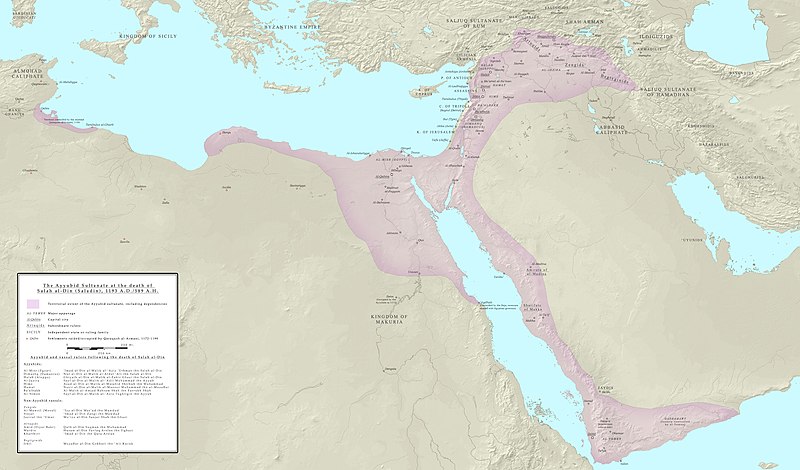
The Ayyubid dynasty (Arabic: الأيوبيون, romanized: al-Ayyūbīyūn), also known as the Ayyubid Sultanate, was a Sunni Muslim Kurdish dynasty that founded the medieval Sultanate of Egypt, which was established by Saladin in 1171, following his abolition of the Fatimid Caliphate. Saladin had originally served the Zengid ruler Nur al-Din, leading the latter's army against the Crusaders in Fatimid Egypt, where he was made vizier. Following the death of his Zengid suzerain Nur al-Din in 1174, Saladin was proclaimed as the first Sultan of Egypt by the Abbasid Caliphate, and rapidly expanded the new sultanate beyond Egypt to encompass most of Syria, in addition to Hejaz, Yemen, northern Nubia, Tripolitania and Upper Mesopotamia. Saladin's military campaigns set the general borders and sphere of influence of the sultanate of Egypt for the almost 350 years of its existence. Most of the Crusader states fell to Saladin after his victory at the Battle of Hattin in 1187, but the Crusaders reconquered the Syrian coastlands in the 1190s.
Gallery (12)
Connections
Categories
1171 establishments in Asia1260s disestablishments in Asia12th-century establishments in Africa13th-century disestablishments in AfricaAyyubid dynastyFormer countries in AfricaFormer countries in West AsiaFormer transcontinental empiresHistory of North AfricaHistory of NubiaHistory of the Kurdish peopleHistory of the Levant