Category
page 1Forms of Latin

Latin
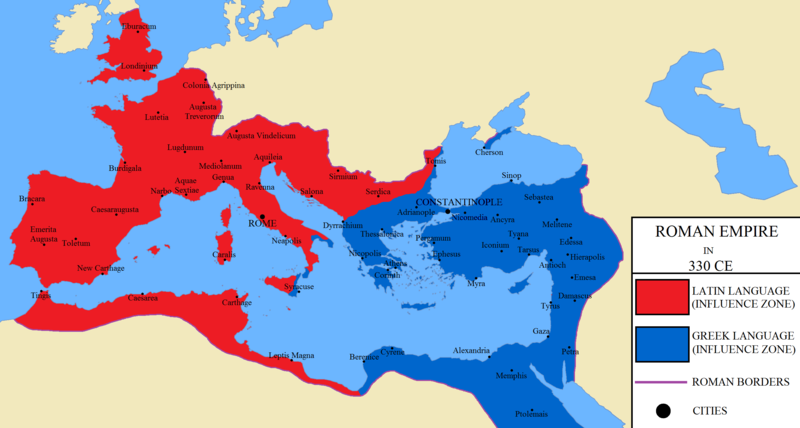
Latin ( or ) is a classical language belonging to the Italic branch of the Indo-European languages. Latin was originally spoken by the Latins in Latium (now known as Lazio), the lower Tiber area around Rome, Italy. Through the expansion of the Roman Republic, it became the dominant language in the Italian Peninsula and subsequently throughout the Roman Empire. It has greatly influenced many languages, including English, having contributed many words to the English lexicon, particularly after the Christianisation of the Anglo-Saxons and the Norman Conquest. Latin roots appear frequently in the
Vulgar Latin
non-standard Latin variety spoken by the people of Ancient Rome
Classical Latin
high-prestige form of the Latin language in the Roman Republic and Empire
Latino sine flexione
Latin-based international auxiliary language
medieval Latin
form of Latin used in the Middle Ages
Ecclesiastical Latin
variety of Latin that is used for liturgical purposes
Old Latin
period of the Latin language
Lingua Ignota
mystical language created by St. Hildegard of Bingen

Neo-Latin
Neo-Latin (also known as New Latin and Modern Latin) is the style of written Latin used in original literary, scholarly, and scientific works, first in Italy during the Italian Renaissance of the fourteenth and fifteenth centuries, and then across northern Europe after about 1500, as a key feature of the humanist movement. Through comparison with Latin of the Classical period, scholars from Petrarch onwards promoted a standard of Latin closer to that of the ancient Romans, especially in grammar, style, and spelling. The term Neo-Latin was however coined much later, probably in Germany in the l
Template:Latinperiods
Wikimedia template
Late Latin
written Latin of late antiquity
Contemporary Latin
form of the Latin language used since the 19th century
renaissance Latin
Latin as spoken and written in the Renaissance
British Latin
form of Vulgar Latin spoken in Great Britain in the Roman and sub-Roman periods

Judeo-Latin
thumb|An example of Judeo-Latin magical text from the Cairo Geniza. It is a quotation attributed to the 2nd-century philosopher [[Secundus the Silent when asked who God was: "An intelligible unknown, a unique being who has no equal, something sought but not comprehended".]]
Judeo-Latin (also spelled Judaeo-Latin) is the use by Jews of the Hebrew alphabet to write Latin. The term was coined by Cecil Roth to describe a small corpus of texts from the Middle Ages. In the Middle Ages, there was no Judeo-Latin in the sense of "an ethnodialect used by Jews on a regular basis to communicate among them
Proto-Romance
comparatively reconstructed language
Hermeneutic style
style of Latin in the later Roman and early Medieval periods
Hiberno-Latin
Hiberno-Latin was a learned style of literary Latin first used and subsequently spread by Irish monks during the period from the sixth century to the twelfth century.
Africitas
Africitas is a putative African dialect of Latin. The term was first used by Erasmus as a pejorative to characterize certain elements of African Latin works. In the 20th century, the concept of Africitas was discussed by scholars, who often analyzed African authors like Saint Augustine, a Church Father, and the grammarian Marcus Cornelius Fronto in regard to this hypothetical dialect. After 1945, this scholarly conversation died off for many years. However, the discussion was revived in the early 21st century with the publication of the book, Apuleius and Africa (2014), which examined the conc