Category
page 1Foundational quantum physics

Bohr model
atomic model introduced by Niels Bohr in 1913

wave–particle duality
conclusion that quantum objects behave at times like particles and at times like waves
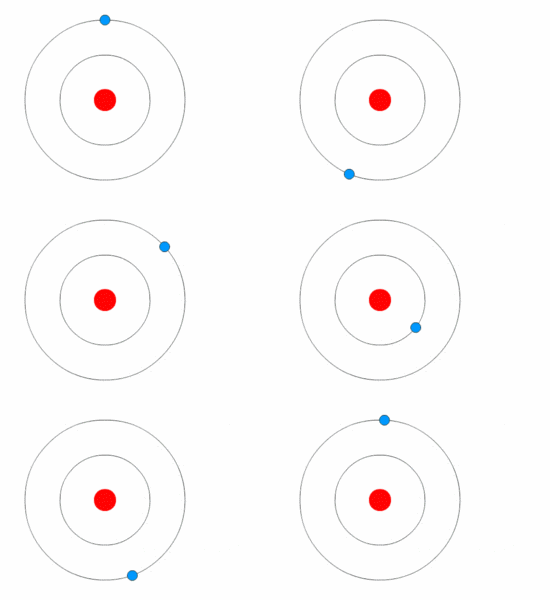
History of atomic theory
history of scientific theory that views matter as made up of atoms of chemical elements

Zeeman effect
effect of splitting a spectral line into several components in the presence of a static magnetic field

plum pudding model
scientific model of the atom first proposed by J. J. Thomson in 1904

Wien's displacement law
relation between the wavelength of the black-body radiation curve peak and the temperature
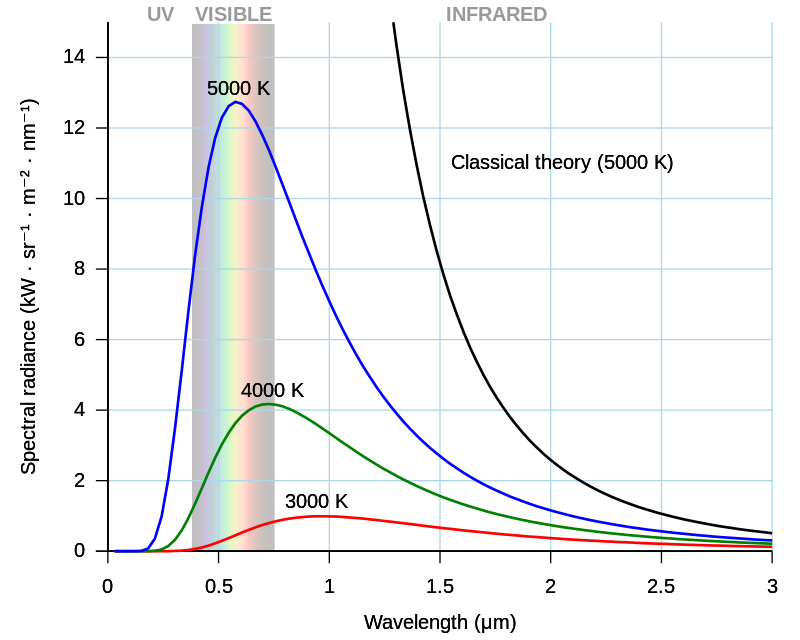
Planck's law
physical law that describes the amount of spectral radiance at a certain wavelength radiated by a black body cavity in thermal equilibrium

Compton scattering
scattering of a photon off of a charged particle
Rutherford model
model of the atom devised by Ernest Rutherford

matter wave
aspect of wave–particle duality

double-slit experiment
experiment in quantum mechanics that shows wave–particle duality

Stern–Gerlach experiment
physical experiment that demonstrated the quantization of angular momentum
Auger effect
physical phenomenon in which the filling of an inner-shell vacancy of an atom is accompanied by the emission of an electron from the same atom
oil drop experiment
experiment conducted by R. A. Millikan and H. Fletcher to measure elementary electric charge
Geiger–Marsden experiment
series of experiments (1908–1913) by Hans Geiger and Ernest Marsden, directed by Ernest Rutherford, at the University of Manchester, proving the existence of the atomic nucleus through alpha particle scattering on gold foil
Franck–Hertz experiment
experiment confirming quantisation of energy levels
Stark effect
energy level splitting via a static electric field
Aufbau principle
principle of atomic physics
hyperfine structure
small shifts and splittings in the energy levels of atoms, molecules and ions
Rydberg formula
formula for spectral line wavelengths in alkali metals
ultraviolet catastrophe
classical physics prediction that black body radiation grows unbounded with frequency
Rayleigh–Jeans law
physical law about blackbody radiation, derived from classical physics, accurate at low frequences but requiring quantum corrections at high frequencies
Davisson–Germer experiment
experiment
Compton wavelength
in quantum mechanics, the wavelength of a photon whose energy is the same as the rest energy of a particle
old quantum theory
set of heuristic corrections to classical physics that served as a predecessor to modern quantum mechanics (1900–1925)
Schrödinger picture
formulation of quantum mechanics in which in which the state vectors evolve in time, but the operators stay constant
Planck postulate
the postulate that the energy of oscillators in a black body is quantized in multiples of the frequency multiplied by the Planck constant
photon energy
energy carried by a single photon
Planck–Einstein relation
energy-frequency relation in quantum mechanics

Phase space formulation
formulation of quantum mechanics in phase space
Bohr-Sommerfeld atom model
extension of the Bohr model to allow elliptical orbits of electrons around an atomic nucleus
Hanle effect
reduction in the polarisation of light caused by a magnetic field, named after Wilhelm Hanle
Mott scattering
physical interaction of charged particles
Wigner–Weyl transform
mapping between functions in the quantum phase space
Transformation theory
Procedure in quantum mechanics