File:Black_body.svg · Wikimedia Commons · See Wikimedia Commons
Planck's law
Sign in to saveAlso known as Planck radiation law
physical law that describes the amount of spectral radiance at a certain wavelength radiated by a black body cavity in thermal equilibrium
Wikidata facts
- Instance of
- physical law
- Named after
- Max Planck
Show 1 more fact
- maintained by WikiProject
- WikiProject Mathematics
via Wikidata · CC0
~40 min read
Encyclopedic overview
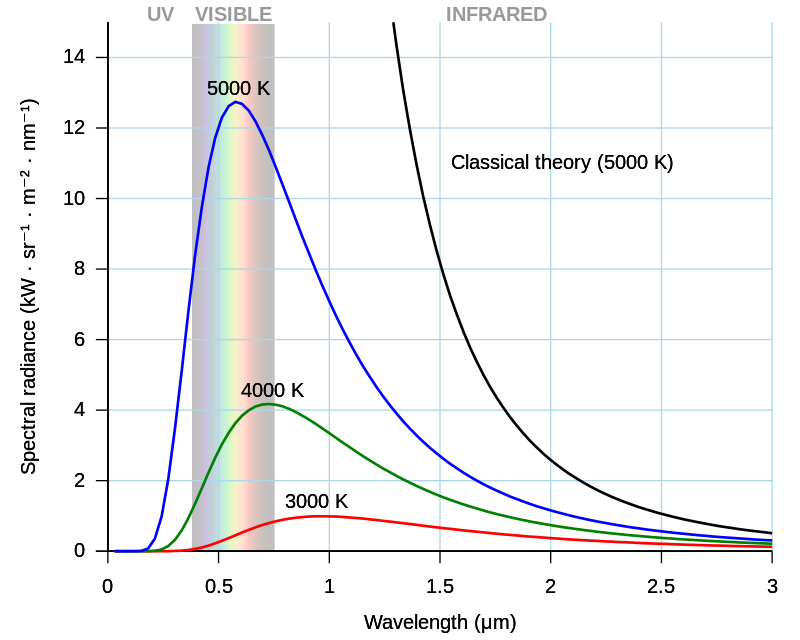
Planck's law accurately describes black-body radiation. Shown here are a family of curves for different temperatures. The classical (black) curve diverges from observed intensity at high frequencies (short wavelengths).
In physics, Planck's law (also Planck radiation law) describes the spectral density of electromagnetic radiation emitted by a black body in thermal equilibrium at a given temperature T, when there is no net flow of matter or energy between the body and its environment.
Excerpted from Wikipedia’s “Planck's law” article, available under the CC BY-SA 4.0 licence.